


The Journey to Trenčín
700394
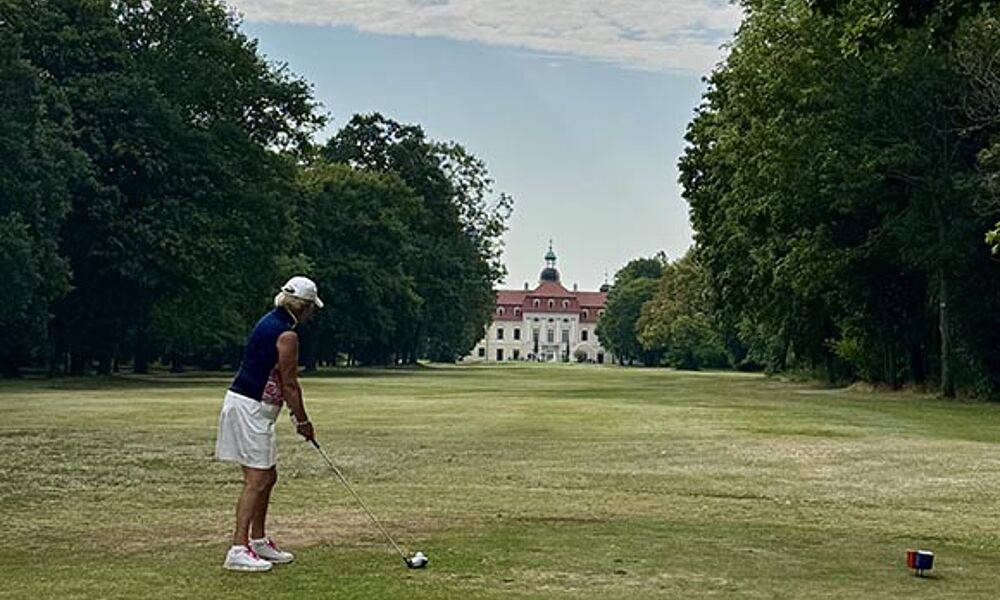
Envisioned as a discerning blend of golf and culture, the itinerary was crafted to culminate in the 2026 European Capital of Culture in Slovakia, with a refined detour in Bratislava to savour a round at the “Black River” golf course. What turned out to be an unexpected outcome was that this course proved to be the most difficult in the country—and virtually unplayable—while the adjacent Schloss Hotel resembled a fairy-tale castle in a deep slumber. The trip did, however, find a happy ending in Trenčín, featuring one of Europe’s largest castle complexes, an encounter with Empress Elisabeth at the Art Nouveau hotel of the same name, and, last but not least, a good score at the “Pinkbay” sports complex.
The Journey Is the Destination
Just an hour’s drive from Vienna, Bratislava—the capital of Slovakia—is most definitely worth a brief visit, especially since it is compact and straightforward to navigate, and one may take in its principal attractions in just a few hours: the historic Old Town, Hviezdoslav Square, St. Michael’s Gate—a medieval city gate with a tower and a view—the Gothic St. Martin’s Cathedral, the coronation cathedral of Hungarian kings, and the sky-blue Art Nouveau Church of St. Elizabeth. En route to the next establishment—where you will encounter the finest and most affordable beer—be sure to wander down the side streets, as they are home to several whimsical bronze statues, most notably Čumil, the so-called “gawker,” peering out of a sewer manhole.
700394

700394

700394

Several factors influenced our decision to visit the Black River Golf Resort afterward: It is just under 20 minutes from Bratislava, and the castle hotel there offers a scene straight out of a fairy tale. We then learned the hard way while playing that the 18-hole championship course “Black River,” with a par of 73 and a slope rating of 155, is considered one of the most challenging golf courses in Europe. The property began in 1995 as a 9-hole layout before being reimagined in 2006 by architect Jaroslav Kachlík as an 18-hole parkland course. What renders the layout “challenging”—beyond the nearly unplayable holes 7 through 18—are the numerous water hazards, including seven substantial lakes, and the extremely undulating terrain, which renders the fairways and greens all but invisible. Furthermore, the course’s general condition leaves much to be desired. The sole advantage is that the opening six holes meander gently through the castle grounds, allowing one to play in serene tranquillity even on Sundays. Yet this calm is deceptive, for the challenge commences in earnest at the seventh tee, which must be played from elevated ground, overlooking the Black River as it winds through the valley below. Losing one’s first ball is therefore all but inevitable. That is why anyone who “stumbles” upon Bernolákovo should regard the round as a “golf adventure” for a 45-euro green fee or simply book a round of soccer golf, which runs parallel to the 18-hole layout. In any case, you will have the opportunity to admire the “Theresia Chateau,” a Baroque castle elegantly renovated in 2023, which formerly served as the summer residence of the Esterházy noble family and is now known as a golf clubhouse, boutique hotel, and—above all—a wedding venue. There is a restaurant here called Maria Theresia, but you’ll need to arrive early enough, as the kitchen closes at 6 p.m. The castle itself closes at 9 p.m. Whether you wish to stay overnight here with no service, no bar, and no other guests is up to you. In any case, we enjoyed a peaceful stay and marveled at the antiques and art in the castle courtyard.
700394

700394

Where exactly is Trenčín?
We find this relatively small city about 100 kilometers from Bratislava in western Slovakia, near the Czech border. Here we discover a lively city with a university, galleries, cafés, and the historic Peace Square (Mierové námestie), where concerts, film screenings, and international festivals take place. The Pohoda Festival, one of Slovakia’s most important music and cultural festivals, is particularly well-known. It brings together music, theater, literature, and the visual arts. There’s also a connection to antiquity: below Trenčín Castle lies a Roman inscription dating from 179 AD. It commemorates the stay of Roman soldiers in Laugaricio during the Marcomannic Wars and is considered exceptional evidence of the Roman presence in Central Europe—something the locals are particularly proud of. The same holds true for Trenčín Castle, the city’s iconic landmark visible from afar. Although the ascent is steep, the panoramic vista of the city rewards the exertion, and once you arrive at the summit, hundreds of steps still lead up to Matúš Tower, affording a sweeping panorama of the Váh Valley. First impressions: In its grandeur, this castle complex—with its multiple courtyards, towers, and palaces—is second to none. That is why the castle is also a key part of the 2026 festival program: It will showcase the Ludwig Palace, where firearms from the 13th to the 19th centuries are displayed; the Zápolya Palace, with its historical portraits of the Ilešházy family; the Cannon Bastion; the barracks; and the Hunger Tower with its “Fountain of Love” in the lower courtyard, which also functions as a museum and a leading venue for contemporary art. Located directly beneath the castle, Hotel Elisabeth still exudes the charm of the Habsburg imperial era and is one of the distinguished “Historic Hotels of Europe.” This alone implies a special sense of comfort in its 78 renovated rooms and culinary experiences in the Art Nouveau ambiance of Café Sisi. We did not allow ourselves the indulgence of the “Caracalla Spa” wellness area, as the principal attractions of the anniversary year lie only a few minutes’ stroll away.
700394

700394

700394

A curious golfing experience worth sharing:
There’s also the story of the Golf & Sport Club Trenčín—Marián Hossa, now called “Pinkbay,” which hosted a tournament to mark the opening of the cultural year. No one seems to know why this multifaceted complex—featuring a 9-hole golf course, tennis and pickleball courts, beach volleyball, and dining options, all sponsored by Slovak hockey icon Marián Hossa—bears that particular name. What is certain, in any case, is that the 9-hole course—with a few bunkers and a partly undulating fairway—was laid out along the Váh River near the city center and offers a splendid view of Trenčín Castle in some spots. We played ahead of a group of teenagers and savoured the serenity of the course. According to the operators, it is intended to be a “place where you play and live in pink”—a symbol of joy, community, sport, and relaxation. We found the concept delightful, especially since the dining offerings further enhance the experience.
700394

700394

For further details, please visit: www.visitbratislava.com www.golf.sk www.trencin2026.eu regionpovazie.sk



![[Translate to en:] AMADEUS Riva (c) Lüftner Cruises](/fileadmin/_processed_/d/e/csm_AMADEUS_Riva_ebdf4c2c55.jpg "[Translate to en:] AMADEUS Riva (c) Lüftner Cruises")













































![[Translate to en:] AMADEUS Riva (c) Lüftner Cruises](/fileadmin/_processed_/d/e/csm_AMADEUS_Riva_64c1995e26.jpg "[Translate to en:] AMADEUS Riva (c) Lüftner Cruises")