


Dominican Republic
The Dominican Republic, known by many as the Dom Rep for short, is regarded in German-speaking countries as an "all-inclusive paradise" for price-conscious holidaymakers who want to enjoy two weeks of sun and beach at their leisure. And of course, the countless resorts dotted around the island are perfect for this! But the Dom Rep can do so much more! The Dom Rep can do luxury, can do culture and history, can do cuisine, can do adventure, can do nature, can do diversity, can do sustainability, can do hospitality! So it's worth discovering the Caribbean island on your own or putting yourself in the hands of a professional like the Swiss Michael Wyss from Dominican Expert.
The Dominican Republic covers two thirds of the island of Hispaniola - the central and eastern parts. The western third of the island forms the state of Haiti. The green, scenic and varied island is surrounded by the Atlantic Ocean to the north and the Caribbean Sea to the south. It also has a total of 1,609 kilometers of coastline with some of the most beautiful beaches in the world, but in less than three hours you can also reach the cool mountain world of the Cordilleras from the sea. There you will find the 3,087-metre-high Pico Duarte, the highest mountain in the Caribbean. The Dom Rep also boasts the lowest point in the Caribbean: The saltwater lake Lago Enriquillo is about the size of Manhattan, is home to pointed crocodiles and lies 40 meters below sea level. The fact that 25 percent of the entire national territory is protected is also impressive.
On the coast of Samaná lies the Los Haitises National Park. One of the most beautiful landscapes in the Dominican Republic can be found here. Imposing cliffs rise out of the sea, surrounded by dense mangrove forests. The southwest is a completely different story. Desert-like landscapes with dunes up to 35 meters high dominate here. The island is also known for its numerous lagoons and cenotes (water holes), which are ideal for swimming. In Punta Cana, the Reserva Ecológica Ojos Indígenas nature reserve covers an area of six square kilometers and offers a whole series of paths along which you can easily reach twelve freshwater lagoons on foot.
lagoons can be easily reached on foot.
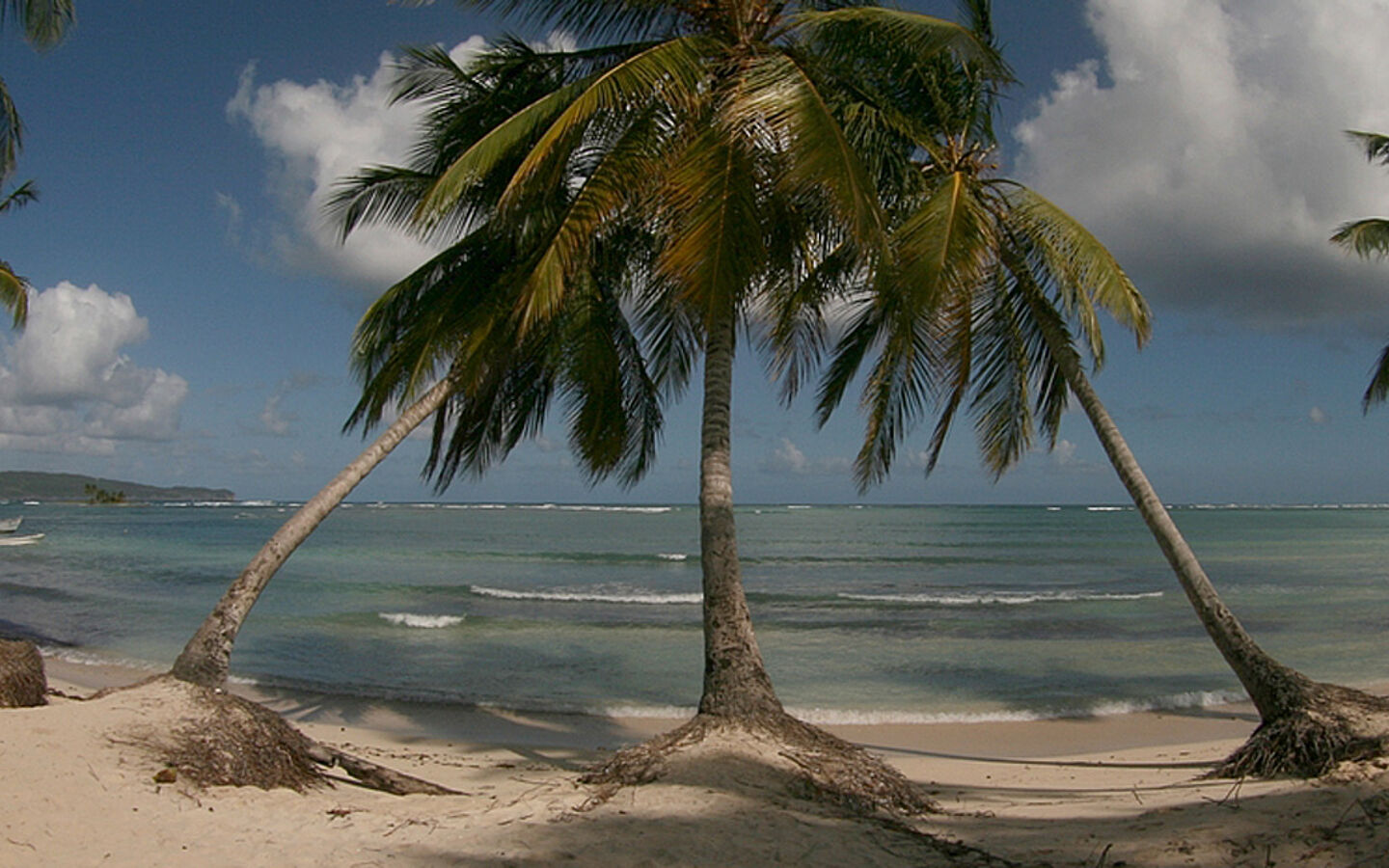
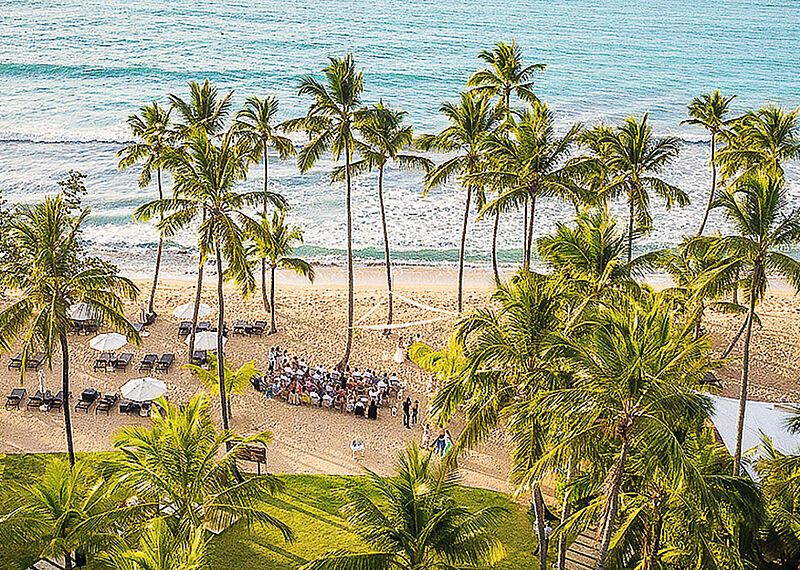
Punta Cana in the southeast has developed into a tourist hotspot in recent years and has increasingly outstripped Puerto Plata, Cabarete and Sosua in the northwest, where all-inclusive tourism once developed in the Dom Rep. From Cap Cana in the south to Uvero Alto in the north, there is a tourist zone around 50 kilometers long with modern infrastructure and numerous beach resorts. Where the Atlantic and Caribbean meet, the flat landscape is characterized by miles of wide, bright, fine sandy beaches and countless coconut palms. For golfers, Punta Cana is a particularly rewarding destination with ten courses located directly on the coast. There are also three courses to the west of Punta Cana on the Casa de Campo estate. The region is still characterized by sugar cane cultivation. The largest sugar factory in America was once based in La Romana until its owners switched to the tourism industry in 1974 and opened the luxurious Casa de Campo vacation resort, which is now also a popular destination for celebrities.
Santo Domingo, the capital and largest city in the Caribbean with over three million inhabitants, is only visited by very few travelers. After the discovery of the Americas, Santo Domingo was the first city founded by the Spaniards, has the first paved street and the oldest university on the continent - no wonder the old town is a UNESCO World Heritage Site. Modern Santo Domingo, on the other hand, has a lively scene, with art and culture, chic bars, cafés and good restaurants. Incidentally, the Dom Rep is a very interesting culinary destination: lots of seafood, first-class local produce and a creative Caribbean-European cuisine mix whet the appetite for more.
Particularly pleasant: Everywhere you go in Santo Domingo, you will meet warm and open-minded people, including in the north around Puerto Plata. Although located on the Atlantic coast, Cabarete and Sosua in particular, two lively vacation resorts with colorful stores, bars and restaurants, have more Caribbean flair and a more varied landscape than Punta Cana. In the meantime, a lot has been invested and the region is also celebrating a small tourist revival with new hotels.Samaná - the natural paradise focuses on sustainable tourism
The route heads east along the coast to the Samaná peninsula, one of the most scenic corners of the Dom Rep. In this natural paradise, efforts are being made to develop sustainable tourism without sacrificing luxury. Even today, this part of the Dominican Republic is almost as remote as it was in the 16th century. Back then, pirates hid in lush palm forests and hidden caves. Today, Samaná attracts visitors with its pristine beaches, coconut plantations and rainforest. The 2,500 or so humpback whales that come to the bay of Samaná every year seem to appreciate the beautiful nature just as much as the visitors. During the whale season, you can enjoy the tropical landscape and the impressive animals in the bay on a boat trip.
But there are also a variety of other ecotourism adventures on offer: Bodyboarding and kitesurfing in Las Terrenas. Hiking, birdwatching and cave tours in Los Haitises National Park. Or a horse riding excursion to the El Limón waterfall. More than enough good reasons to consider an individual luxury vacation in the Dom Rep.
www.godominicanrepublic.com/de
Arriving
The Dominican Republic has a total of five international airports. For German-speaking countries, Punta Cana, Puerto Plata and the capital city airport of Santo Domingo are the most important from a tourist perspective. However, Samaná and La Romana are also served, at least seasonally. The latter is also an important airport for international private flights.
All year round, the vacation airlines Condor, Eurowings Discovery or Edelweiss fly non-stop to the Dom Rep from various cities such as Frankfurt, Munich, Düsseldorf or Zurich.
scheduled airlines such as the Portuguese TAP (via Lisbon) or KLM/Air France (via Amsterdam or Paris) also fly to the Caribbean island.
Climate & travel time
The climate is tropical all year round with pleasant temperatures. Due to its relative proximity to the equator, the temperature fluctuations are small. In the high season from December to March, daytime temperatures reach a maximum of 30 degrees and the lowest night-time temperatures are 20 degrees.
The months from January to March are considered the driest. In the summer months from June to October, it gets warmer and more oppressive. There are also regular thunderstorms. However, it usually clears up quickly. The hurricane season lasts from around July to November. Nevertheless, the Dominican Republic is a year-round destination, especially as the island is less affected by hurricanes than other islands in the Caribbean.
Currency
The official currency is the Dominican Peso. However, the US dollar is also commonly used, at least in hotels and for other tourist services. Paying by credit card is not a problem.
Shopping
No one is likely to fly to the Dominican Republic just to go shopping. Nevertheless, the Dom Rep is the leader in the Caribbean when it comes to shopping. There are large shopping centers and malls everywhere, especially of course in and around the capital Santo Domingo, but also in Punta Cana. For example, you can browse the designer stores in the shopping centers of Santo Domingo, especially in the Blue Mall and Ágora, or the high-quality Dominican and international boutiques in Punta Cana and La Romana. Major international brands are also well represented.
Art and local handicrafts can be found all over the country. The best selection can be found in the city centers, for example in the galleries of the colonial old town in Santo Domingo or near the central park of Puerto Plata. The neighboring towns of Cabarete and Sosúa also offer numerous stores and stores. Also close to Puerto Plata is Santiago, which is considered the "Cigar Capital of the World", with corresponding shopping opportunities for cigar fans.
On the way, you will often pass colorful market stalls with fruit and vegetables in the towns and villages.
and vegetables. The largest market hall in Santo Domingo was built in 1942 and is one of the
of the city's most important tourist attractions. The colorful market is located near the old town. Particularly popular with tourists are amber or Larimar jewelry, cigars, chocolate, coffee and Mamajuana, the local liqueur.
local liqueur.
Location
Karibik
Area
48.442 km²
Population
10 million inhabitants
Language
Spanish
Largest city
Santo Domingo
Capital city
Santo Domingo
Religion
Catholicism is the state religion under a concordat with the Vatican, even if there is freedom of religion.
Weather
The average air temperature in the north is 28 °C and the climate is tropical with high humidity. In winter, the temperature on the north coast usually never drops below 16 °C.
The south is much drier, but the temperatures are comparable to those in the north. Only the winter is somewhat milder in the south.
The Dominican Republic is located in the area affected by tropical cyclones (hurricanes). The hurricane season is from July to October.
Best time to travel
North coast: May to October; east coast: December to July; south coast: November to April
Climate
| Jan | Feb | Mar | Apr | May | Jun | Jul | Aug | Sep | Oct | Nov | Dec | |
| Max. Temperature | 29 | 29 | 29 | 30 | 30 | 31 | 31 | 32 | 31 | 31 | 30 | 30 |
| Min. Temperature | 19 | 19 | 20 | 21 | 22 | 23 | 23 | 23 | 23 | 22 | 22 | 20 |
| Hours of Sunshine | 8 | 8 | 8 | 8 | 8 | 8 | 7 | 8 | 7 | 7 | 7 | 7 |
| Rainy days | 7 | 6 | 6 | 7 | 10 | 11 | 11 | 12 | 11 | 13 | 10 | 9 |
| Water Temperature | 27 | 26 | 26 | 26 | 27 | 27 | 27 | 28 | 28 | 28 | 27 | 27 |
Time difference (to MEZ)
MEZ: -5 Stunden
Vaccinations
Recommended vaccinations: Diphtheria, tetanus, polio, measles (or immunity after illness), hepatitis A
Food Caribbean - Our restaurant tips The Dom Rep has a colorful, varied cuisine that mixes local ingredients with Caribbean elements and also European, especially Spanish elements. High-quality products are also imported from there - Spanish ham is practically omnipresent on the island. Just like the local plantain.
The typical local breakfast usually consists of a dish affectionately known as "Los tres Golpes", which means "the three strokes": mashed plantains with red onions cooked in vinegar sauce, served with baked cheese and baked salami. If that's not enough, there's also a fried egg.
Lunch is the most important meal. Typical is the so-called "Bandera Dominicana" or "Dominican Flag". This dish consists of a large plate of rice and beans with chicken or meat, accompanied by an avocado salad and tostones (crispy fried plantain slices). In the Caribbean, fish and seafood are always part of the cuisine. In coastal towns such as Puerto Plata, Samana or Punta Cana, red snapper and lobster are served freshly caught.
Dominicans love to buy snacks on the street, especially late in the evening. Frituras, or deep-fried delicacies, are particularly popular. Chimichurri, or "chimi" for short, is popular late at night: Dominican-style hamburgers filled with a combination of spiced grilled meat, cabbage, onions and tomatoes.
Drinks are dominated by the local Presidente beer and rum in all its variations - neat or as a long drink, such as Santo Libre with Sprite or as a cocktail. It is therefore worth leaving the all-inclusive resort and visiting one of the many local restaurants.
One such good restaurant is the Boca Marina in Boca Chica on the south coast, where you can enjoy a fantastic meal right by the sea.Santo Domingo has a very lively gastronomic scene. A romantic dinner at Plaza Espana in the Pat'e Palo restaurant is a good idea. Very good local specialties are served at Adrian Tropical right by the sea. Jalao also serves good local cuisine, often with music and dancing. The Segazione is known for its inexpensive tapas as well as Italian and Mexican dishes. You can also eat very well at the new and very trendy Maraca, where you should definitely make a reservation. In a green courtyard in the old town, you can have lunch at Menón e Bari;
Santo Domingo
La Capital, as the Caribbean's most dynamic metropolis is affectionately called, combines centuries-old architecture and history, large shopping centers and art galleries, vibrant nightlife and a booming gastronomic scene.
Exploring the historic old town, Ciudad Colonial, the first European settlement in the Americas and a UNESCO World Heritage Site, is a must. Today, the colonial buildings house museums, stores, hotels, restaurants and street cafés, among other things. The Chu Chu Colonial tourist train runs a 45-minute tour through the old town.
The Jardín Botánico Nacional, the largest botanical garden in the Caribbean, invites you to relax. At sunset, it is worth taking a stroll along the Malecón promenade, where you can enjoy the view of the sea and the colorful hustle and bustle.
Culture lovers cannot miss the Casa de Teatro. This historic venue regularly hosts art and photography exhibitions as well as film screenings and live concerts. The Alcázar de Colón is one of the most popular museums in the colonial city. Christopher Columbus' son Diego lived in the palace built around 1512 with his wife María de Toledo, the niece of the Spanish king.
Calle del Conde was the first shopping street in the New World and is now the country's most popular pedestrian zone. It is lined with restaurants, cafés and souvenir shops as well as street vendors selling handicrafts.
Typical Chinese gates mark the beginning and end of Santo Domingo's Chinese quarter, the Barrio Chino. The streets are lined with characteristic sculptures and there are also some authentic
Chinese restaurants.
El Limon Waterfall
The waterfall on the Samaná peninsula is considered one of the most beautiful in the Caribbean. The hike through the rainforest to get there is also an experience.
Catalina Island
Located off La Romana, this small, uninhabited island scores with white dream beaches and countless tall palm trees - ideal for a snorkeling trip.
Saona Island
What Catalina Island is to the south, Saona Island is to the east: an absolutely gorgeous, tropical destination for sunbathing, swimming and snorkeling.
Laguna El Dudu
In the north of the Dom Rep lies this beautiful lagoon, which is an ideal excursion destination for adventurous vacationers:
You can jump from ten meters into the water or glide over the lagoon on the zipline.
Hotels



![[Translate to en:] AMADEUS Riva (c) Lüftner Cruises](/fileadmin/_processed_/d/e/csm_AMADEUS_Riva_ebdf4c2c55.jpg "[Translate to en:] AMADEUS Riva (c) Lüftner Cruises")











































![[Translate to en:] AMADEUS Riva (c) Lüftner Cruises](/fileadmin/_processed_/d/e/csm_AMADEUS_Riva_64c1995e26.jpg "[Translate to en:] AMADEUS Riva (c) Lüftner Cruises")