


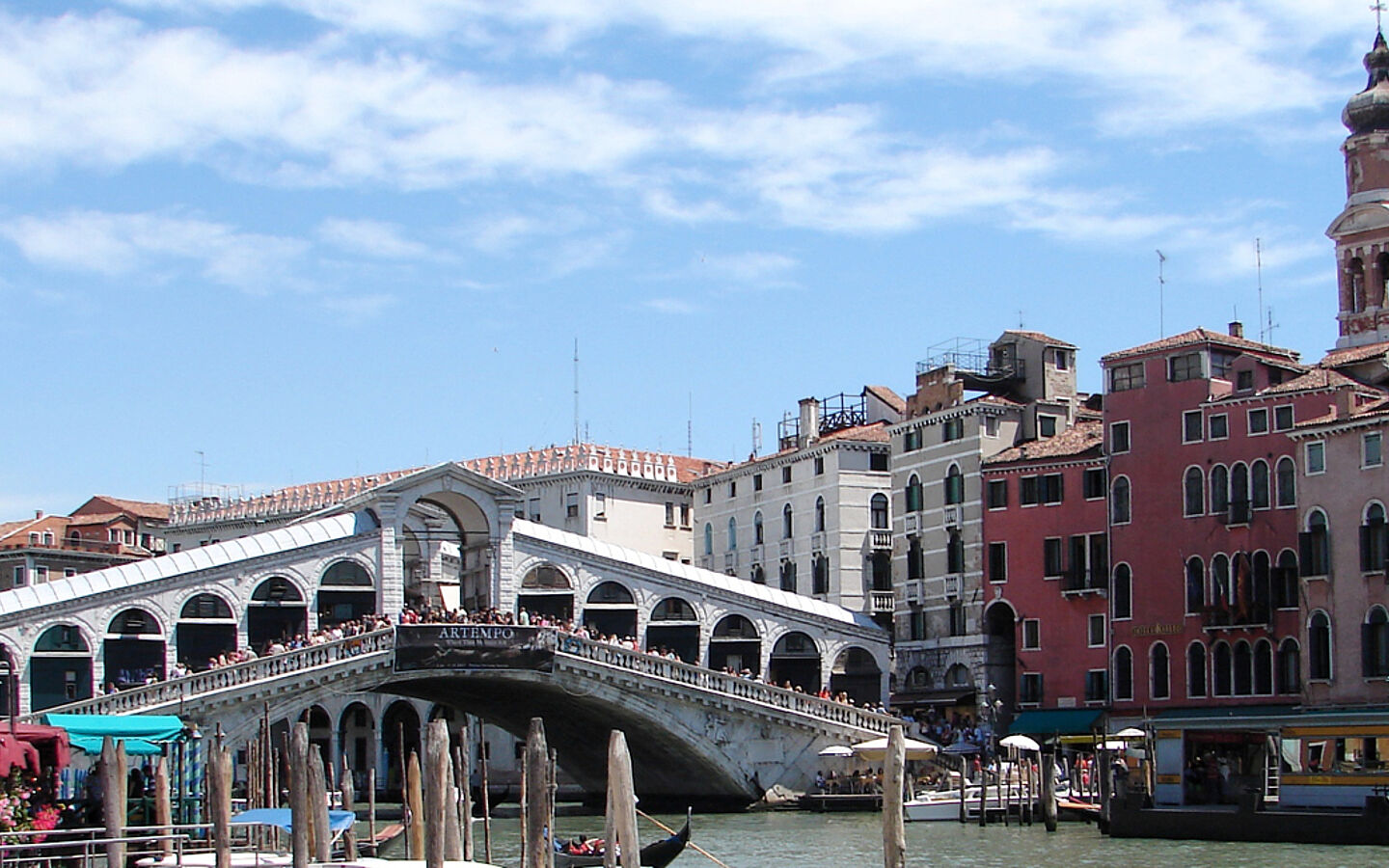
Venice
"I saw the city rise from the sea like a treasure lifted by magic." Lord Byron wrote this 200 years ago. Even today, the scenery cannot be put into words more poetically. Like a mirage, Venice floats above the lagoon as you approach by water cab. It delicately peels out of the haze on the horizon, first drawing the tall bell towers against the milky sky, soon the mighty domes of cathedrals and churches, until finally facades with columns, loggias or ornate symmetrical ornaments can be made out: the "palazzi dei nobili", aristocratic palaces in the Byzantine Romanesque, Gothic or Renaissance, Baroque or Classicist styles. There are several hundred of them spread over seven square kilometers, some of which have been turned into museums, others into hotels.
Whether from a distance or in the midst of the magnificent buildings, whether on bridges, canals or campi, you can't help but rave about it. No matter which district you stroll through, no matter how many times - the architectural beauty of this work of art, its harmony and the subtle marriage of stone and water are always stunning. Even the crowds of tourists don't change that. There are around 16 million visitors a year, a large proportion of them day visitors from cruise ships. Because their stay is limited - roughly from half past ten to 4 p.m. - if you time it right, you can enjoy the most famous sights such as the Doge's Palace and St. Mark's Basilica without having to queue for long, even in the high season.
The Serenissima, the "most Serene", as it has been called since the 16th century, literally offers new facets of its multi-faceted 1,500-year existence around every bend in the road. Once you've ticked off the must-sees, it's worth taking a stroll through the districts that are virtually untouched by mass tourism. Between you and me: most of them are. For example, in the Castello district. While the waterfront promenade is populated by an incessant stream of visitors, in the interior of the island you can stroll through a quiet labyrinth of charming alleyways and canals, across atmospheric church squares and past old-fashioned delicatessens. Students, old people and locals sit in cafés. And if you look up, you will discover washing lines between the gables.
Venice's old docks stretch out beyond the lonely harbor basins. For centuries, the "Arsenale" was one of the largest and most efficient industrial complexes in Europe. As early as the 4th Crusade at the beginning of the 13th century, 100 galleys and 30 cargo ships were built here in just a few months. During the Biennale, the huge workshops serve as an exciting contrast to the modern art, which is then installed or hung between rust-red shades of decay.
Art and campi in Dorsoduro
A stroll through Dorsoduro on the other side of the Grand Canal is no less attractive. The waterway lined with palazzi winds its way through Venice like a mirror-inverted S, cutting it in half. Dorsoduro is home to the three most important art collections: Galleria dell' Academia with the most important works of Venetian painting, the Collezione Peggy Guggenheim with classical-modern art and the Dogana, the former main customs office redesigned inside by Tadao Ando with contemporary art. Right next to it is the magnificent baroque building of Santa Maria della Salute, one of Venice's two votive churches. The background is accompanied by a strolling atmosphere along narrow canals and on the Zattere promenade with a view of the island of Giudecca.
The largest and perhaps most popular square is the Campo di Santa Margherita with traditional stores, terrace bars and a few market stalls. One of the fish stalls belongs to Giampaolo. According to Luigi Frascella, he sells the best fish and the freshest seafood: the chef of the Palazzina can be found here almost every morning. The fish market halls near the Rialto Bridge are even more picturesque. They are stocked by the 150 or so main commercial fishermen of the Laguna di Venezia, among others. You need to know this: Venice's cuisine is fish cuisine.
"Acqua Alta" without Brunetti
The prophecies of doom inevitably ring in our ears on walks: Venice is doomed. Although the prophecy, even if it sounds like a sword of Damocles, has nothing to do with divine behavior, but with tides and climate change. In the winter months, the chance of experiencing the proverbial doom is greater than in summer: "Acqua Alta" is the name of the phenomenon. From just 80 centimetres above mean sea level, St. Mark's Square mutates into a reflective surface. Straight wooden walkways, assembled at night, help to prevent wet feet. From 1.20 meters, a third of the city is flooded. Although well known - after all, Donna Leon's Commissario Brunetti trudged through the masses of water years ago - this comes as a surprise to most visitors. And so some Venetian traders rub their hands in delight. The sale of rubber boots is booming. It is quite possible that nowhere else is the range on offer larger, more colorful and more fashionable. Venice is not only the most illustrious art metropolis on earth, it also has some very mundane superlatives to offer.
Text: Kiki Baron
Photo: Photo: © Stuelpner / pixelio.de
The world-famous lagoon city has not only turned Donna Leon's head: almost every visitor here is looking for that special Venice kick. And there are plenty of them. Not far from the main attractions, little-discovered treasures are hidden behind often inconspicuous walls. Whether art, culinary delights or hostels. You just have to know where.
Highlights
Fish trains
Married to the sea, so to speak, it is no wonder that Venice's cuisine is based on fish and seafood. The Berlin special interest agency Sapio is dedicating a six-day trip to this tradition. Whether out on the lagoon with fisherman Damiano, with fish expert Lollo Manna through the fish market, with TV chef Maria Grazia Calo at the stove in Commissario Brunetti's palazzo or a visit to Venetian taverns with "Slow Food Venezia" director Rebecca Roveda - the experience is intense and very personal.
www.sapio.de
DIPLOMATIC MISSIONS
in Germany
Italian Embassy in Berlin
Hiroshimastr. 1,aße10785 Berlin
Tel +49 30 254400
Fax +49 30 25440116
E-mail: segreteria.berlino@esteri.it
www.ambberlino.esteri.it
in Austria
Italian Embassy in Vienna
Rennweg 27, 1030 Vienna
Phone: +43 1 7125121
Fax: +43 1 7139719
E-mail: ambasciata.vienna@esteri.it
www.ambvienna.esteri.it
in Switzerland
Italian Embassy
Elfenstrasse 14, 3006 Bern
Phone: +41 31 3500777
Fax: +41 31 3500711
E-mail: ambasciata@ambitalia.ch
www.ambitalia.ch
Location
Italien
Area
414,6 km²
Population
260.060
Language
Italian
Religion
Predominantly Roman Catholic
Weather
Venice is located in the temperate climate zone. It is warmest in the months of July and August. The lowest temperatures are in January with an average of 3 °C. November is the month with the most precipitation.
Best time to travel
Spring
Climate
| Jan | Feb | Mar | Apr | May | Jun | Jul | Aug | Sep | Oct | Nov | Dec | |
| Max. Temperature | 6 | 3 | 12 | 16 | 21 | 25 | 27 | 27 | 23 | 18 | 11 | 7 |
| Min. Temperature | -1 | 1 | 4 | 8 | 12 | 15 | 18 | 17 | 14 | 9 | 4 | 0 |
| Rainy days | 7 | 6 | 6 | 8 | 8 | 9 | 5 | 6 | 5 | 6 | 7 | 6 |
Time difference (to MEZ)
MEZ
Currency
Euro
Food in Venice - fish variations of all kinds
In
Venice has adapted to the wishes and preferences of tourists in recent years and therefore serves pasta dishes as the main course, especially at lunchtime.
pasta dishes as the main course. For Venetians, a restaurant that does not serve
Venetians consider a restaurant that does not serve pizza to be a sign of quality.
particularly delicious in such a restaurant in the evening. Thanks to its proximity to the
Venetian cuisine is dominated by fish dishes. These
include various risotto dishes, as well as a wide variety of pasta
pasta dishes with squid sauce or mussels. A particular
specialty is "Fegato alla
Veneziana con Polenta", Venetian-style liver with polenta.
Nightlife in Venice - an atmospheric and lively atmosphere
Venice is particularly lively and atmospheric in the evening. The Piazza San Marco is home to the best and largest number of bars and restaurants. The bars around Cannaregio and San Polo offer a cheaper alternative
and San Polo. Students in particular spend sleepless nights here and numerous fishermen meet to enjoy the atmosphere.
enjoy the atmosphere. But many bars in Venice close around midnight.
Sights in Venice - The city on the water
The city of Venice is located in the north-east of the Republic of Italy and is one of the most popular tourist destinations in the whole of Europe. Every year, numerous tourists from all over the world spend their vacation in the city on the Adriatic. It is characterized by the fact that it was built on more than 100 islands, which is why the canals are the main traffic routes in the historic old town and are navigated by gondolas and boats.
One of the most important sights is St. Mark's Basilica (Basilica di San Marco). It is located directly on St. Mark's Square (Piazza San Marco) and is a landmark of the city. In the 9th century, a Byzantine-style shrine was built on this square for the remains of St. Mark the Evangelist.
Shopping in Venice - a particular highlight
A
shopping trip in Venice is a very special highlight. The old town
is dominated by small boutiques and cute stores with regional products.
products. The weekly market in particular attracts numerous visitors
and offers all kinds of clothing at bargain prices. Venice
is also famous for its handicrafts, such as Venetian masks.
masks, for example. Shoes from Venice are probably a special
souvenir from Veneto and are of the highest quality.


![[Translate to en:] AMADEUS Riva (c) Lüftner Cruises](/fileadmin/_processed_/d/e/csm_AMADEUS_Riva_ebdf4c2c55.jpg "[Translate to en:] AMADEUS Riva (c) Lüftner Cruises")
















































![[Translate to en:] AMADEUS Riva (c) Lüftner Cruises](/fileadmin/_processed_/d/e/csm_AMADEUS_Riva_64c1995e26.jpg "[Translate to en:] AMADEUS Riva (c) Lüftner Cruises")