


Marrakech
Mick Jagger loves the labyrinth of souks, director Oliver Stone searched for new film sets here, Brad Pitt and Michael Douglas are currently looking for suitable townhouses. There is no doubt about it: Marrakech has magic. More and more travelers from all over the world, from Hollywood stars and film directors to package tourists, are discovering the charm of the more than 1,000-year-old Moroccan fairytale city at the foot of the Atlas Mountains. And now that there are more direct flights and cultural events such as art and film festivals, luxury accommodation is springing up like mushrooms from the red clay soil, from small but fine old town houses to magnificent palaces inside and outside the red city walls.
Riad-Mania
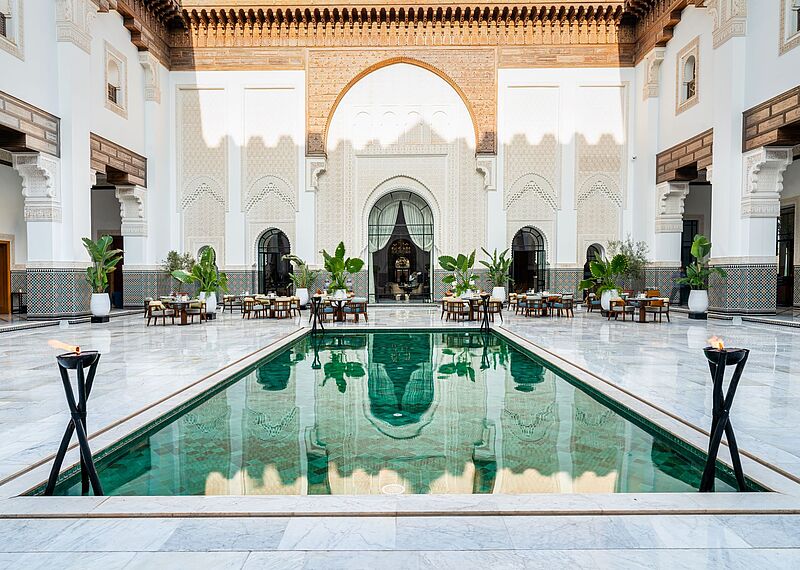
Visitors to Marrakech are sure to find the greatest oriental magic in the medina. Hidden behind inconspicuous doors are winding old town houses with enchanted, lush green courtyards. Many of these riads have now been transformed into more or less luxurious small hotels with the character of private homes. These include jewel boxes in the traditional style such as the Villa des Orangers, Morocco's first Relais & Chateaux hotel, or the Dar Les Cigognes with the best view of the stork's nests of the royal palace.
But there are also offshoots of international hotel groups such as the Angsana Riads Collection with five atmospherically designed hotels, each with five to eight rooms and suites. And newcomers such as the AnaYela, a riad elegantly styled in silver and white, which Bernd Kolb and his wife Andrea have turned into a prominent meeting place for CEOs and business leaders over the last two years.
The boom is huge: at the beginning of the 1990s, riads were still a rarity as hotel accommodation, but today the number is estimated at over 800. The special charm of the restored medina houses lies in the skilful mix of contemporary comfort and oriental magic, some now even offer small wellness centers with oriental steam baths and massage rooms, many have a roof terrace with the best view of the Red City and small, fine restaurants serving a mix of Moroccan and international cuisine. Oriental ambience with bubbling fountains, painted ceramic tiles, ornate stucco work, wood-carved ceilings, seductive scents and melodic sounds create a romantic, fairy-tale atmosphere straight out of the Arabian Nights. As a hotel guest, however, you have to reckon with mostly small, winding rooms, but you can look forward to hosts who spread a familiar "home away from home" feeling in the middle of a foreign world. There is a great deal of service, which sometimes even includes a free loaner cell phone that you can use to call your riad at any time if you get lost in the old town.
Oriental splendor - from the jugglers' square to La Mamounia
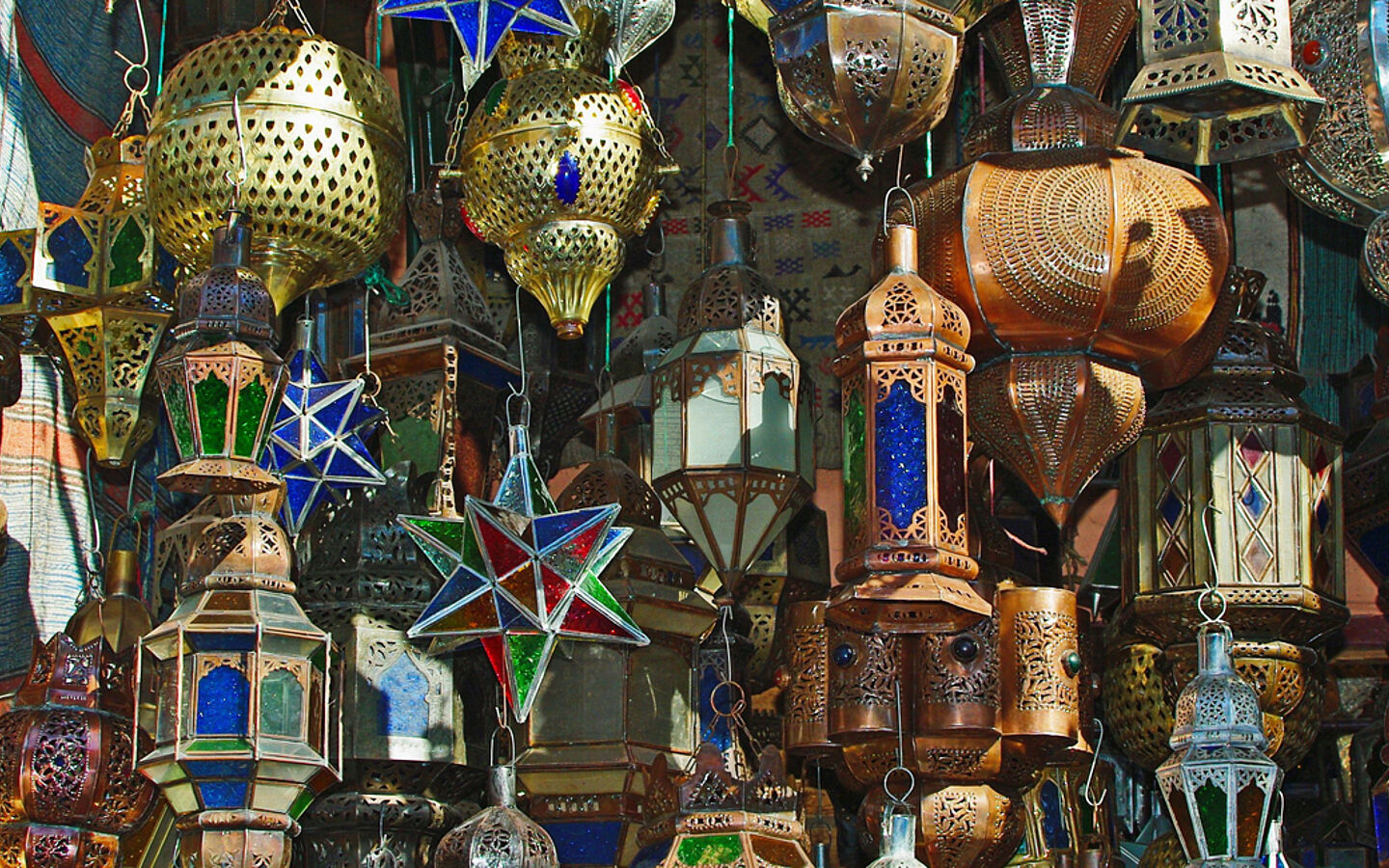
This is easy to do, especially around the Djemaa el Fna, the square of the jugglers, where writer Elias Canetti could hear "The Voices of Marrakech", which he described in his book of the same name, particularly clearly. Vendors sell fresh figs, oranges and kebab skewers, donkey carts clatter over the cobblestones, snake charmers play their flutes. In the maze of alleyways in the medina, the scent of mint tea mingles with the smell of leather and countless herbs from curry to coriander. In between, colorful earthenware, hammered vessels made of brass and silver, fabrics interwoven with gold, finely chiseled Berber jewelry and delicate, embroidered leather slippers.
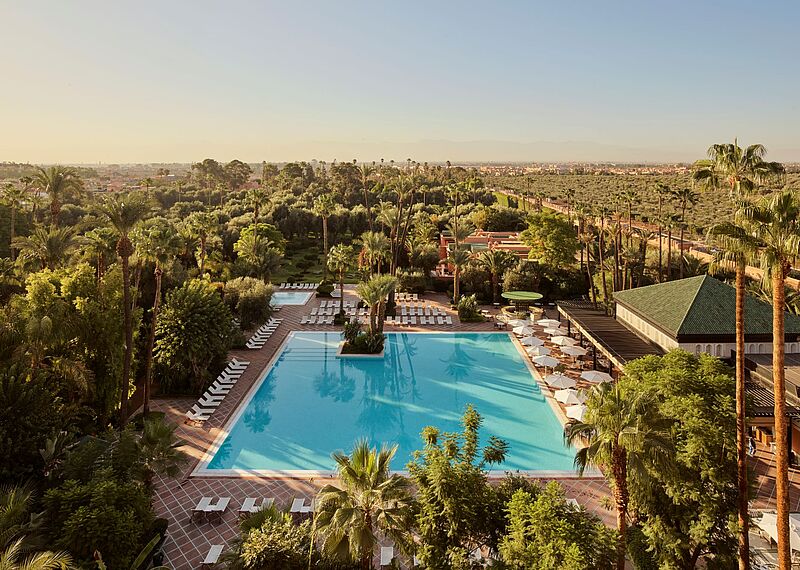
Oriental splendor paired with the highest level of hotel comfort, plus the absolute best location in the middle of a huge garden in the old town in the immediate vicinity of the city's most beautiful sights such as the famous Koutobia Mosque, the Medersa Ben Youssouf Koranic school and the magnificent Al-Badi Palace - that is what La Mamounia offers. Opened in 1923, the grand dame of all Moroccan luxury hotels was given a glamorous makeover by star architect Jacques Garcia in 2009 after years of a multi-million euro facelift. While La Mamounia belongs to the Moroccan railroad company and the city of Marrakech, today's King Mohamed VI has created his own hotel monument with the Royal Mansour using the greatest possible craftsmanship.
Luxury living in Gueliz and Hivernage
The Agdal Gardens, which, like the Menara Gardens and the Medina, are a UNESCO World Heritage Site, have long been an oasis of relaxation as the city's oldest park. Guests here mostly come from chic villas and apartments in Gueliz or Hivernage, the upmarket districts that are also very popular with hotel guests. In addition to hotels, trendy eateries such as the Grand Café de la Poste and elegant Arabic restaurants such as Al Fassia and Dar Moha have also established themselves here. Those looking for top Western designers such as Dior, Gucci, Prada or Fendi will find their boutiques mainly in La Mamounia. In Gueliz, around Place Liberte and Place du 16 Novembre, more and more modern Moroccan designers with international chic are now setting up shop.
The range of products on offer is constantly increasing, and shopping in Gueliz is less stressful and usually more quality-conscious than in the old town. Not to forget: instead of haggling, fixed prices apply, which can also be very relaxing. But regardless of whether you prefer the relaxing atmosphere of the gardens and palm groves or the loud babble of voices in the streets of the old town, the general rule is: once you have succumbed to the magic of the Red City, the magic of Marrakech will never let you go.
Artists have long been drawn to the fairytale city at the foot of the Atlas Mountains. The focus of interest is on the pretty old town riads, which are now also being stormed by discerning guests.
Highlights
Connoisseur special tip:
Relaxing in the Palmeraie
Visitors to Marrakech who still find the old and new city too turbulent are drawn to the Palmeraie. This is where the rich have built their villas, and golf courses, luxury hotels and palatial complexes such as the Amanjena, the Jardins d'Ines and the Palmeraie Golf Palace have sprung up, surrounded by a total of over 100 fairways of the finest quality. Four magnificent golf courses with up to 27 holes, including Jack Nicklaus' Samanah Country Club, attract golfers from all over the world. A fifth course, Al Maaden, has been completed. Here, far outside the city gates, it is usually very quiet, with only the wind rustling through the palm leaves and even the muezzin's call barely audible.
DIPLOMATIC MISSIONS
In Germany:
Embassy of the Kingdom of Morocco
Niederwallstraße 39, 10117 Berlin
Phone: + 49 30 2061240
Fax: + 49 3020612420
E-Mail: kontakt@botschaft-marokko.de
www.botschaft-marokko.de
in Switzerland:
Embassy of the Kingdom of Morocco
Helvetiastrasse 42, 3005 Bern
Phone: +41 031 3514630
Fax: +41 031 3510364
E-mail: sifamaberne2@bluewin.ch
in Austria:
Embassy of the Kingdom of Morocco
Opernring 3-5, 1010 Vienna
Phone: +43 1 5866651
Fax: +43 1 5867667
E-Mail: emb-pmissionvienna@morocco.a
Location
Königreich Marokko - Marrakesch liegt im Südwesten Marokkos am Fuß des Atlas-Gebirges und ist die Hauptstadt der gleichnamigen Provinz
Area
446.550 km² (Marrakesch 230 km²)
Population
33 million (Marrakech 928,850)
Marrakech: 1,036,500
Language
Arabic, Berber languages, French
Capital city
Rabat
Religion
Islam
Weather
Marrakech is located in the Saharan-continental climate zone with very hot summers (up to 45°C) and cold winters (lowest temperatures around zero). In summer, the hot desert wind sirocco blows. Little rainfall.
Best time to travel
Spring and fall
Climate
| Jan | Feb | Mar | Apr | May | Jun | Jul | Aug | Sep | Oct | Nov | Dec | |
| Max. Temperature | 19 | 21 | 23 | 25 | 28 | 33 | 36 | 36 | 32 | 27 | 24 | 20 |
| Min. Temperature | 9 | 11 | 12 | 12 | 14 | 16 | 19 | 21 | 19 | 17 | 13 | 10 |
| Hours of Sunshine | 7 | 8 | 8 | 9 | 10 | 10 | 10 | 10 | 10 | 8 | 8 | 7 |
| Rainy days | 7 | 7 | 5 | 4 | 1 | 0 | 0 | 1 | 1 | 3 | 4 | 6 |
Time difference (to MEZ)
Minus 1 Stunde gegenüber der Mitteleuropäischen Zeit (MEZ).
Currency
Dirham (DH) / Cent
Visa
No visa required. Passport must be valid for at least 6 months
Vaccinations
none prescribed. Vaccinations against tetanus, diphtheria, polio and hepatitis A are recommended.
Moroccan food - true culinary delights
In the Orient
still tell fairytale stories of the luxurious life at the court of the
court of the caliphs. There, people surrounded themselves with everything the Orient had to offer
precious things: incense and fine essences, jewels and precious stones
precious stones, silks and exquisite exotic spices. While
Middle Ages still prevailed here, people in the Orient already knew how to
world cuisine of the most refined flavors. One of the
famous chefs of that time was Ibn al-Warraq - a kind of Paul Bocuse
of the ancient Orient. He cooked only for the families of the upper
ten thousand. Around the year 950 AD, he wrote one of the most important
cookbooks of all time, the "Annals from the Caliph's Kitchen". In it
contains hundreds of recipes for precious spice mixtures. With saffron
and cinnamon, cardamom and almonds, lemons and oranges. Ibn al-Warraq's
elegant way of cooking took root early on, especially in Morocco.
Saffron - the color of dawn
Morocco alone
its favorable location alone, Morocco offers ideal conditions for
good cuisine: fertile farmland in the coastal regions, at the foot of the Atlas Mountains
of the Atlas Mountains grazing land for cattle, sheep and goats. Finally
the Atlantic and the Mediterranean as fishing grounds for sea fish,
seafood and crustaceans. No wonder that this attractive
attractive region aroused desires early on - Morocco was not only sought after by
North African Berber peoples, but also by Arab tribes in pre-Islamic times.
by Arab tribes in pre-Islamic times. From the coasts of the Middle East,
especially from what is now Syria, they brought their goods along the
silk and incense routes and across the Mediterranean to Morocco.
trade goods to Morocco. This also brought their good cuisine to the country. And
the cultivation of oranges and lemons. And of course their spices.
First and foremost saffron. Saffron originally comes from Crete and has
has also been cultivated in Morocco for thousands of years. The town of
Taliouine at the foot of the High Atlas has become famous for its saffron cultivation.
become famous. Alongside Iranian saffron, Moroccan saffron is considered to be
the best. Its aroma is elegant and powerful, its scent warm and intense.
intense. Since Ibn al-Warraq's time at the latest, saffron has been an integral part of
Moroccan cuisine would be unthinkable without it. Especially in
spice mixtures, for example with cinnamon, ginger or pepper, for meat
meat dishes, ragouts and grilled food. Or with ground almonds and
pistachios for desserts. Not forgetting for couscous. And because
spices and specialties are either transported from far and wide or - like saffron
had to be laboriously refined by hand, they were once as expensive as gold.
expensive as gold. Only high society from the Arabian Nights could afford them.
could afford them. They even offered spices as sacrifices to the gods.
The poet Homer once sang of the red-hot yellow of saffron as the "color of dawn".
"color of the dawn".
The yellow cuisine of Morocco
Not only
the bright yellow of saffron that makes Moroccan cuisine so sunny.
appear so sunny. It is also oranges and lemons, apricots and almonds,
prickly pears and chickpeas that give many of the country's traditional dishes an
give many of the country's traditional dishes an exceptionally cheerful appearance. Anyone who is surprised
that Andalusian and Moroccan cuisine have so many things in common
similarities, this observation strikes at the heart of Morocco's cultural identity.
cultural identity of Morocco. At the time of the Arab caliphs, Morocco and
Morocco and southern Spain belonged together for a time - which is only logical
only obvious when you consider that the Strait of Gibraltar between Tangier
Tangier and the Andalusian coast is just 14 kilometers at its narrowest point.
kilometers at its narrowest point. The fact that bitter oranges are still harvested in Seville today and
Moroccan desserts are flavored with orange blossom, that the Spanish paella and
Spanish paella as well as Moroccan couscous are traditionally flavored with saffron.
saffron is anything but a coincidence. This tradition
tradition became even stronger in the 15th century when, in the course of the
recatholization of Spain, many Jews and Muslims had to emigrate to the Maghreb.
had to emigrate. This gave another boost to Morocco's culinary heritage.
another boost. The style of Moroccan cuisine finally took shape.
developed. Today, connoisseurs refer to it as "yellow cuisine".
Apricots and almonds, oranges and lemons, saffron and cinnamon flavor the two
the two pillars of Moroccan cuisine: couscous and tagine. Like the
couscous, tagine is also a dish from the Berber tradition.
It consists of meat, usually beef, goat or lamb, mixed with vegetables,
vegetables, fruit or nuts and spices in a clay pot with a pointed lid.
pot with a pointed lid.
On the back of the camels
Moroccan
Moroccan cooks handle spices like conductors who drive their orchestra to
drive their orchestra to harmony. They have mastered the sophisticated use of cinnamon,
cardamom and coriander, mint and orange blossom, saffron, nutmeg and pepper.
pepper from the inside out. Just as if the tradition of
Ibn al-Warraq's tradition of aromatic cuisine continues to this day. Al-Warraq
created spice blends from pepper, rose petals, nutmeg, cinnamon and galangal, saffron
galangal, saffron, cardamom, lemons and cane sugar. He sourced the ingredients
from India and China, the Spice Islands and the Middle East.
In those days, instead of ships and airplanes, the spice trade was carried along the
the routes of the Silk Road. Donkeys and camels were used for transportation.
Fine craftsmanship: argan oil
Not
not only the lengthy transportation, but also the fact that many spices were
spices were refined by hand also contributed to their preciousness. Today
more than ever a guarantee of quality. This also applies to
argan oil, the "liquid gold" of Morocco. The tradition of
of argan oil extraction was founded by Berbers. Even today, the best
argan oil is still produced by hand in Morocco. The fruits of the argan tree are
the fruits of the argan tree are harvested and dried, the pulp is removed by hand
and beaten individually until the almonds are exposed. These
sorted, roasted and - again by hand - ground in stone mills.
ground in stone mills. The result is a nutty-tasting, incredibly fragrant, balsamic
fragrant, balsamic oil. Once you have tasted it, you will understand why
why the Berbers did not usually use it themselves. Instead, they preferred to sell it to the
caliph's court.
Morocco golf vacation - The most beautiful golf courses in Marrakech
Golfing has a certain tradition in Morocco. Already
since the early 1920s, thanks to King Hassan II, there has been the exquisite Royal
Golf Course in Marrakech, which strongly promoted this sport. Once a year
a major invitational tournament was organized once a year, in which the best players in the
world took part and put their skills to the test. Since 1996, the
Moroccan national tourism office has organized an international press golf tournament
to promote golf in Morocco and make it a leader in the development of tourism.
tourism development.
Sights in Marrakech - A feast for the senses
Due to the large number of architecturally
and historically significant buildings, a walk through the city is like a journey through history.
history. The old town of Marrakech has been declared a UNESCO World Heritage Site.
declared a World Heritage Site.
You should not miss the Koutoubia Mosque, which was built in 1162,
the Kasbah from the 12th century and from the 14th century the
Ben-Jusuf-Medersa in the old town. The world-famous medieval market
Djemma el Fná, is one of the city's main attractions. Here you will meet
oriental storytellers, musicians, acrobats, snake charmers and jugglers.
jugglers.
But the new town also has some sights to offer.
and a visit to the Jardin Majorelle is always worthwhile. This stands out
from other gardens due to its variety of plants and unique architecture.
gardens.
Hotels


![[Translate to en:] AMADEUS Riva (c) Lüftner Cruises](/fileadmin/_processed_/d/e/csm_AMADEUS_Riva_ebdf4c2c55.jpg "[Translate to en:] AMADEUS Riva (c) Lüftner Cruises")









































![[Translate to en:] AMADEUS Riva (c) Lüftner Cruises](/fileadmin/_processed_/d/e/csm_AMADEUS_Riva_64c1995e26.jpg "[Translate to en:] AMADEUS Riva (c) Lüftner Cruises")