


Malta: eyes on the beauty of the Mediterranean
There is plenty to discover on the three sun-drenched islands of Malta, Gozo and Comino
04/22/2025 Reading time: 9 Minutes
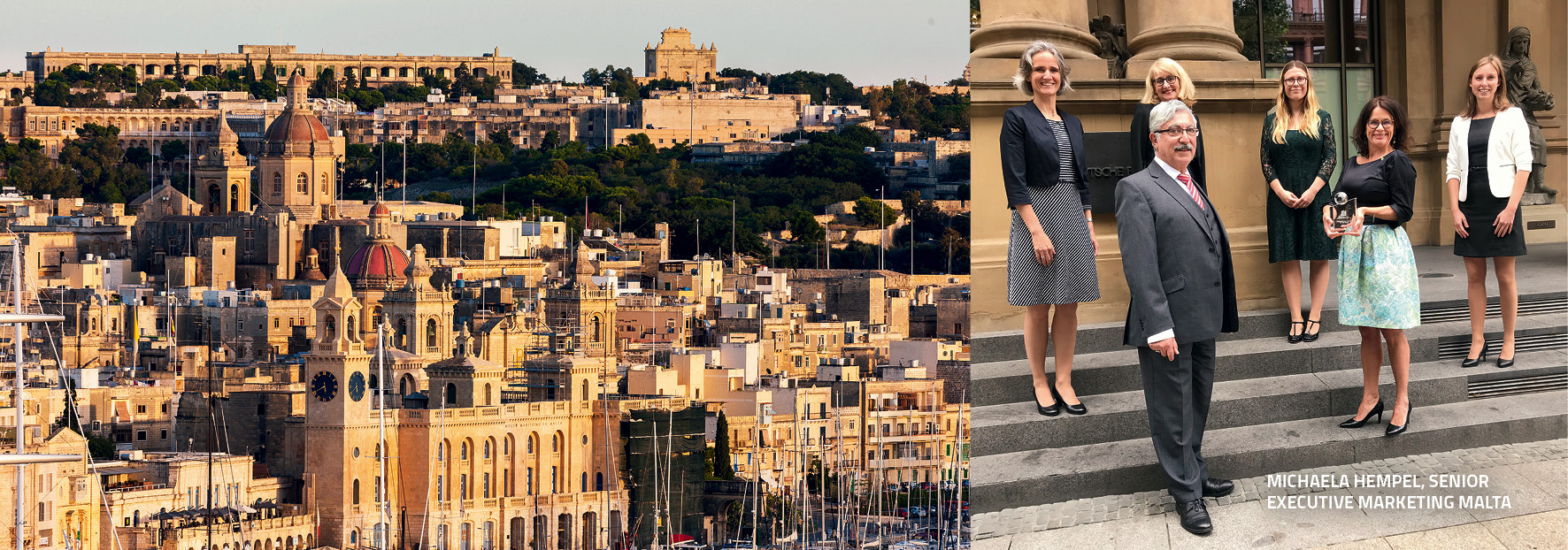
History and stories are interwoven here like the traditional local bobbin lace. And culture, culinary delights and relaxation are usually just a stone's throw away from each other.Two colorfully painted boats rock gently in the picturesque bay off Valletta. With the unagitated routine of a Venetian gondolier, the boat cab guide maneuvers his so-called Dgajsa to the jetty, and new guests quickly climb onto the wooden benches under a protective canopy. While there used to be hundreds of these boats in the waters of the Grand Harbor, today there are only a few - but still enough to cross over from Valletta to the three towns opposite in the traditional way. With a bit of luck, you might catch the "St. Angelo", in which Elizabeth II, then still a princess, was taken to Fort St. Angelo. The future Queen was well-liked in the country. Or to put it with the tongue-in-cheek pride of the Maltese: "Born in England, made in Malta!" A more beautiful journey to the so-called "Three Cities", which form the urban core of Malta, is hardly conceivable. Vittoriosa, Cospicua and Senglea are almost indistinguishable today, so seamlessly do they merge into one another. No wonder, as Malta is one of the most densely populated countries in the world .
With Valletta and the Upper Barrakka Gardens, whose balustrade is lined with 19th century cannons, at our backs, we sail into picturesque Vittoriosa. The sound of the traditional shot fired at midday still hangs lazily in the air, and in the middle of the bay you don't really know where to look first: Aft lie the high fortress walls of the capital, above which the interlocking houses play Tetris like sandstone-colored blocks . Ahead, Fort St. Angelo towers over the rocks, and in between there are vintage schooners and high-tech yachts to admire.
Kissed awake
For a long time, tiny Valletta was considered a sleepy museum town, where all the sidewalks along the defiant fortress walls were turned up after dark. That's a thing of the past, because today you can sip champagne or wine on the steps leading down to the water, eat crispy pastizzi and admire the setting sun. The World Heritage city is wide awake, and it's not just Strait Street that is full of life again. The missing sailors have left a gap where the "beauties of the night" once waited for customers leaning against walls during the day and transvestites performed in the bars. Because when Malta gained its independence from the British in 1964, left-hand traffic and red telephone boxes remained in the country but the customers suddenly disappeared. Tourists have now filled this gap again. And so today the alleyways of Valletta are lined with busy pubs and bars, interspersed with the odd craft business such as the leather specialist Captain's Cut or the long-established haberdashery Victor Galea Haberdashery. Those in search of the old, sleepy Valletta will also find what they are looking for, as not all corners of the city have been renovated and spruced up. They still exist, the scuffed doorways and peeling store signs and billboards - and that's a good thing.
700394

Showdown for Caravaggio
Amidst the hustle and bustle of the city, the imposing St. John's Co-Cathedral, one of the 365 churches in the country, reminds us of a little peace and quiet. The Italian Michelangelo Merisi, known as Caravaggio, created a monument to himself here in 1608 with his commissioned work, the oil painting "The Beheading of John the Baptist". The artist was also knighted in the co-cathedral. However, the ruffian was unable to enjoy the honor as he was on the run due to a fatal brawl. At Valletta Resound's concert "The Caravaggio Experience" in the oratory of the church, the three artists in authentic Order of Malta costumes take you back in time. The contrast to a bronze sculpture attached to the side façade of the cathedral, which has been converted by the locals into a monument to Daphne Caruana Galizia , could not be greater. In 2017, the investigative journalist and blogger was killed by a car bomb on the island.
700394

Our guide Dane Munro suggests a break at Caffè Cordina , which opened in 1837. Munro is not only an anthropologist, classical philologist and historian, but also a true Knight of the Order of the Knights of Malta . There are around 100 of them in Malta and around 14,000 worldwide. "The Order is the oldest charitable organization of all!" At the next table, three ladies are chatting in Malti, and behind the long counter it's not just the espresso machine that's hissing ...
The noise level is high. Munro smiles: "It must be colorful and loud in Malta!" We toast to this with Kinnie, a kind of Maltese "national lemonade", . "Viva qui regne!" is the ever-appropriate toast, which means something like "To the government". Governments come and go, but the Maltese stay, according to the subtext. In the Grand Master's Palace , Munro points out particularly impressive pieces, such as a knight's armor decorated from head to toe, which is said to have once even inspired Louis Vuitton, or a rifle muffler that was common in knightly times. The Italian architect Renzo Piano also took his cue from this era when he redesigned Valletta's parliament: he based the height of his staircases on historical models and designed them so low that a crusader could climb them despite wearing heavy armor. The modern building blends in well with the historical ambience, although not all Maltese see it that way. Some are said to have compared the building to a dovecote.
Small and large journeys through time
We enter medieval Mdina through the impressive baroque main gate, which was built in 1724 by Manoel de Vilhena, a Grand Master of the Order of Malta. Tourists and budding influencers work on their own fame with selfie sticks and enjoy the photogenic city gate of King's Landing from the series "Game of Thrones" . Only in the off-season does the town, which is known as a quiet town, live up to its nickname. We stroll through winding alleyways until we come across a marble slab. It commemorates a young man who died here many years ago, as an elderly gentleman who happens to be passing by explains in a gibberish of Malti and English. He points out another historical peculiarity. Above a window hidden behind blue-painted shutters, two drop axes carved into the stone face each other. An indication of its former occupant: the executioner. We leave this unpleasant corner and follow our self-appointed guide, who wants to show us the Palazzo Falson, built in the 13th century. Even if the inside is interesting, the way there is even more so.
Mdina is virtually car-free. Tourists on foot are carted through the alleyways in one-horse carriages. Oleanders and other greenery in heavy clay pots flank the entrances to the houses, some of which have open doors, with only a waist-high metal grille blocking access. A remnant of the days when herds of sheep and goats were still driven through the villages. An old lady gives us a disappointed look through an open window of her wooden balcony. She must have been hoping to meet a talkative neighbor when she heard our footsteps. The Gallarija, the Maltese term for balcony, is a living example of the Arab influence. Balconies painted in many colors can be found in almost every alley and street: Blue, red, green, yellow, etc. Whether simple or almost baroque: Fortunately, they have never gone out of fashion in Malta.
700394

Postcard beauty
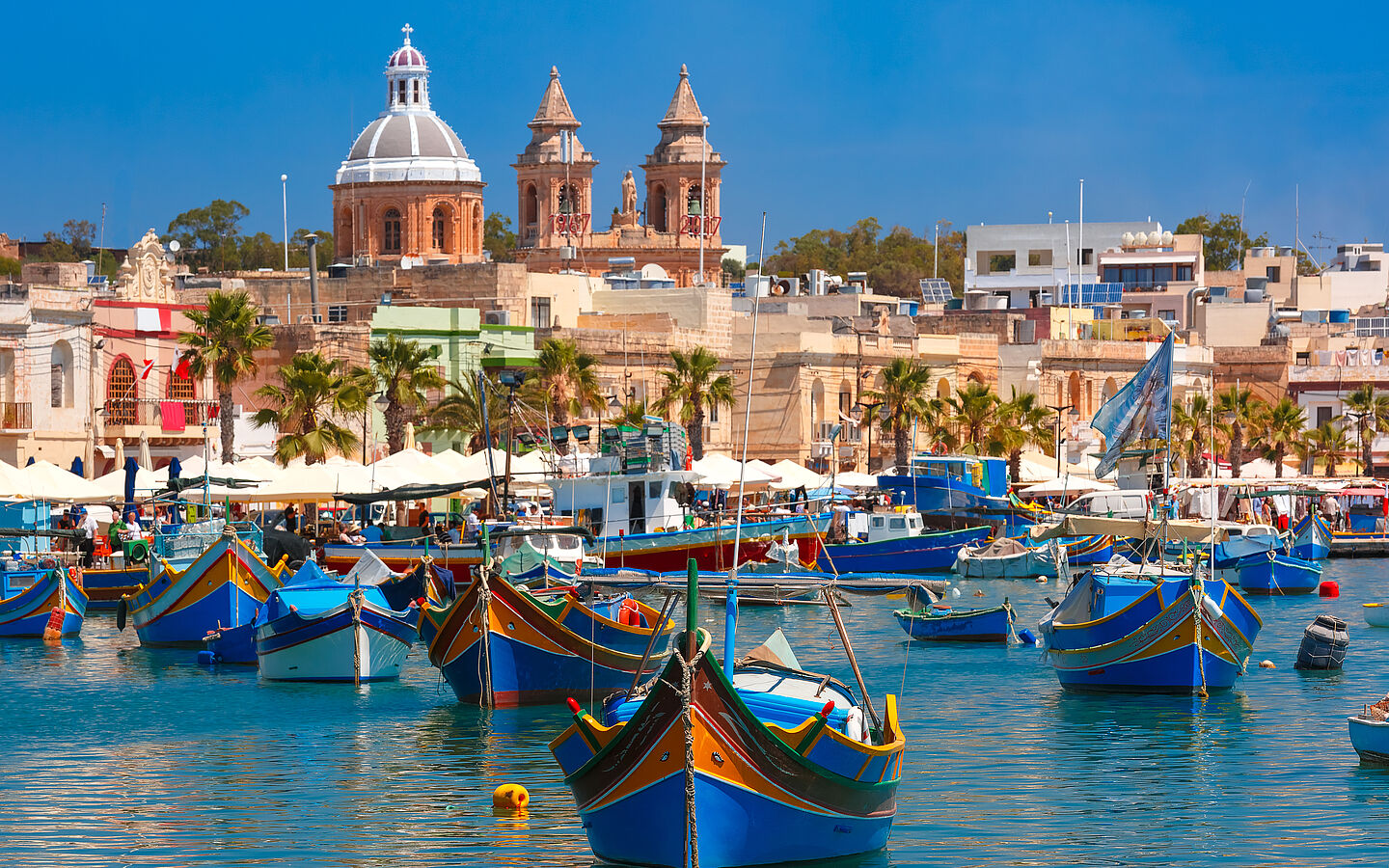
If you visit Malta, you can't miss the fishing village of Marsaxlokk. There, the brightly painted Luzzi, small fishing boats, sway photogenically in the waves . The eyes painted on the bow, which are supposed to protect against evil, are reminiscent of the heavily made-up Elizabeth Taylor in "Cleopatra". At the Sunday market, tourists and locals crowd in front of the stalls. In addition to fake designer goods, sunshades made from machine-made bobbin lace, vegetables and freshly caught fish such as lampuka (dolphinfish) are sold. If you have good eyesight, you can see the container port of Kalafrana on the opposite side, whose cranes look like giant arms jutting out of the sea from a distance. This does not detract from the perfect postcard idyll. The three men brushing their teeth and cutting each other's hair in a fishing boat also fit perfectly into the picture.
700394

Detour to the small neighbors
Malta is more than just Malta, after all, in addition to the three main islands of Malta, Gozo and Comino, the country consists of 18 other small, uninhabited islands. What you have to see? The ones mentioned by name. Because one thing is clear: Without having snorkeled in the Blue Lagoon on Comino, something is missing . The turquoise-blue bay shimmers through the rugged rocks from afar. The land route is possible, but it is easier to organize a dive or a visit to the many caves by boat. There is more to see on Gozo, where the towering citadel of the town of Victoria is impressive. Two long-established families still live within the thick walls. How much longer is unclear. Rumor has it that the last two houses inhabited by locals will not be rented out again, but will be used for other purposes in the future. Music drifts softly from one of these houses and the scent of freshly chopped herbs wafts through the half-open door. These signs of a living city could soon be history.
700394

700394

Talking about the weather usually means that a conversation has stalled. Not so with Josephine Xuereb, whose salt pans are located along the Xwejni coast on Gozo. This is where the Romans mined salt. For Josephine, this trivial topic has a special meaning, because a hot, sunny day can make the difference between success and failure. "Salt production depends on the weather. Sometimes the sea takes the harvest back by flooding the pans," she explains, adding philosophically: "Nature takes and gives." The temples of Ġgantija in Xagra, just a few kilometers away, are evidence of a Stone Age civilization and have been a UNESCO World Heritage Site since 1980. It is not for nothing that Malta and Gozo are considered an Eldorado for visitors interested in culture. Some even claim that Gozo served Homer as a model for the island of Ogygia described in the Odyssey. In any case, it is true that everything on the small islands is only a stone's throw away, so that culture, cuisine or diving and beach feeling can easily be packed into a single day.
700394

DISCOVER NOW: The best addresses in Malta!





![[Translate to en:] AMADEUS Riva (c) Lüftner Cruises](/fileadmin/_processed_/d/e/csm_AMADEUS_Riva_ebdf4c2c55.jpg "[Translate to en:] AMADEUS Riva (c) Lüftner Cruises")
















































![[Translate to en:] AMADEUS Riva (c) Lüftner Cruises](/fileadmin/_processed_/d/e/csm_AMADEUS_Riva_64c1995e26.jpg "[Translate to en:] AMADEUS Riva (c) Lüftner Cruises")