


Slovenia
A small country with just over two million inhabitants. As many as in Vienna and the surrounding area. And fewer than the whole of Berlin. Slovenia. The miracle. Miracle? Why a miracle? Miracle, because the country with its few inhabitants seems densely populated almost everywhere. There is a mighty church on every large hilltop, and villages sit close together in the landscape. Connecting everything, new highways and (unfortunately still) old railroads plow up the land. And movement everywhere. Slovenia's inhabitants seem to be constantly on the move. A busy people, hard-working, flexible and enterprising. The fun-loving Prussians of the northern Balkans.
But be careful: the Slovenes don't like to be called the Balkans. This categorization has earned them years of membership in the Yugoslav Federal Republic, which they were allowed to leave almost twenty years ago after a short but fierce war. In the country's new history, the Slovenes see themselves as a tiger state of the European Union. A continuing success story ever since.
! Photo slider: © Matthias Brinker / pixelio.de!
Miracle Slovenia
It's also a wonder because this small, sparsely populated and yet densely populated country has all kinds of interesting landscapes. Neighboring Austria has a similar situation, but the Alpine republic lacks the sea. Slovenia has a puszta, the Hungarian steppe, the forerunner of the desert; Slovenia has a lot of hilly country, often of volcanic origin, with lots of vineyards on it, steep, picturesque locations; Slovenia has a high mountain range with the national landmark Triglav (the mountain with the three peaks) and also an internationally recognized ski resort (Kranska Gora near Carinthia); Slovenia has a lake district with Bled and Bohinj, which even the autocrat Tito appreciated as a recreational resort; Slovenia has the barren Karst, the result of deforestation for Venice; Slovenia has a narrow coastline on the northern Adriatic, which is crowded in summer. And Slovenia has a beautiful capital, Ljubljana, which lies in the middle of the country and, as befits beautiful cities, is crossed by a small river, the Ljubljanica, the Ljubljana, and a canal, the Gruber Canal. There are also huge caves, moors (where a few tanks were sunk during the War of Liberation) and thermal springs. The only thing Slovenia is missing is the Himalayas.
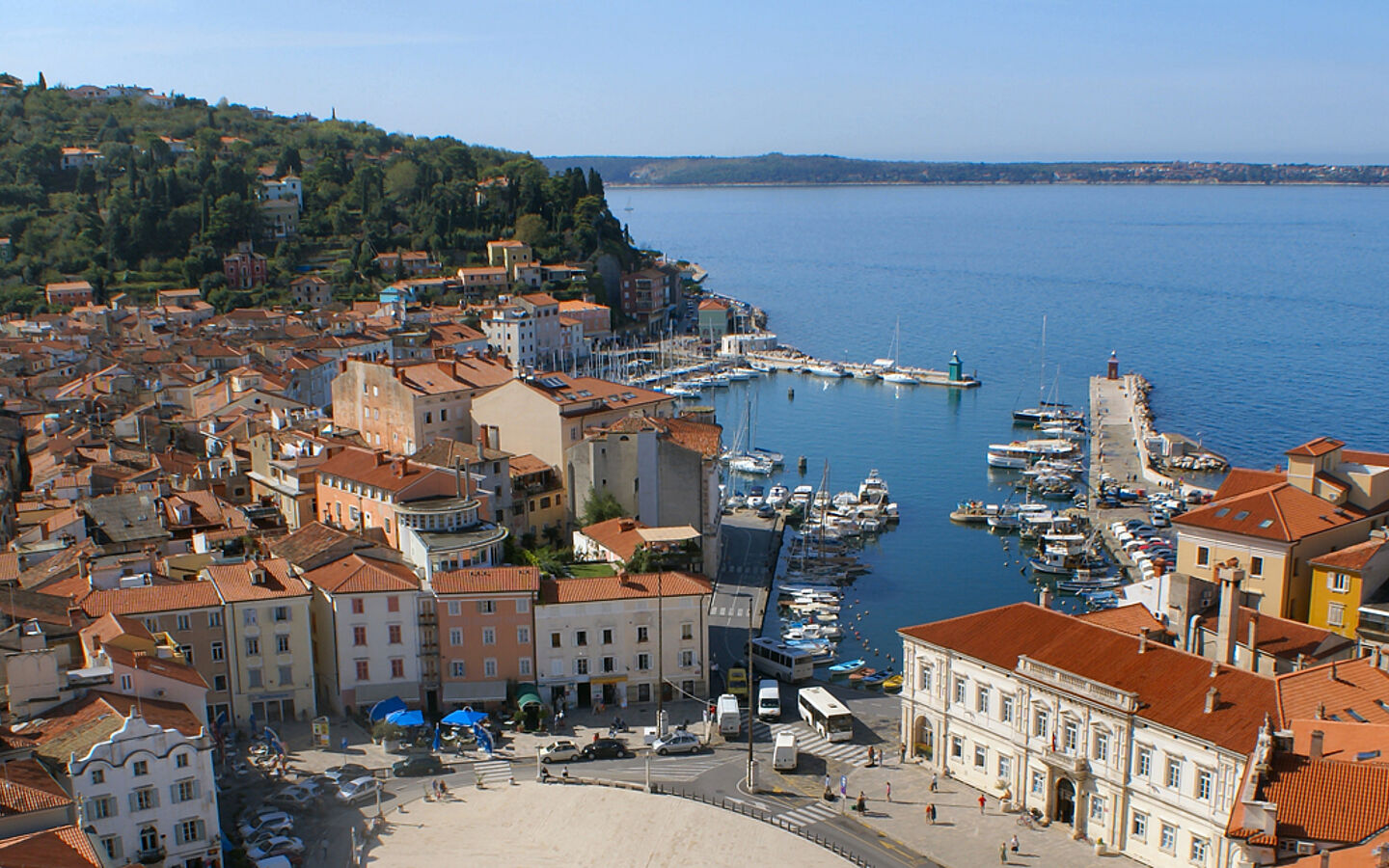
Piran - the pearl of the Slovenian Adriatic
Unique, however, is Slovenia's short coastline, where everything that makes an Adriatic state must take place in just a few kilometers. Coming from the north, you are greeted by a large seaport, Koper, which is in the direct vicinity of the much larger port of Trieste and yet still competes with it, followed by the somewhat inconsequential coast near Izola, where a beautiful marina attracts wealthy clientele. Then the Piran peninsula juts out into the sea, which begins with the entrance town of Strunjan (quiet and secretive) and ends with the fashionable exit town of Portoroz (loud and lively).
Piran itself is the pearl of the Slovenian Adriatic. And it knows it. The Venetian-influenced town is now the stomping ground of many tourists. It is best visited outside the summer months. Even better now, in spring. And then visit one of the many inns and eat fried polpetti. Accompanied by a white wine from the Karst. Simple and delicious. Simply delicious.
Slovenia and wine is a long and not always exciting story. Modern viticulture only arrived in Slovenia at the end of the seventies. Slovenia is a historic wine-growing region. Slovenian wines are a long journey, because their diversity is unique. After the Styrian border regions, which are characterized by the local Central European grapes and shine above all with fresh and fruity white wines, comes the coastal region and with it strong and full-bodied wines, such as those grown in the Italian Karst or in nearby Croatia.
These are completely different, an exciting difference that you won't find in Austria or Germany. Driving from the coast behind Trieste, you come to the Karst and from there to the Slovenian Collio, where top winegrowers such as Simcic or Movia make internationally renowned wines. This sounds more obvious than it is, as Slovenia's winegrowers sell almost all of their wines in their own country. There is hardly any pressure to prove oneself in the world. Unless you put yourself under pressure. Many self-confident Slovenian winemakers, especially those who live within earshot of the successful and export-oriented Italians, want to enter this competition. And outdo the Italians. This is an old cockfight that already took place in the days of the Danube monarchy. Regionally, little changes. No matter which system takes hold of the people.
Slovenia is the most beautiful country in the world. This is not an absurd exaggeration, but the result of a simple survey. From puszta to hilltop, from karst to coast, everything is there. A complete region. Like nowhere else.
Food in Slovenia - a culinary treat
It is difficult to talk about a uniform Slovenian cuisine
because, even though it is very straightforward, geographical differences
geographical differences, natural resources and its numerous neighbors (Italy, Austria, Hungary and Croatia) have an impact on Slovenian cuisine.
In the Slovenian Alpine region, for example, people do not eat the same way
as in the Mediterranean region of Slovenia. "The delicious dishes" of Slovenian cuisine
Slovenian cuisine range from refined Mediterranean dishes,
fish specialties, dried meat specialties from the Karst region, extremely
Karst region, extremely healthy buckwheat and cornmeal porridge, polenta,
potize (cakes with nut filling), strukli (boiled or baked pastries with cheese) to
pastries with cheese) to the famous Prekmurska gibanica
(strudel-like cake filled with quark, poppy seeds and apples). Far and wide
The smoked ham from the Karst is known far and wide and is at the top of the
of the Slovenian culinary offer.
Nightlife Ljubljana - going out in the capital of Slovenia
Ljubljana is the city of culture. It is home to numerous theaters, museums and galleries, and has one of the oldest philharmonic halls in the world. You can also visit one of the many open markets and take a stroll through the streets of the old town with its many cafés, bars and restaurants serving traditional Slovenian and numerous other international cuisines.
The nightlife in Ljubljana offers live music, various pubs and wine bars. During the summer, you can relax at one of the open cafés on the banks of the Ljubljanica River. You can also try your luck in the casino and dance in numerous discos and clubs.
Sights in Slovenia - something for everyone Slovenia, with its varied and beautiful natural landscape, is a true holiday paradise for
natural landscape, Slovenia is a true vacation paradise for tourists with
the most diverse requirements. On the beach of the beautiful Adriatic coast
the warm sun on the beach of the beautiful Adriatic coast, experience beautiful cycling tours or
mountain hike, the range of leisure activities is rich and varied.
varied. But Slovenia also has numerous sights to offer
that can make a stay in this country interesting.
interesting.
The numerous national parks in particular are
very popular with nature lovers and are among the most important
sights of the country.
Ljubljana is the capital of
Slovenia and, with its medieval old town and romantic market square
romantic market square, it has a very special charm. During a
a leisurely stroll through the narrow streets, visitors can discover
numerous baroque buildings and some art nouveau palaces.
Art Nouveau palaces.
Close to the Italian border is the Lipica
the Lipica stud farm, where the world-famous Lipizzaner horses are bred.
are bred here. A real experience for horse lovers, because here you can not only
behind the scenes of such a popular horse breeding farm,
but also take a romantic carriage ride or a riding course.
or take a riding course. Another popular excursion destination for tourists and locals alike
is the Sea Museum - Serge Masera - in the harbor town of Piran. Here
visitors a fantastic insight into the underwater world of the Adriatic Sea.
granted.
Hotels


![[Translate to en:] AMADEUS Riva (c) Lüftner Cruises](/fileadmin/_processed_/d/e/csm_AMADEUS_Riva_ebdf4c2c55.jpg "[Translate to en:] AMADEUS Riva (c) Lüftner Cruises")


































![[Translate to en:] AMADEUS Riva (c) Lüftner Cruises](/fileadmin/_processed_/d/e/csm_AMADEUS_Riva_64c1995e26.jpg "[Translate to en:] AMADEUS Riva (c) Lüftner Cruises")