


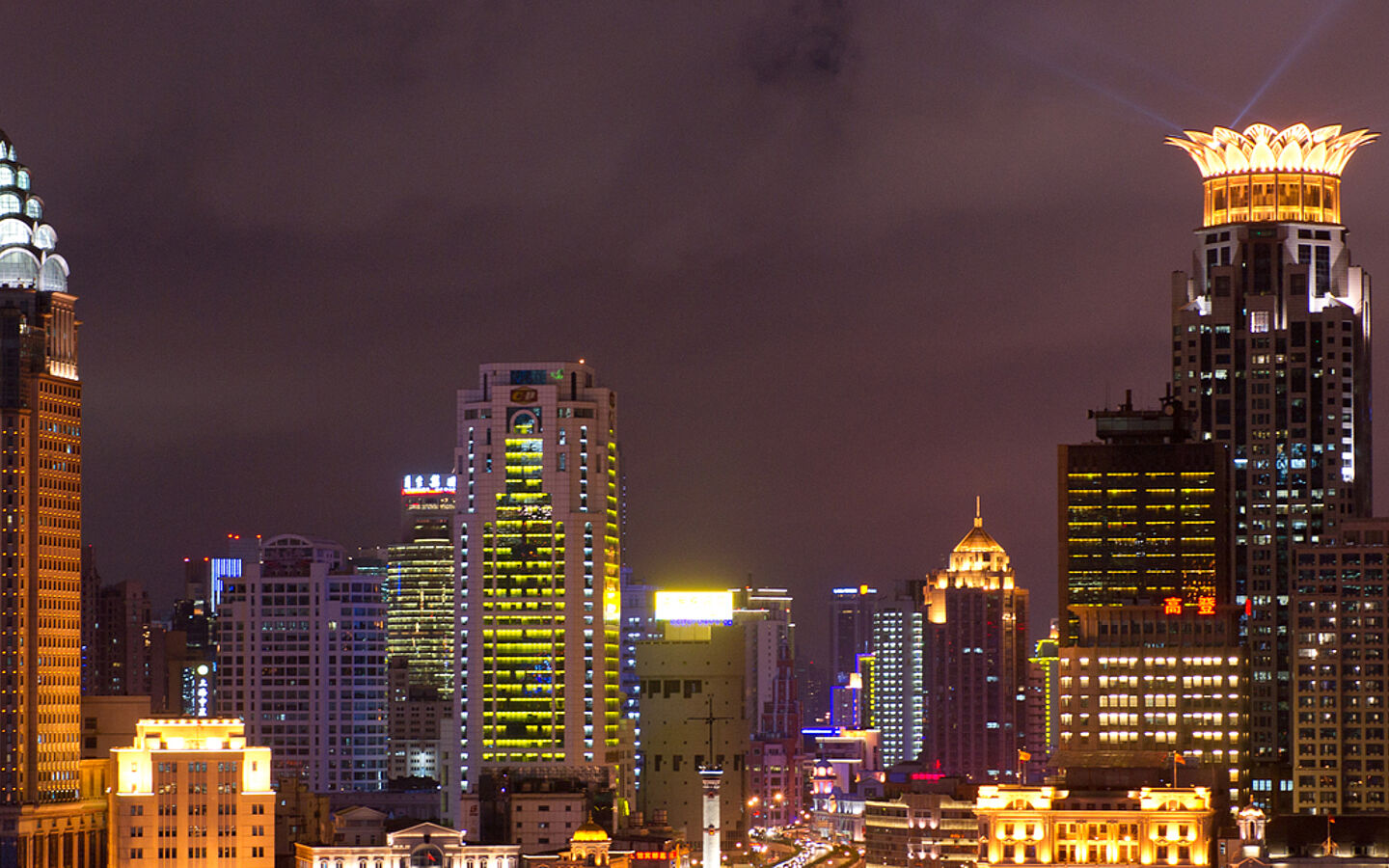
Shanghai
Shanghai is the most beautiful face of China, says Wei Hui, author of the bestseller "Shanghai Baby", of her home city. She is right: The mega-metropolis has by far the most attractive outfit and the most successful facelift in China. What makes the lady so particularly chic is her irresistible mix of styles, because this is where modern China meets old traditions: The highest hotels, the hippest restaurants and bars, the trendiest stores and boutiques vie for the favor of visitors from all over the world with the charm of colonial architecture steeped in history, romantic avenues of plane trees and atmospheric parks.
Those who look out over the city from the skyscraper hotels often have a box view of neon signs from their beds and bathtubs. Depending on preference and business aspect, you can choose your domicile in Puxi or Pudong - i.e. on the western or eastern side of the Huang Pu River, which not only divides Shanghai into two different districts, but also into two different worlds and two completely different backdrops for the hotel scene.
In Pudong, near the huge new exhibition center where Expo 2010 was held, a separate skyscraper world has emerged in recent years, where business and financial companies hold court and employees disappear behind anonymous apartment towers. Hotel classics such as the St. Regis were already established here ten years ago, and hotel sensations such as the Hyatt, the world's tallest hotel with 87 floors in the Jin Mao Tower - which was soon eclipsed by the Park Hyatt in the new Shanghai World Financial Center with 101 floors - were built here. The Ritz-Carlton Pudong and a Shangri-La were also built in Pudong - if you're a hotel operator, you have to be represented here.
One city - two worlds
Old Shanghai, with its colonial charm and imposing architecture on the Bund, bustling shopping streets and chic boutiques, old townhouses and modern museums, lies on the Puxi side. Just behind the Bund, probably the most famous architectural ensemble of colonial China from the time when Shanghai was still regarded as the elegant and rich "Paris of the East", classic hotels such as the Ritz-Carlton and Four Seasons opened in the 1990s, Later came the Hyatt on The Bund, the HangTang Jumeirah Shanghai in Xintiandi, the Swissôtel near the main shopping street Nanjing Road, followed in 2009 by the Peninsula Hotel on The Bund, the Conrad in Xintiandi, and the All Suites Hotel Banyan Tree on the Huang Pu River. A veritable hotel invasion on both sides of the river, and each location has its own charm.
Business travelers prefer Pudong because of its proximity to the financial world and the headquarters of large companies - tourists will prefer to stay close to the Bund in Puxi, where the flair of old Shanghai is still visible in some places. You can still find park idylls like Fuxing Park here, where the last night owls from the chic bars of Xintiandi meet early risers who start the day with Thai chi and qiqong exercises. Later, pensioners hang their birdcages in the trees here and play board games, while in the evenings lovers from the nearby clubs and bars come here.
Those who want to immerse themselves in the bustling Chinese life in the middle of the modern mega-metropolis are drawn to Chinatown. Cross a zigzag bridge to reach the Yuyuan Garden, Shanghai's most famous sight from ancient China. All around is the old town with original medicine and herb stores, jewelry stores with pearls and jade, teahouses and small restaurants.
Those looking for inexpensive Chinese souvenirs will find what they are looking for here, as will gourmets who want to try delicious dim sum (filled dumplings) or sweet cakes made from lotus paste. And if you need a break after a shopping spree in the busy shopping streets and upmarket boutiques on the Bund, you can feast at the highest level in super chic restaurants such as the Whampoa Club in the art deco-style lifestyle temple "Three on the Bund".
Just as hip as the Bund as a mix of old and new is Xintiandi, a no-frills shopping district with boutiques, restaurants and bars in old Chinese houses with Shanghai chic at its finest, such as in Shanghai Tang, the flagship store of China's first international designer brand. Visitors can find out more about the architecture and life in old Shanghai in the middle of the French Quarter in the original "Tea Room", where they can find a quiet place to browse and drink tea late into the night.
Movie and antique lovers alike will get their money's worth on an antique stroll in the somewhat secluded Duolun Lu. At the edge of the tranquil pedestrian zone with its antique and junk stores is the Old Film Coffee, where you can watch classic films from the 1930s over coffee or tea. If you then want to switch back to the new China, take a look into the future at the Museum of Urban Development.
Even from the outside, the boldly designed building on People's Square is an architectural highlight. Shanghai's development over the next 20 years is presented here. A tip for those in a hurry: on the second floor there is a gigantic city model that clearly shows the dizzying dimensions of Shanghai. Here, on the drawing board and in reality, there is an atmosphere of construction and demolition in equal measure, which every visitor to Shanghai can feel. The metropolis of 17 million people, which once began its career as a port and trading city over 150 years ago, casts a spell over everyone as the largest and most modern city in China. Celebrating modernity and preserving tradition at the same time - this requires a daily balancing act that keeps everyone on the move. This keeps the old lady young and makes her the glamor girl of China - provocative, popular and at the same time with a distinctive patina ...
From Shanghai to Shangri-La
The dragon sleeps with its mouth open: its white skin glistens in the sun, its pointed teeth protrude rock-grey into the bright blue sky. "The mountain protects Lijiang," says Lu as she places a glass of jasmine tea on the small wooden table and gazes reverently over to the snow-covered Jade Dragon Massif. Everywhere on the verandas of the shabby wooden huts, people are squatting in front of beers or sodas, moving white and black stones across a board playing Chinese Go, laughing under their workers' caps or pensively watching the women from the Naxi tribe in their colorful traditional costumes hurrying across the bumpy pavement.
The other China
Yunnan, the south of China. Small-town idyll instead of glassy modernity. Quaint stone walls as places to sit and wait and drink tea instead of the Great Wall. Colorful traditional costumes instead of Mao uniform jackets, because there are more tribes living in Yunnan than anywhere else in China: the Naxi, the Dongba, the Baisha, the Yi, Mosuo and all the others. They wear their distinctive marks on their heads: purple and light blue turbans here, elaborate black hats there. And always that pride, that smile. A flight of around three hours takes you to this second face of the vast Middle Kingdom. A cab takes you through lush green rice fields and vast pastures, past mud houses with gracefully curved roofs to the small town of Lijiang - an unpolished gem. A gray, rough shell with a core of lovely beauty, declared a World Heritage Site by Unesco. The Chinese call it the city of eternal spring. Because Lijiang's summers do not know the sweltering heat of Beijing, its winters do not know the freezing cold of the capital. The ancient kingdom of the Naxi people. In the Black Dragon Pond, the reflections of the Jade Dragon Mountain, the magnificent pagoda and the Crescent Bridge, where lovers kiss, change color. A yueqin player sits on the bank, plucking the strings and thus also the souls of those who listen to him. An enchanted atmosphere, an enchanted land. Made for legends. Like the one about the tiger that jumped over the raging waters of the Yangtze not far from here, over the spray that smells of wet stone, between the rocks that are stacked threateningly on top of each other here.
Fabled Shangri-la
It is 30 meters to the other side. There, behind the Tiger Leaping Gorge, begins the legendary Shangri-La, the land with "sun and moon in its heart" in Tibetan. In the famous book "Lost Horizon" by British author James Hilton, this is the paradise that its hero only finds once - and then never again. From here, the serpentines wind their way up to an altitude of over 3,000 meters. Waterfalls cascade down the slopes, cattle graze on lush green meadows - and stubborn yaks stare across. Bright yellow catmint, blood-red wild roses and gentian in all the colors of the sky dazzle the eyes. Nomads drive their herds forward, the colorful saddles of their horses bobbing merrily. The houses in the valley have colorful borders on the windows and balconies. A landscape, undecided between Tibet and Switzerland. A touch of Alpine idyll in Asian style. Sweeping views from the balcony of the original Tibetan cottages of the Banyan Tree Ringha. And alongside wine and whisky, large oxygen bottles at the minibar. The air quickly becomes thin up here. "Just don't go too fast," advises manager Herman Buspa with a smile. "That really exhausts you up here!" Trekking through the mountains? Along the Shudugang River meandering gently through the greenery? Tomorrow. First, a cab ride to the town of Zhongdian. The golden roofs of the Sanzalin Monastery gleam in the sun, seeming to hover over the town like giant protective hands. A cascade of clay buildings built into the hillside. A homely refuge for 800 Tibetan monks. Red robes everywhere: giggling children, old men in conversation, serious young men sweeping the dusty entrances with a broom made of white yak hair. In front of the monastery, Naxi women grill rice patties and sell them with a dip of spicy sauce. The land lies lush and content in the evening light. The sun quickly disappears behind the mountain peaks. Sharp contours remain in the sky. Down in the old town, the market square fills with people. Foreign-sounding melodies come out of nowhere and suddenly the whole square is in motion. The people of Shangri-La are dancing their evening away, life, their city. It happens every evening, an old tradition.
Photo: © Lothar Krause / pixelio.de
China's most modern and fastest growing metropolis casts a spell over every visitor. Provocative and popular on the one hand, tradition-conscious on the other, the city presents itself like a glamorous lady with two faces.
Highlights
Connoisseur Circle tip
Shanghai Chic: 3 on the Bund is the name of the top address on Shanghai's boulevard. An Armani boutique on the ground floor, art and designer labels on the second floor, an art gallery and a posh Evian Spa above, and three restaurants with star chefs, each of which deserves a design award: Jean-Georges, Whampoa Club, Laris and New Heights with a roof terrace. The smallest and most exclusive restaurant in the city is located in the former bell tower of the magnificent neoclassical building: Brad Pitt and Angelina Jolie are among those who have booked dinner in front of two.
www.threeonthebund.com
DIPLOMATIC MISSIONS
Embassy of the People's Republic of China in Germany
Märkischer Ufer 54, 10179 Berlin
Tel: +49 30 275880
Fax: +49 30 27588221
www.china-botschaft.de
Embassy of the People's Republic of China in Austria
Metternichgasse 4,1030 Vienna
Tel: +43 1 7143149
Fax: +43 1 7136816
E-Mail: chinaemb_at@mfa.gov.cn
www.chinaembassy.at
Location
China
Area
6.340 km²
Population
24.15 million
Language
Putonghua (frequently spoken standard Chinese)
Religion
Buddhism, Christianity, Daoism
Weather
Shanghai has a subtropical maritime monsoon climate with four distinct seasons, whereby spring and fall are comparatively short. Winter is cold and damp, with temperatures averaging 3.4 to 5.6 degrees Celsius. Occasionally there are also severe frosts.
Best time to travel
Shanghai and the east are best visited from May to September.
Climate
| Jan | Feb | Mar | Apr | May | Jun | Jul | Aug | Sep | Oct | Nov | Dec | |
| Max. Temperature | 8 | 8 | 13 | 18 | 24 | 28 | 32 | 32 | 27 | 22 | 16 | 10 |
| Min. Temperature | 0 | 1 | 5 | 10 | 16 | 20 | 25 | 25 | 20 | 15 | 9 | 2 |
| Hours of Sunshine | 5 | 4 | 5 | 5 | 6 | 5 | 7 | 8 | 5 | 5 | 5 | 5 |
| Rainy days | 6 | 7 | 9 | 9 | 10 | 10 | 9 | 9 | 9 | 6 | 5 | 5 |
Time difference (to MEZ)
In China gibt es keine Sommerzeit, d.h. es gilt für ganz China MEZ +7 Stunden.
Currency
Renminbi
Visa
Tourist visa (L visa):
For people visiting China for tourism or family reasons. The validity is limited to three months. A stay of 30 days is possible. An extension of the stay in China is possible on site (up to 90 days).
Vaccinations
No special vaccinations are required, Shanghai is considered malaria-free. More information at the Tropical Institute. Information without guarantee.
Restaurants in Shanghai - Shanghai Delights
Shanghai can impress not only with its unique skyscrapers in Shanghai Pudong or the colonial buildings on the Bund, but also with truly captivating original Chinese food that is very rarely served in Germany. In China, you don't just eat with your mouth, but also with your eyes and nose. Moreover, eating is an undertaking that can sometimes take the whole evening.
Restaurants come and go in Shanghai. So if you have an outdated
guidebook, it can often happen that some restaurants that are still
guide no longer exist. The Chinese are generally
are generally more likely to eat out than foreigners. Lunch is taken no later than
at 12 noon at the latest, and dinner around 6 pm. So if you go
restaurant around 8 p.m., most of the Chinese have already left.
gone again.
Shanghai nightlife - Intoxicating night scene
The nightlife in Shanghai is smooth and colorful, because here life means more because it is elegant. The scenery at night is a must-see. The richly decorated classical and modern buildings provide a new and exciting insight and are illuminated by an abundance of colorful lights. The view over the Huangpu River from the Oriental Pearl TV Tower and Jinmao Tower is a magical sight. A Huangpu River Cruise at night is a wonderful opportunity to appreciate the nightlife of Shanghai
Shanghai leisure - relax in the hectic metropolis
The range of leisure activities in Shanghai is extraordinarily large. Enjoy a relaxing day in a wonderful spa or discover Shanghai on a delightful boat that takes you through the city. Golfing is also popular in Shanghai, and the Tomson Golf Club in particular is definitely worth a visit.
Shanghai sights - Historical highlights
Fascinating
are above all the varied landscapes
landscapes and metropolitan areas that
Shanghai has to offer. With a
variety of exciting cities and
sights, Shanghai has long since ceased to be
no longer an insider tip. Shanghai's
sights are just as varied as the
varied as the country itself. The long
Shanghai's long history has left countless
cultural monuments
On the eastern side of the Huangpu
River is the modern Pudong
business district with numerous skyscrapers
skyscrapers such as Jinmao Tower, World
Financial Center.
With 88
floors, spread over a height of
420.5 meters, the Jin Mao Tower is
Tower is certainly one of the highlights of Shanghai's imposing skyline
skyline of Shanghai and an absolute "must
have seen" when visiting the
financial district of Pudong in the heart of the
city.
Shopping in Shanghai - A wide range of offers
Shopping in
Shanghai is almost a leisure activity and there is hardly anything that is
is not available. The only thing that is difficult is western foodstuffs
such as cheese and sausage. Larger supermarkets such as the French chain Carrefour
offer a small selection, unfortunately at considerably higher prices.
Otherwise, you have to haggle and take a good portion of patience and perseverance as well as money.
and perseverance.
The most famous and
largest shopping street is Nanjing Lu. It is divided into two sections:
From the Bund waterfront promenade to Renmin Square is the most
the most touristy and overcrowded part, while the smaller stores to the west
invite you to store. Huaihai Lu is considered the city's classiest shopping street,
fashionable department stores are lined up next to luxury boutiques. Other popular
shopping areas are Jingling Donglu and the area around Xujiahui subway station
Xujiahui subway station, where a modern shopping district has developed. Caution
beware of the hawkers on the street, who take their customers to
dubious salesrooms in back courtyards.
Hotels



![[Translate to en:] AMADEUS Riva (c) Lüftner Cruises](/fileadmin/_processed_/d/e/csm_AMADEUS_Riva_ebdf4c2c55.jpg "[Translate to en:] AMADEUS Riva (c) Lüftner Cruises")













































![[Translate to en:] AMADEUS Riva (c) Lüftner Cruises](/fileadmin/_processed_/d/e/csm_AMADEUS_Riva_64c1995e26.jpg "[Translate to en:] AMADEUS Riva (c) Lüftner Cruises")