


Oman
of Sinbad the Sailor does not reveal its secrets at first glance.
If you want to discover the country, you should bring time with you - and a certain thirst for adventure.
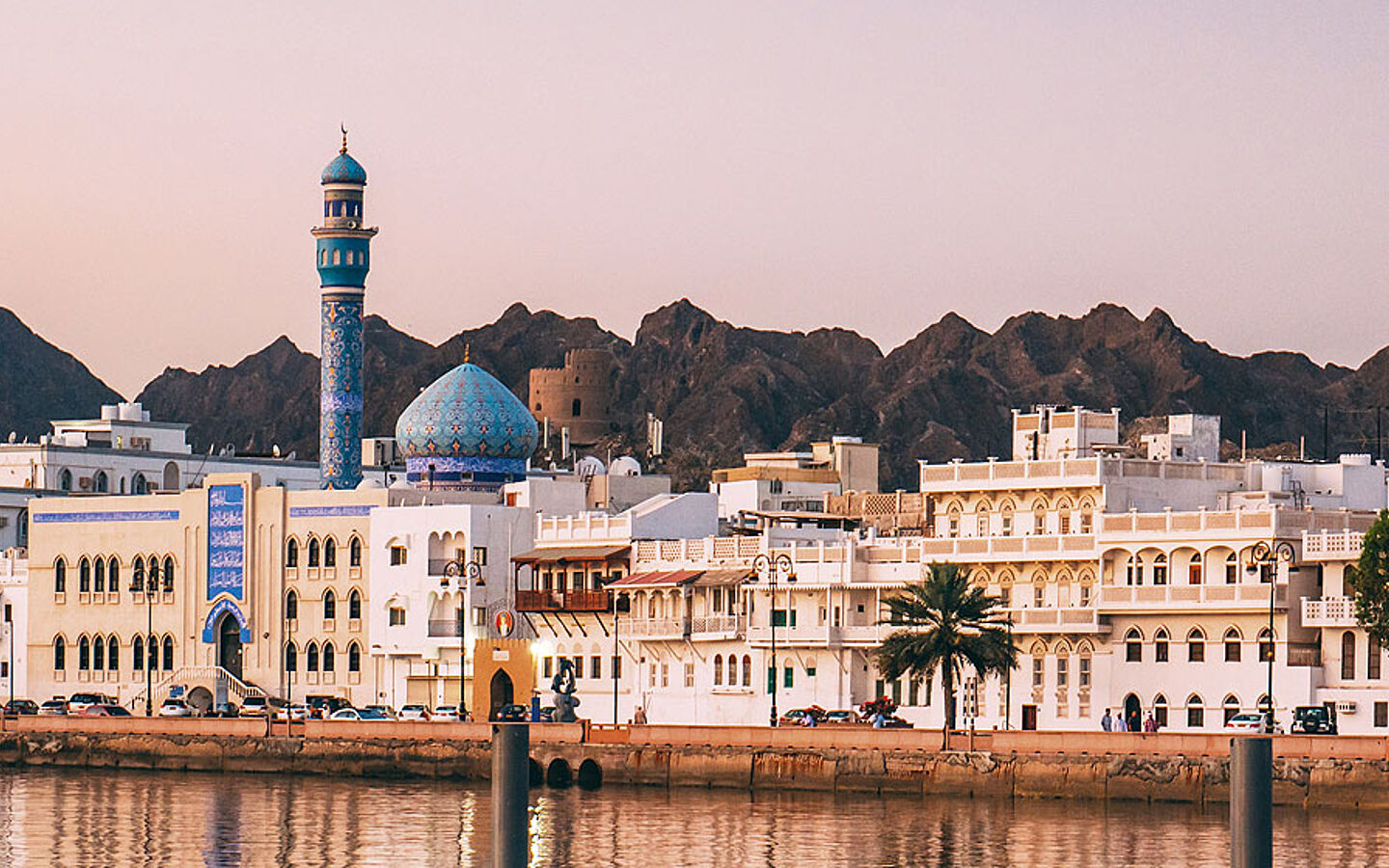
The Sultanate of Oman surprises with wildly rugged high mountains, deep canyons, idyllic oases, blooming rose gardens and extensive plantations. Endless expanses characterize the fascinating sand and gravel deserts. The 3,165 km of coastline is characterized by the varied rhythm of white beaches and steep cliffs. Muscat is the perfect introduction to Oman and, in addition to the traditional, historic districts of Mutrah and Muscat, is a young city with impressive, modern Arabian architecture that has emerged in the last 30 years.
The "Capital Area" now stretches around 50 kilometers along the coast.
Between mosques and palaces, the view of the glowing sea opens up again and again. In the souk of Mutrah, the air is filled with the scent of frankincense, the most expensive luxury good of antiquity from southern Oman. Colorful fabrics, the finest cloths, gold and silver jewelry, but also household goods, shoes, toys and all kinds of more or less handcrafted items are traded. The traces of 5000 years of maritime trading tradition are also omnipresent here.
It is only a few minutes' walk from the souk to the fruit and fish market. In the early hours of the morning, the fishermen unload their catch directly at the pier - a noisy, colorful hustle and bustle that is worth getting up early for!
Historic Muscat lies in a small sheltered rocky bay: "Muscat" means anchorage and was once of great importance as a stopover on the way to India. It is still the seat of the Sultan today. His colorful palace is flanked by two old Portuguese fortresses. The Bait al Zubair Museum and the Muscat Gate Museum bear interesting witness to this bygone era. The city is dominated by the large Sultan Qaboos Mosque, which was opened in 2001 and is particularly impressive when illuminated at night.
From the coast to the mountains
From today's capital, it is 160 kilometers inland to the former capital. At the foot of Jebel Akhdar, the "Green Mountain", in the Hajar Mountains, surrounded by endless palm groves, lies the oasis of Nizwa, the capital in the 6th and 7th centuries and still a spiritual and cultural center of the country today. The main attraction is the large souk with its animal market, where every Friday there is loud haggling over goats, sheep and cows.
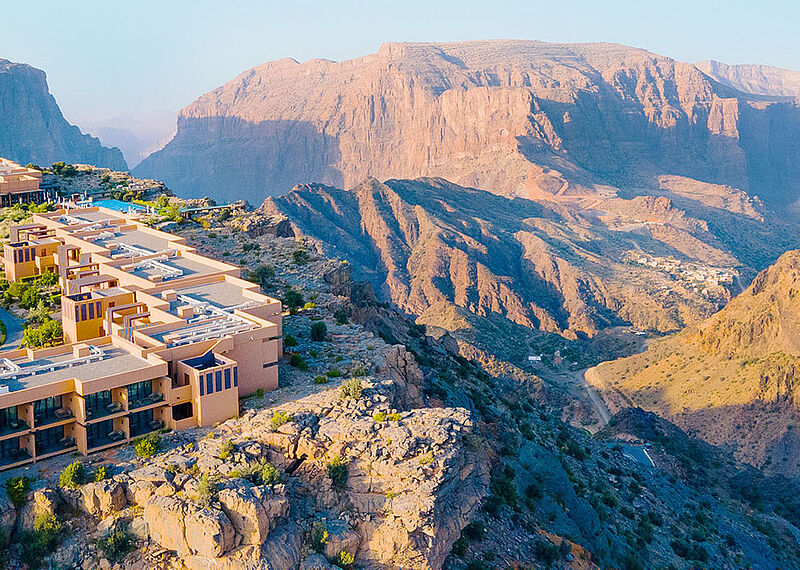
The Hajar Mountains impress with terraced fields on steep slopes, magnificent gorges and canyons, imposing fortresses and palaces as well as idyllic mountain villages. At an altitude of around 2,000 meters, where temperatures are no longer a humid 35 degrees, the mountain village of Al-Ayn is lined with neatly laid out terraced beds, apple and fig trees grow, garlic is cultivated and the roses that are known worldwide for the luxury perfume "Amouage" produced in the sultanate bloom. Thanks to two luxury hotels, the Alila and the Anantara, on Jebel Akhdar, you can enjoy this unique mountain world in extreme comfort.
In Oman's south
Speaking of temperatures: when the Arabian Peninsula is sweltering in summer, thousands of tourists from the Gulf States seek refuge from the heat in Salalah, in the south of Oman. From July to September, this coastal strip is shrouded in thick fog and drizzle by the foothills of the monsoon. "Khareef" is the name given to the period of the southwest monsoon. The vegetation in the mountains explodes, waterfalls cascade down into the valley - a cool green paradise in the middle of a blazing furnace. Salalah, the "Shining One", stretches for 15 kilometers along an endless sandy beach, fringed by a belt of subtropical plantations. Bananas and papayas grow particularly abundantly under the green canopy of coconut palms. No wonder that a tourist zone with a marina and comfortable hotels has developed around the country's second largest city and capital of the Dhofar governorate in recent years. Finally, Salalah Beach is also ideal for all kinds of surface and underwater sports.
Deserts from 1,001 nights
Not far away, in the mountains, lies Wadi Dawkah, an inhospitable stony desert where the shaggy frankincense trees grow as they once did. Even today, frankincense is omnipresent in Oman's everyday life and the archaeological sites along the Frankincense Route bear witness to its former wealth.
Large parts of the province of Dhofar and Oman are desert. Many visitors from the Emirates drive their powerful SUVs the 1,000-kilometer route from Muscat to Salalah via the well-developed "desert highway". Along the border with Saudi Arabia, the majestic dune mountains of the Rub al-Khali, the "Empty Quarter", push far into Omani territory. But there is an easier way: just under three hours' drive from Muscat, the Wahiba Desert, also known as Ash Sharqiya Sands, is an easily accessible excursion destination. The Bedouins still roam the endless expanse of the sea of sand with their camels, goats and mobile palm branch huts. Exploring this breathtaking landscape under the expert guidance of a Bedouin and spending the night under the stars is one of the highlights of a trip to Oman - especially as trips into the desert with romantic nights under the stars are now also offered in the luxurious "glamping" version.
CC travel tip:
Wild Musandam
The Musandam region is an exclave in the far north of Oman, surrounded by the territory of the United Arab Emirates.
Here, the foothills of the Hajar Mountains drop steeply into the sea and form a unique coastal landscape with pristine bays and fjords. Some of Oman's greatest diving spots are also located on this remote, rugged stretch of coastline with a multitude of small offshore islands. The journey to this natural paradise is arduous. Although there are some flights, most people travel by 4WD jeep over gravel roads and through untouched mountain landscapes. Alternatively, the route can also be covered by boat across the sea. The easiest way, however, is to travel via Dubai or Ras al Khaimah with a subsequent transfer.
With the Six Senses Zighy Bay (see Check In, p. 115), the peninsula has one of the most luxurious hotels in the entire sultanate.
Highlights
■ Experience Muscat privately
DERTOUR Deluxe offers attractive private excursions with driver and guide. The offer includes: city tours in Muscat with a visit to the vegetable market and cooking class, luxury yacht tours with dolphin/whale watching and BBQ on the beach as well as trips through the mountains with wadi visits. www.dertour.de/deluxe
DIPLOMATIC MISSIONS
in Germany
Embassy of Oman
Clayallee 82, 14195 Berlin
Phone: +49 30 8100510
Fax: +49 30 81005199
www.oman-embassy.de
in Austria
Embassy of the Sultanate of Oman
Währinger Straße 2-4/24-25, 1090 Vienna
Tel. +43 1 310864344
Fax: +43 1 3107268
E-Mail: embassy.oman@chello.at
Location
Sultanat Oman
Area
309.500 km2
Population
3.632 million
Language
Arabic
Arrival
A new terminal was opened at Muscat airport just this spring. The sultanate's airline, Oman Air www.omanair.com flies directly from Munich and Frankfurt to Muscat. Domestic flights, for example to Salalah, are also operated by Oman Air. Other airlines also fly to Oman: Qatar Airways www.qatarairways.com for example, has very good daily connections from Berlin, Munich and Frankfurt via Doha to Muscat. KLM and Turkish Airlines also offer flights to Oman. There are also flights to Salalah from Frankfurt, Munich, Düsseldorf, Vienna and Zurich - for example with Emirates and Fly Dubai via Dubai.
Capital city
Nutmeg
Religion
Islam, predominantly Ibadites; other religions are respected
Weather
In winter, temperatures in the north are around 25° Celsius, the water is pleasantly warm, with only occasional thundery showers. In summer, on the other hand, temperatures of over 40° are the rule, inland even up to 50°. Between June and September, the coast of the southern province of Dhofar is hit by monsoon storms. These envelop the region in dense fog and drizzle (Kharif season), which makes the coastal mountains subtropically green. Due to the strong currents in summer, it is only possible to swim in the sea on the south coast of Oman in winter. The average temperature in the south is around 30° Celsius all year round.
Best time to travel
The best time to travel to Oman is between October and April with temperatures between the mid-20s and 30 degrees. In summer, temperatures can reach well over 40 degrees - but it is generally noticeably cooler in the mountains than in Muscat. Exception: Salalah is affected by the foothills of the monsoon in the summer months. This is the high season for holidaymakers from neighboring Arab countries.
The coastal town of Quriat also holds the record for the hottest night on the planet. On June 26, 2018, the temperature did not drop below 42.6 degrees Celsius, while 49.8 degrees Celsius was measured during the day.
Climate
| Jan | Feb | Mar | Apr | May | Jun | Jul | Aug | Sep | Oct | Nov | Dec | |
| Max. Temperature | 25 | 26 | 29 | 34 | 39 | 40 | 38 | 36 | 36 | 35 | 30 | 27 |
| Min. Temperature | 17 | 17 | 21 | 24 | 29 | 31 | 30 | 28 | 27 | 24 | 21 | 18 |
| Hours of Sunshine | 8 | 9 | 8 | 10 | 12 | 11 | 10 | 10 | 10 | 10 | 10 | 9 |
| Rainy days | 3 | 5 | 4 | 2 | 0 | 0 | 0 | 0 | 0 | 2 | 3 | 3 |
Time difference (to MEZ)
MEZ: +3 Stunden
Currency
One Omani rial is currently equivalent to around 2.30 euros. Credit cards are accepted everywhere.
Visa
Attention: An electronic visa is required for entry, which can be applied for on the homepage
of the Royal Oman Police evisa.rop.gov.om can be applied for.
Visas are no longer issued at the airport.
EU citizens require a visa, which can be applied for at the Omani Embassy or directly when entering Oman. The passport must be valid for at least six months when the visa is issued or when entering Oman. (Exception: A visa agreement concluded between Oman and the Emirate of Dubai states that EU citizens who wish to enter Oman from the Emirate of Dubai and have a valid visa issued by the authorities of the Emirate of Dubai may also enter the Sultanate of Oman with this visa and stay in Oman for a maximum of three weeks).
If you stay in Oman for longer than the period stated in the visa, you will be fined OMR 10 for each day that is not covered by the visa.
Food Oman - gourmet cuisine
The cuisine of Oman is not typical of the country, but rather the sum of Indian, Indonesian and East African influences as well as traditional Bedouin recipes.
Most dishes are Indian curries - rice dishes in various combinations, well spiced and tasty, with freshly caught fish from the sea, generally lots of lamb, dates and rice. Most of the good restaurants are located in the large hotels. The Bin-Atique restaurants in Muscat, Salalah and Nizwa serve good authentic Omani dishes.
Sultan Qaboos Mosque
The mosque in Muscat was opened in 2001. The magnificent main prayer hall is decorated entirely in white, blue and gold.
A chandelier made of Swarovski crystals hangs from the ceiling. The floor is covered by a handmade Persian carpet, which was made by 600 weavers and covers over 4,200 square meters.
www.sultanqaboosgrandmosque.com
Souk Muscat
The souk is a labyrinth of alleyways full of surprises. In addition to typical local clothing, jewelry, spices, antiques and Bedouin carpets, you can also find craft stores where the traditional silver daggers, also known as khanjars, are made.
Royal Opera House
The Royal Opera House in Muscat was opened in 2011. It was a project of the Sultan and the first building of its kind on the Arabian Peninsula. Located in the heart of the city, it offers classical music, jazz and ballet. www.rohmuscat.org.om
Bait al Zubair Muscat
The Bait al Zubair is a remarkable complex of private houses that serves as an ethnological museum. It was recently extended to include an Omani Renaissance building. The extensive collection conveys a picture of the daily life of the Omanis through the centuries.
www.baitalzubair.com
Nizwa
Nizwa is the ideal starting point for tours into the desert. The former capital of the country was built around a green oasis. The souk is one of the most interesting in the sultanate. A special attraction is the cattle market, which takes place every Friday morning.
Also worth seeing are the fortifications high above the city with a mighty watchtower. The fortress is the largest in the entire Arabian Peninsula and houses a museum.
Incense
Dhofar with the city of Salalah is considered the "frankincense center" of Oman. Four places in the region were declared World Heritage Sites by UNESCO in 2000: These include the frankincense trees of Wadi Dawkah, the remains of the caravan oasis of Shisr and the port of Khor Rori, as well as the archaeological site of Al Balid.
Al Balid Maritime Museum Salalah
The museum offers a look back at 5,000 years of maritime history in the Sultanate of Oman - from shipbuilding to shipping and the sea routes across the Indian Ocean.
Sport
Diving
Oman offers numerous excellent diving spots with a fascinating underwater world and great biodiversity. There are nine professional diving schools in the greater Muscat area alone. Salalah, Jebel Sifah and the coast in the north also offer good conditions. The best time for diving is between April and July, when visibility is good and the water temperature is pleasant. In general, however, you can dive all year round, except in Dhofar, where conditions in the sea are difficult during the monsoon season.
Hiking and cycling
There are at least 30 hiking trails in the Hajar Mountains, stretching over several hundred kilometers. Trekking enthusiasts can even undertake a major hike through the western part of the Hajar massif from Jebel Shams to Jebel Akhdar, which takes around twelve days.
In the area around Al Hamra, you can book around a dozen guided bike tours with professional guides.
www.bikeandhikeoman.com
Climbing
With more than 160 registered spots, Oman is a popular destination for climbers. One very well-known spot is Jebel Misht in the western Hajar Mountains. However, its 1,000 meter high cliffs are only for experienced climbers. The via ferratas in Snake Canyon (Wadi Bani Awf) and on the cliffs of Bandar Al Khayran, from where you have a view of the sea, are also suitable for beginners if accompanied by a guide.
Fixed
Ramadan
Ramadan is the ninth month in the Islamic calendar. In 2019, it takes place from May 5 to June 4. During this time, devout Muslims are not allowed to eat anything between sunrise and sunset. During Ramadan, many stores are closed during the day. The month ends with Eid al-Fitr, a week-long festival where family and friends come together to eat traditional food and celebrate.
Friday
Friday is roughly equivalent to Sunday. Alcohol is only served on this day from 2 pm, after Friday prayers.
Muscat Festival
The Muscat Festival is held between January and February. The best of Omani culture is presented at events throughout the city. These include concerts, exhibitions and cooking events with local chefs.
www.muscat-festival.com
Tour of Oman
In February, cycling fans should not miss the Tour of Oman, which attracts top riders from all over the world.
www.tourofoman.om
Sailing regattas
The old sailing tradition lives on thanks to top-class international regattas.
The most important are Sailing Arabia - The Tour (February) www.sailingarabiathetour.com the Extreme Sailing Series (March) www.extremesailingseries.com the Mussanah Race Week (March)
www.mussanahraceweek.com
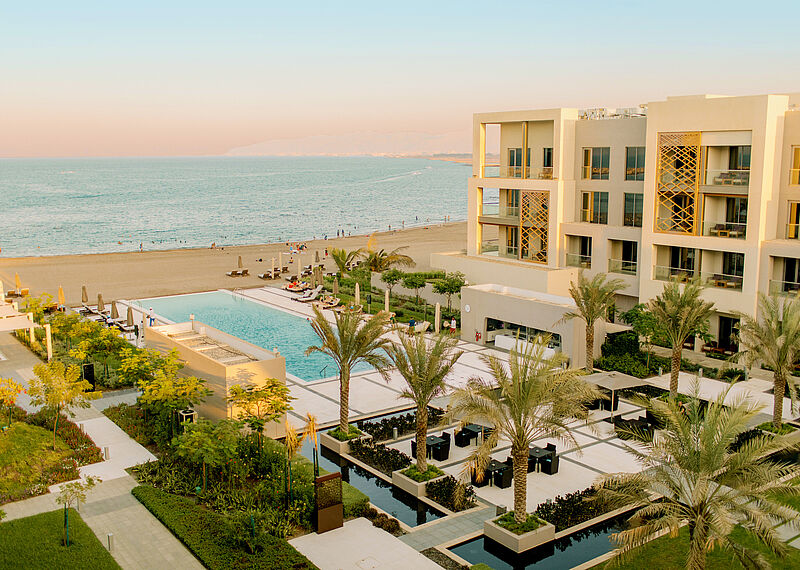
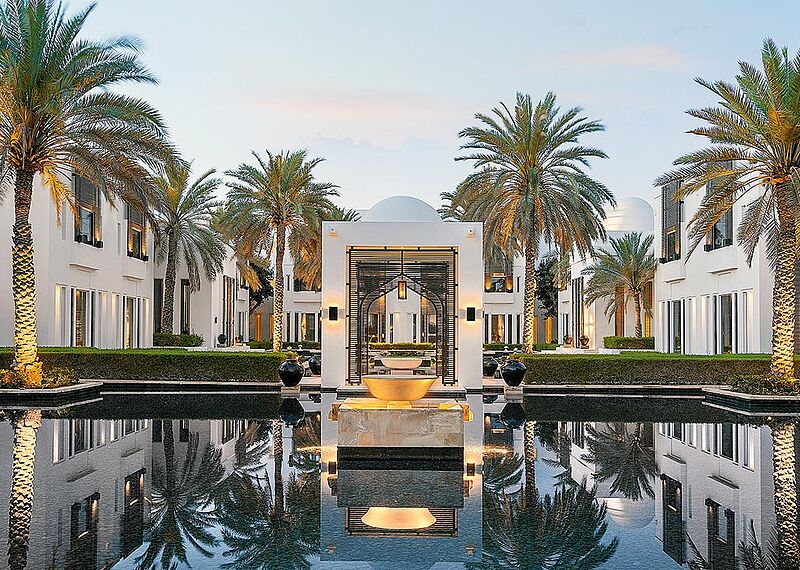
Hotels





![[Translate to en:] AMADEUS Riva (c) Lüftner Cruises](/fileadmin/_processed_/d/e/csm_AMADEUS_Riva_ebdf4c2c55.jpg "[Translate to en:] AMADEUS Riva (c) Lüftner Cruises")
















































![[Translate to en:] AMADEUS Riva (c) Lüftner Cruises](/fileadmin/_processed_/d/e/csm_AMADEUS_Riva_64c1995e26.jpg "[Translate to en:] AMADEUS Riva (c) Lüftner Cruises")