


Marseille
Haute Volée in the harbor
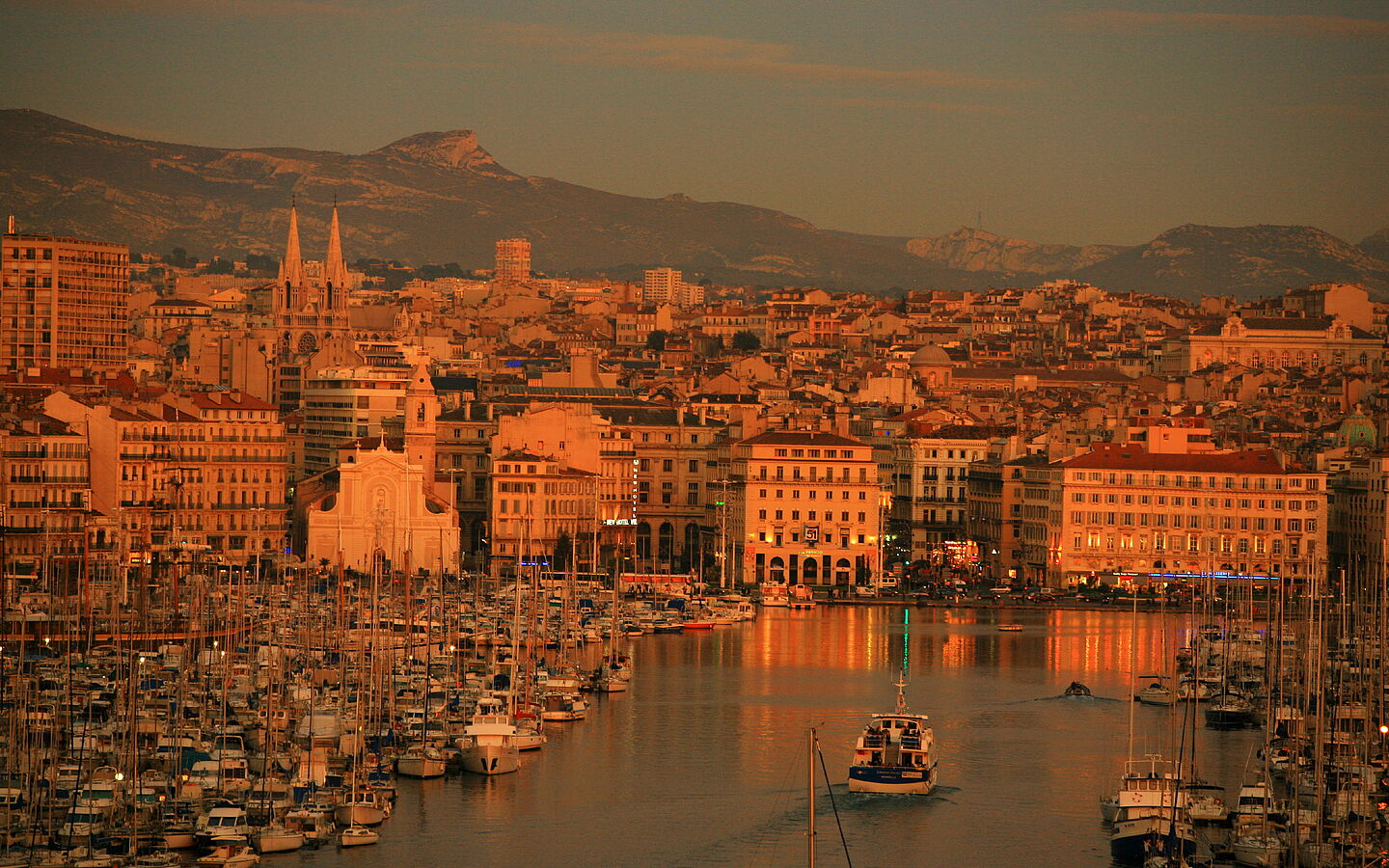
The Old Port is the nucleus of the city, which was founded in 600 BC as the Greek colony of Massalia. Such a charming scene would never have occurred to you before your visit. The view scans thousands of sailing masts, wanders between mighty fortress walls out to sea to the Frioul Islands and up to the imposing Notre-Dame-de-la-Garde Cathedral. On its tower, visible from afar, is the "bonne mère". Eleven meters high, the golden-robed Mother of God shines from the highest of the many hills over which Marseille spreads like a wrinkled cloak. On one side of the harbor, history flourishes in converted warehouses, market halls and former dive bars. On the other, modern apartment buildings are bathed in sunlight. In between is the Quai de Belges. This is where fishermen moor their boats at the harbor wall in the morning and hoist their fresh catch onto stalls. A pretty photo motif, but has always been the source of ingredients for the famous bouillabaisse. Due to extensive harbor improvements, the fish market is currently squeezed into a few car lengths. Based on a design by Sir Norman Foster, promenades are being widened on all three sides and the once eight-lane waterfront road has been narrowed to just a few meters. Mayor Jean-Claude Gaudin explains this as restoring the "essence" of the famous harbor. The forerunners of the anticipated flair have long since settled here. Numerous terraces line both the harbor basin and the former Carré Thiars galley area. See and be seen is the motto of tout Marseille these days. A table in the front row, an ice-cold aperitif in front of you, chic sunglasses on top, elegant ladies in gesticulating conversation, the gentlemen studying the sports news in a relaxed manner.
Mix of cultures: Marseille's many faces
Just a few blocks away around the former Noailles East train station, you suddenly feel like you're in a souk. The Marché des Capucins and its branching alleyways reflect Marseille's history of immigration with their North African ambience. Life pulsates around vegetable stalls and between open stores where halves of mutton dangle, sacks of herbs and spices exude an oriental scent and containers of pickled olives and chilies tempt you to try them. France's oldest city was and still is not only a hub for the movement of goods to and from Africa, it is also a place where many different cultures come together. Almost half of the inhabitants are of Maghrebi descent. In some suburbs of Marseille, the mix of peoples has not always led to smooth coexistence. As a visitor, however, you don't touch these places. It is fascinating to meet people of all shades of skin while strolling along the Canebière boulevard. Rope workshops once lined up here near the shipyards. After the demolition of the Arsenal 270 years ago, magnificent palaces such as the Bourse were built.
Contrasting program on the Cours Julien. In a way, the street is the southern French answer to Hamburg's Schanze. In the trendy district of the "Bobos" (Bohemièn Bourgoisie) with Place Jean Jouré at its center, music venues, avant-garde fashion labels and pubs form a colorful cocktail of experiences, peppered with plenty of street art. Fashion aficionados will be delighted on their way back down to the Vieux Port via Rue Grignan. Behind baroque facades, boutiques of international and local labels tempt you to pull out your credit card. What you don't necessarily know is that Marseille has emerged as a creative pool when it comes to fashion since the 1990s, following an idiosyncratic Mediterranean style with bold elements and refreshing ideas.
The Quai de Belges leads into the Rue de la République with its finely restored Second Empire architecture. The Haussmann façades and the stores behind them are elegant. The impressive boulevard borders the hump of Le Panier. Until a few years ago, Le Panier was still considered a disreputable poor people's quarter. Then the city gave it a fresh patina. The charm remained. Artists, delicatessens and cozy bars have now established themselves in the romantic little squares, crooked alleyways and narrow stairways. The sightseeing highlight is the Vielle Charité. The former poorhouse with its charming columned galleries now houses magnificent collections of African, Oceanic and Indian art.
Fascinating beauty in the south of Marseille
A vacation atmosphere à la Côte d'Azur in between? Marseille has that to offer too. From the southern exit of the Vieux Port, romantic rocky coves such as the Anse des Auffes line up at the beginning, followed by beach after beach along the Corniche Kennedy. Beyond the road, upper-class villas rise out of manicured palm gardens. A total of 57 kilometers of coastline line the Marseille conurbation, and with 14 marinas it is the second largest yachting center in Europe. And on the south-eastern edge of the urban area, wild beauty breaks loose almost suddenly. Silver-grey limestone cliffs stretch up to 400 meters high into the sun-drenched sky. No houses, but plenty of shrubs frame the steep-sided calanques at the foot of the Montagne Marseilleveyre. The deep bays with their crystal-clear sea cut like daggers into the pale stone scenery. In the hinterland, loneliness looms between herb bushes and kermes oaks. Eagles circle. Lizards scurry over the scree. Back to the terrace café? The Vieux Port is only 25 minutes away by car or an hour by excursion boat.
www.marseille-tourisme.com
Photo: (c) Atout France / F. Charel
Location
Frankreich
Food in Marseille - fish with a difference
The coastal city of Marseille has an abundance of fresh fish and other delicacies, although the city's cuisine is heavily influenced by its surroundings. In particular, the delicious boullabaise - a fish soup - can be found in almost every restaurant and is definitely worth trying.
Shopping in Marseille - a shopping paradise in a class of its own On the Cours Julien and around the Place Jean Jaurés, you will find small boutiques with local labels as well as traditional manufacturers, such as the Savonnerie Marseillaise (34, Cours Julien) with its wonderfully fragrant natural soaps. Helène Racine's store Casablanca (63, Cours Julien) offers asymmetrical items in soft fabrics, while luxury boutiques line Rue de Grignan, led by the Marianne Cat concept store in the 1790 Hôtel de Paul (No. 53). Sporty, creative fashion made from wonderful fabrics can be found around the corner at Sugar (16, Rue Lulli). If you love kitchen utensils, whether traditional or modern, you will find your paradise at Maison Empereur (4, Rue des Recolletes).
Hotels


![[Translate to en:] AMADEUS Riva (c) Lüftner Cruises](/fileadmin/_processed_/d/e/csm_AMADEUS_Riva_ebdf4c2c55.jpg "[Translate to en:] AMADEUS Riva (c) Lüftner Cruises")












































![[Translate to en:] AMADEUS Riva (c) Lüftner Cruises](/fileadmin/_processed_/d/e/csm_AMADEUS_Riva_64c1995e26.jpg "[Translate to en:] AMADEUS Riva (c) Lüftner Cruises")