


Milan
Let's be honest: Milan is love at first sight for only a few people. Unlike other Italian cities such as Rome, Florence or Venice, whose beauty is obvious, the northern Italian fashion and trade fair city has more of a reputation for being a bustling beauty that is stingy with its charms. This is more or less true.
For it is only on closer inspection that Milan reveals its appeal: with luxurious hotels and restaurants, magnificent gardens and courtyards hidden behind inconspicuous entrances, art treasures of the highest order and a highly vibrant fashion, design and lifestyle scene that sets standards not only in Italy.
What the city in the Po Valley has to offer in terms of superlatives appears at first glance to be more attractive to business travelers than tourists. With almost two million inhabitants, it is Italy's second largest city, a stock exchange, financial and media center and home to almost all of the country's major fashion houses, advertising and design agencies. It is undoubtedly a mecca for creatives: no wonder, then, that the mentality of the people here is fast-paced and busy, the traffic chaotic and the pace breathtaking.
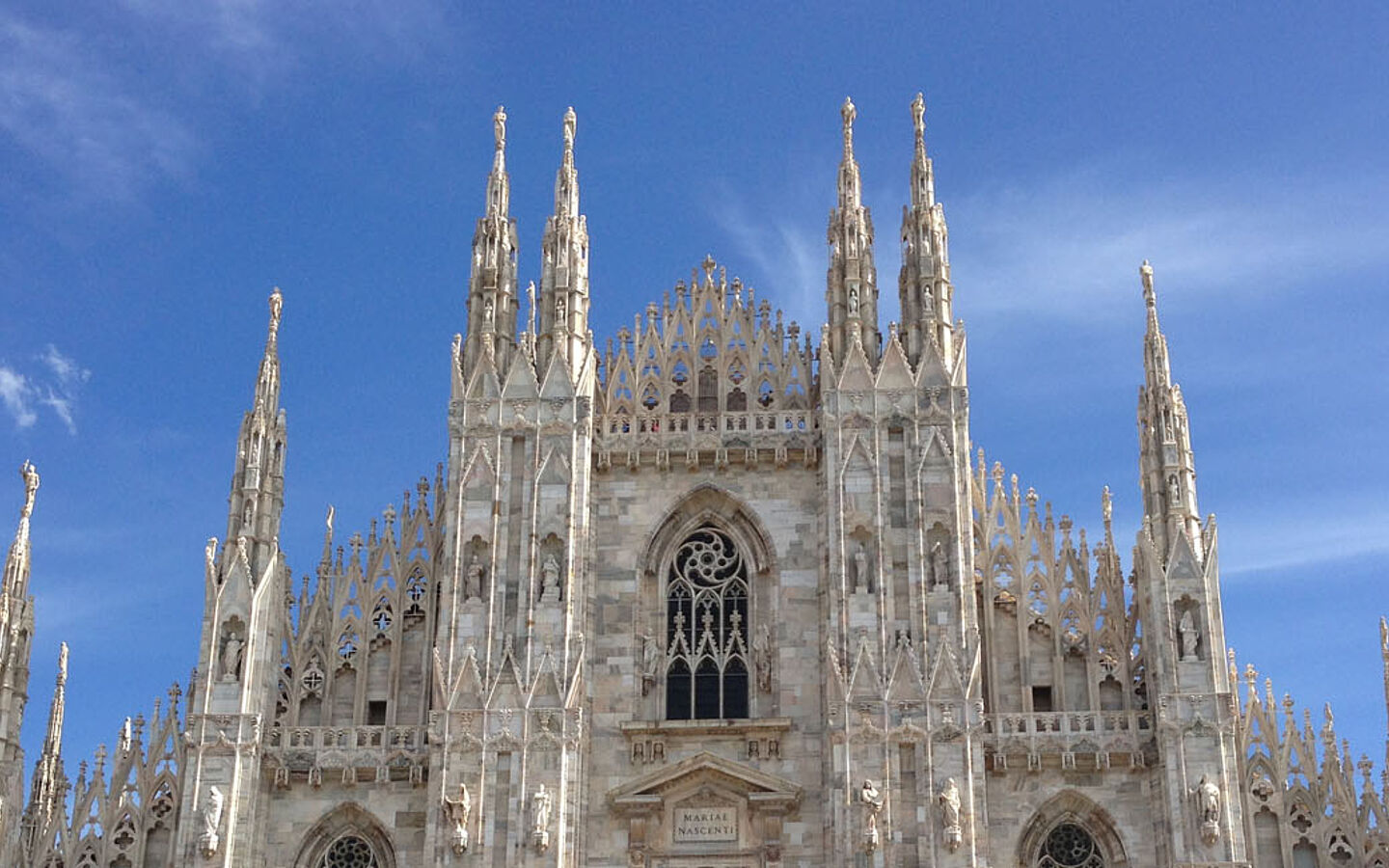
It is sometimes forgotten that Milan has had a long and rich cultural history since Roman times. In the 14th century, it became one of the leading centers of the Italian Renaissance under the Sforza dynasty, the builders of the famous Castello Sforzesco. The cathedral - described by Goethe as a "marble mountain", its construction was begun in the Gothic period and took around 4 centuries - today dominates the entire center as a monumental masterpiece of Italian Gothic architecture. When the façade appears gleaming white again, it fills the Milanese with pride, because they love their cathedral about as much as they love the aperitivo, the hours between 6 p.m. and dinner, when people meet after work in all the city's bars for a glass of wine or prosecco and are served small Italian delicacies - free of charge.
The fact that a church and a lifestyle ritual are equally popular shows the flexibility with which the locals effortlessly build bridges between tradition and daily pleasure. Thanks to the Austrian Empress Maria Theresa, the Milanese have the world-famous Pinacoteca de Brera in the artists' quarter of the same name, where you can view paintings by Tintoretto, Caravaggio and Hayez between a stroll through the boutiques, a visit to the furniture design and antique shops and a cappuccino break.
The classical building of Milan's La Scala was also completed under the Habsburgs; it opened in 1778 with an opera by Salieri and was completely renovated in 2004. Today, it is still a mecca for music fans from all over the world, which means that famous conductors and singers consider the grand hotels Principe di Savoia, Grand Hotel et de Milan or trendy designer hotels such as the Bulgari, Four Seasons or Park Hyatt as their "home away from home", depending on their taste. There are also small but fine and very original design hotels such as the Hotel Straf, the Sina the Gray diagonally opposite or the 3Rooms, a three-suite hotel in the well-known lifestyle concept store 10 Corso Como.
Milan is also popular as a stronghold for hotels, which prefer to be located in old palazzi with the latest design. Such as the W Hotel by Starwood (renovation work until 2018), the Sheraton Malpensa or the hotel by Armani, who used it to expand his gigantic 6,000 m2 emporium on Via Manzoni.
Just as effortlessly as the Milanese master the balancing act between art and commerce, they also manage to combine lifestyle and business: Whether wearing the latest fashion, cutting-edge furniture or suits and costumes with natural elegance and paying as much for a designer chair as for an expensive objet d'art. Financial managers, society ladies and creative people from the worlds of fashion and design form an interesting, affluent clientele that dominates the city's restaurant scene at lunchtime and in the evening.
Here, the spectrum ranges from the traditional trattoria on the corner to the purist, avant-garde design of Trussardi alla Scala. The place for all those who want to see and be seen is strategically located between the city's living room, the lively Piazza del Duomo with its surrounding bustling street canyons, and the Golden Quadrilateral, the center of the shopping vanity between Via Montenapoleone, Via della Spiga, Via Sant'Andrea and Via Manzoni, where the shop windows themselves are works of art and all the fashion designers from Alaia to Prada show today in their latest collections what will be fashionable tomorrow.
Between the cathedral and the fashion district lies the shopping temple of the Belle Epoque, the glass-roofed Galleria Vittorio Emanuele, which guarantees a good mood even in bad weather. Here, the high heels of Jimmy Choo and Manolo Blahnik clatter on antique marble floors, people meet in the Gucci Café, in La Zucca, the birthplace of Campari, or at Savini.
Claudia Bette-Wenngatz (2007) updated 2017
Milan may be stingy with beauty at first glance, but the northern Italian fashion and trade fair city is elegant and lively on closer inspection. A creative fashion, design and lifestyle scene, luxurious hotels and restaurants, magnificent gardens and courtyards - not forgetting the cathedral, a masterpiece of Italian Gothic architecture.
! Photo: © Britta Lüdecke / pixelio.de!
Highlights
Connoisseur special tip:
The most extraordinary slow shopping experience Milan has to offer: 10 Corso Como. A multifunctional space - designed by trendsetter Carla Sozzani - an exciting mix of hotel, gallery, café, bookshop, music store and bar. Away from the fashion stars, it is home to an exquisite luxury range of "no-name labels", which has rightly been elevated to the ultimate "must-see" by the global design and lifestyle scene. Unfortunately, or rather fortunately, 10 Corso Como is a little out of the way, but well worth a visit.
10 Corso Como, 20154 Milan
Tel.: +39/02 65 48 31
www.10corsocomo.com
DIPLOMATIC MISSIONS
in Germany
Embassy of Italy
Hiroshimastraße 1-7, 10785 Berlin
Phone: +49 30 254400
Fax: +49 30 25440116
E-mail: segreteria.berlino@esteri.it
www.botschaft-konsulat.com
in Austria
Italian Embassy
Rennweg 27, 1030 Vienna
Phone: +43 1 7125121
Fax: +43 1 7139719
www.ambvienna.esteri.it/ambasciata_vienna
for Switzerland
Italian Embassy
Elfenstrasse 14, 3006 Berne
Phone: +41 31 3500777
Fax: +41 31 3500711
E-mail: ambasciata@ambitalia.ch
www.ambberna.esteri.it
Location
Italien
Area
301 338 km² (Mailand 182 km²)
Population
59.8 million
Language
Italian
Capital city
Milan (1.3 million inhabitants)
Religion
Roman Catholic
Weather
Very warm in summer, cold in winter - it can snow heavily. Fog and smog are the order of the day.
Best time to travel
May and June and September
Climate
| Jan | Feb | Mar | Apr | May | Jun | Jul | Aug | Sep | Oct | Nov | Dec | |
| Max. Temperature | 4 | 8 | 13 | 19 | 23 | 28 | 30 | 29 | 23 | 17 | 10 | 5 |
| Min. Temperature | -2 | 0 | 4 | 8 | 12 | 16 | 18 | 11 | 14 | 9 | 4 | 0 |
| Hours of Sunshine | 2 | 3 | 4 | 6 | 7 | 7 | 9 | 8 | 6 | 4 | 2 | 1 |
| Rainy days | 7 | 5 | 7 | 9 | 10 | 7 | 5 | 5 | 6 | 8 | 8 | 7 |
Time difference (to MEZ)
Mitteleuropäische Zeit (MEZ) mit europäischer Sommerzeit (kein Zeitunterschied).
Currency
Euro
Visa
Residents of EU countries can stay for an unlimited period without a visa. A valid passport is required, for a stay of up to 3 months a valid identity card is also sufficient. Information without guarantee. For more information, please contact your embassy.
Vaccinations
none
Food in Milan - for fashion gourmets
Fashion is not only in the air in Milan, but also on the plate.
Italians like to take their time to eat in order to enjoy the wide variety of dishes. The variety of regional
delicacies is what makes Italian cuisine so unique. Excellent wines,
tasty Prosecco, sparkling mineral water and high-proof grappa.
The
Italian cuisine consists not only of pasta and pizza - although both are
both are excellently prepared - but depending on the region, you can indulge in
delicacies such as truffles, prosciutto, sheep's cheese or porcini mushroom dishes.
can be enjoyed. Places that are located directly by the sea in particular offer fresh fish and mussels
mussels deliciously prepared. The secret formula for the preparation of Italian specialties probably lies in the
freshly harvested ingredients and a delicious wine accompaniment.
Sightseeing in Milan - much more than just a fashion metropolis Whoever comes to Milan doesn't usually come for the sights or the cultural highlights.
sights or because of the cultural highlights. Yet
Milan has a lot of museums and
world-famous exhibitions. At the latest since Dan Brown's
bestseller, everyone knows "The Last Supper " , by Leonardo Da Vinci, which adorns a wall in the Dominican monastery of Santa Maria delle Grazie.
You can either walk from one sight to the next, which in the case of
Milan, which is ideal as most of the sights are grouped around the
sights are grouped around the cathedral in the
cathedral in the city center. Or you can get an overview of Milan
Milan's sights by taking one of these hop-on hop-off buses through Milan.
Milan on one of these hop-on hop-off buses. These are usually red double-decker buses that travel through tourist towns past the most popular sights. With a day ticket you can
ride and hop off as often as you like.
Shopping in Milan - The best
best shopping addresses
Milan offers excellent shopping opportunities for both small and large purses. On the many shopping streets
and shopping centers you will find both inexpensive mass-produced goods and trendy
trendy designer stores - the many weekly markets tempt you to
stroll and dream.
In the famous Via Montenapoleone, all the big - and above all Italian - designers are lined up door to door from number 1 to 27. The alleyways all around (the Quadrilatero fashion district) are also worth an extended luxury shopping visit, as are the fashion centers around Via della Spiga, Via Sant'Andrea, Via Gesí and Via Santo Spirito. Milan is by far the most fashionable and chic of all Italian cities.
Hotels

![[Translate to en:] AMADEUS Riva (c) Lüftner Cruises](/fileadmin/_processed_/d/e/csm_AMADEUS_Riva_ebdf4c2c55.jpg "[Translate to en:] AMADEUS Riva (c) Lüftner Cruises")







































![[Translate to en:] AMADEUS Riva (c) Lüftner Cruises](/fileadmin/_processed_/d/e/csm_AMADEUS_Riva_64c1995e26.jpg "[Translate to en:] AMADEUS Riva (c) Lüftner Cruises")