


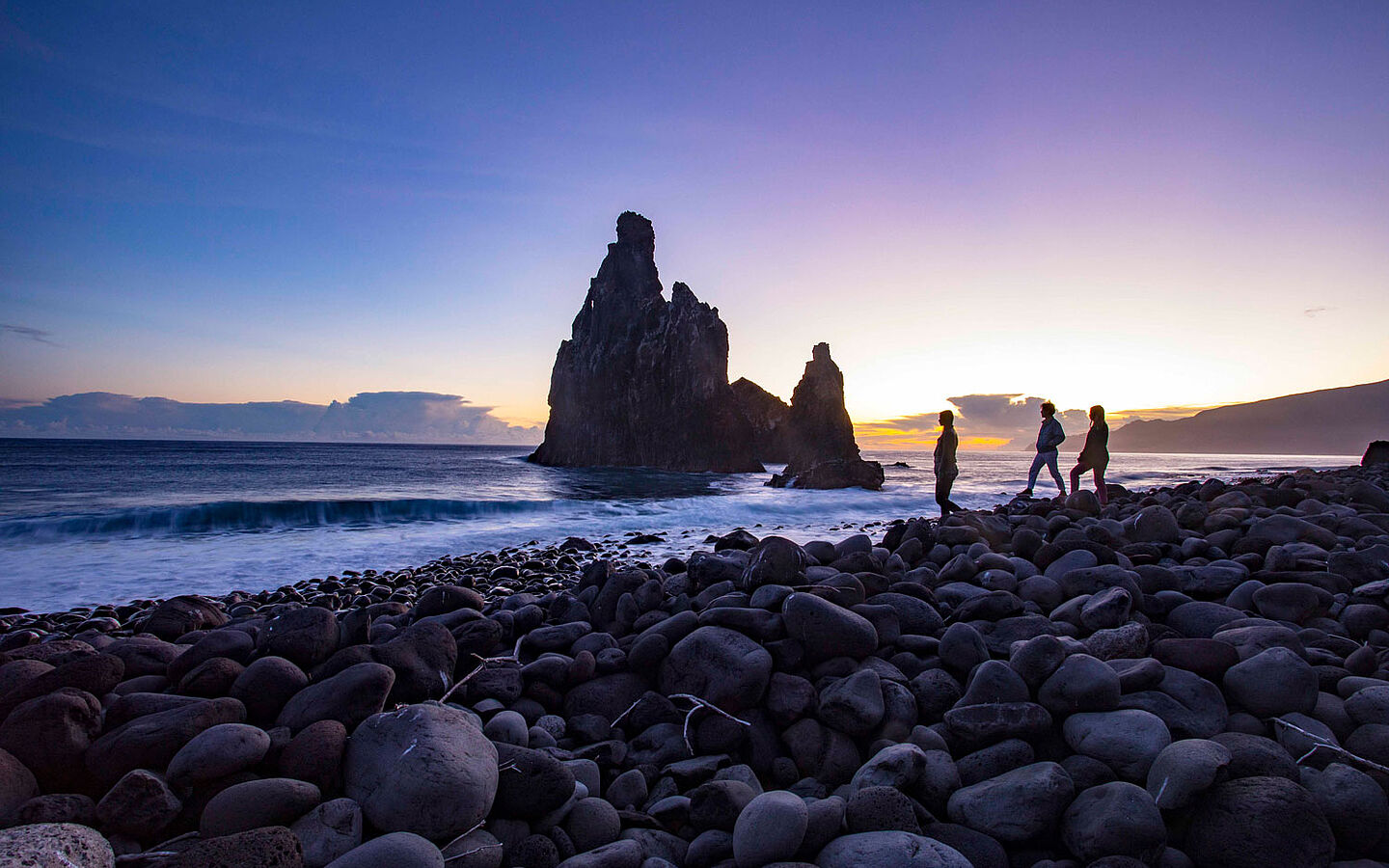
Madeira
As we all know, all good things come in threes. On Madeira, this also applies to the number of possible landings at Cristiano Ronaldo Airport. Treacherous shear winds - often just as stormy as the soccer god and namesake of the airport himself - sometimes require courageous take-off maneuvers. If there is still no balmy breeze blowing down from the mountains on the third attempt, it is usually a case of diverting to Porto Santo, Tenerife or Marrakesh and waiting for better weather there. But today everything goes well. After a final long right turn directly off the coast, our TAP Airbus descends gently and confidently towards the runway. The best place to toast the successful arrival with a glass of champagne and a cup of tea? The terrace at Reid's Palace! Situated high above the port of Funchal, the fine art of afternoon high tea has been celebrated here since 1891. Silver trays with finely sliced cucumber sandwiches, artfully decorated pralines and sweet and salty scones with clotted cream and strawberry jam are then carried to the white-laid wicker tables. The whole thing is accompanied by a 24-item tea menu - and the aforementioned glass of champagne. The Queen would love it, and her favorite Prime Minister Winston Churchill was more than amused.
He came to Reid's several times to let the Atlantic sun shine on his Borsalino far away from the London winter. Other famous guests, whose portraits are scattered throughout the halls and hotel corridors, include George Bernhard Shaw, Charlie Chaplin and Empress Sisi, who even celebrated her birthday behind the pink walls of the hotel palace.
Although we have to do without her hundred-strong court, we still feel like royalty in our suite perched high above the palm tree tops of the hotel's own private garden and in William, the Reid's starred gourmet restaurant...
Funchal first
The first day belongs to the island's capital. That was the case on our first visit to Madeira many years ago - and nothing has changed since then: Check out the harbour basin to see which yacht owners on a transatlantic course have immortalized themselves with colourful pictures on the quay wall since our last visit. Sipping an espresso with a cinnamon stick instead of a sugar spoon on the elegant Avenida Arriaga. And, always a treat: try at least one island fruit in the market hall that you've never heard of before (this year's discovery: cherimoya, a winter fruit also known as "cinnamon apple", which tastes neither of cinnamon nor apple, but of pineapple and banana). There are rituals that are just as much a part of Madeira as the wine of the same name, which you can taste in vintage bottlings up to 50 years old in the Blandy's flagship store directly opposite the Jardim Municipal. Much younger is the street art that can be admired a few hundred meters away in the old fishermen's quarter. It was created as part of the reconstruction work following the major landslide in 2010.
At that time, Funchal's city government allowed anyone who could present a creative concept to paint one of the many wooden front doors. The result was an open-air gallery with around 200 works - from kitschy to truly artistic. The valley station of the cable car to Monte is located in the Jardim do Almirante Reis, where the old town meets the sea. The ride over Funchal's rooftops, gardens, alleyways and banana plantations takes 15 minutes. For those with a head for heights, this is a heavenly pleasure. For everyone else, we recommend taking a cab instead. Once at the top, it is worth visiting the Jardim Tropical Monte Palace, which is one of the ten most beautiful botanical gardens in the world and leads through the world of orchids, tree ferns, palms and climbing plants on winding and steep paths. Situated 600 meters above sea level and spoiled by sun, rain and fog in equal measure, you can practically watch the jungle greenery grow here. The 70,000 m2 site is also home to Portuguese tile paintings, African masks, Japanese pagodas, Chinese terracotta warriors and an Old English-style manor house. Did we mention that Funchal is also a great place to combat wanderlust?
An island like a Garden of Eden
On the drive from the south coast towards the northeast, the mountains get higher, the clouds thicker and the roads more winding. What remains unchanged, however, are the warm spring temperatures, which rarely allow the thermometer to make big jumps above or below the 20°C mark. Fruit and vegetables are harvested here all year round in small, terraced gardens, and wine also grows in this climate from the steep slopes high above the sea down to the pitch-black lava beach. In addition to the liqueur-like Madeira, distinctly independent red and white wines have also been produced on the north coast for a few years now. The winegrowers at Quinta do Barbusano are among the pioneers. At their winery in the hills above Sao Vicente, you can first take a guided tour through the vineyards and then enjoy a simple lunch accompanied by wine. The typical island espetadas (pieces of grilled beef on a bay branch skewer) are served with bolo do caco (warm sweet potato bread with garlic butter) and milho frito (deep-fried cornmeal cubes). Add a simple salad and you have a lunch that could hardly taste better and certainly couldn't be served in a more promising way.
Speaking of views: Quinta do Furao also has a view that takes your breath away. Situated on a vine-covered rocky plateau several hundred meters above the sea, the sun-yellow painted estate with its infinity pool among the vines reminds us a little of South Africa. We also like the Laidback Luxury, the country-chic ambience and the small spa area - above all, it makes the Quinta the perfect base for extended expeditions into the mountains and hikes along the levadas.
Water music for hikers
Around 1,300 of the stone canals flow through more than
2,000 kilometers in length across the entire island. It is an ingenious network of paths, some of which are more than 500 years old, which needs to be maintained so that everything really flows and nothing can clog or leak. Narrow riverside paths have been created along the levadas for this purpose. The levadeiros, full-time "guardians of the water", use them for their patrols. For us hikers, however, they serve as an "analog navigation system" that guides us safely across the island. Only where the water music of the levadas suddenly becomes louder and changes from major to minor, because waterfalls plunge into the depths or rocks block the path, is surefootedness required. PR9, one of the most spectacular levada hikes of all, begins very close to Quinta do Furao. From the parking lot near Queimadas (even the approach along a small road lined with wild hydrangeas and dense laurel forests is an experience!), it leads right into a steamy basin reminiscent of the jungle landscapes of South East Asia and ends directly in front of a 100-metre-high waterfall. No less varied: a tour from Ponta de São Lourenço to Porto da Cruz. If the starting point reminds you of Scotland's Highlands, the destination, a picture-book village by the sea, feels very Caribbean. Admittedly, this is not only due to all the palm trees and turquoise blue water, but also to the aguadente, the strong schnapps that is still produced here from local sugar cane, which is mixed with fresh lime, mandarin or passion fruit juice and sweetened with a wooden whisk of honey to make the national drink, poncha.
And then there is Madeira's central massif. If you want, you can reach it on foot after a climb through dense clouds and fragrant eucalyptus forests. If you don't want to, choose a rental car, which can also be used to reach the Pico di Arieiro. The third-highest mountain on the island measures 1,818 meters and, on a clear day, you can see as far as the neighbouring island of Porto Santo, 50 kilometers away. How much further do you think the waves of the monstrous radar sphere, which the Portuguese army has positioned next to the summit house, reach? Over to Africa? As far as the European mainland? Or perhaps even as far as America? It is only up here that it becomes clear how small Madeira actually is and how isolated it juts out of the Atlantic. In a winter like this, it may seem like the big, wide world to us, but in the end it remains this tiny and wonderful spot of forest green, colorful flowers and rocky grey in the endless Atlantic...
If the 1,818 meters of the Pico di Arieiro don't seem high enough, you can also set off from there to the Pico Ruivo. It lies at 1,862 meters and is the destination of a high alpine hike over narrow stairs, steep steps and stony, wire-secured paths, along which it sometimes descends vertically for several hundred meters on both sides. Behind every bend and every narrow tunnel on this eleven-kilometre tour is a new view that will take your breath away - with happiness and sometimes also with exhaustion and awe.
Built close to the water
Back on the north coast, we recommend at least a few refreshing laps in the natural pools of Porto Moniz or Seixal after such a tour. Some of the huge pools have been carved directly into the lava rock above the wild surf and guarantee safe bathing fun with a view of the meter-high waves. But because we don't just want to swim in pools and relax on hard rock, we plan a detour to Porto Santo for the next day (and the next night). The car ferry takes around 2.5 hours to reach Madeira's sun-drenched and sand-blessed little sister. It takes just 20 minutes by propeller plane. As the ferry only runs once a day this winter (there in the morning and back in the evening), we opt for a mix of both means of transportation: This way, we can enjoy the boat ride out of Funchal's harbor just in time for sunrise and then make the short hop back the next day after a delicious beach lunch.
From the "floating garden" to the "golden island"
As close as Madeira and Porto Santo are to each other (what's 50 kilometers when it's 20 times as far to the European mainland?), the climate on both islands is very different: at 517 meters, Porto Santo's highest mountain, the Pico do Facho, is anything but a (cloud) ripper. Rain is therefore rare. Instead, there is vain sunshine almost all year round. Perfect conditions for swimming in the Caribbean blue Atlantic and indulging in the sweet island life, even in winter. And this mostly takes place on the nine-kilometre-long dream beach Campo de Baixo, which stretches from the island's capital Vila Baleira towards the southwest. Due to its high calcite content, the glamorous golden sand here has
special thermal properties and healing powers. This makes it not only therapeutic, but also a good excuse to simply stay a little longer. There's not much to do on Porto Santo anyway - unless you're a golfer. A fairly challenging 18-hole course, which stretches almost right across the island, was built for golfers. If you want to get active, it's best to hop on a rental bike or horseback. Or lace up your hiking boots on Porto Santo to explore one of the smallest deserts in the world and the Terra Chã viewpoint with views over the whole island.
Our tip: A jeep safari also takes you to some of the most beautiful diving and snorkeling hotspots, which would be hard to find without four-wheel drive and local help. Accommodation on Porto Santo is mostly in smaller mid-range hotels, which often have excellent thalassotherapy facilities. Only two hotels in the Pestana Group offer luxury, but they are closed this winter. Before our departure - and the beach lunch - we prefer to pay a quick visit to the Columbus Museum in Vila Baleira. The navigator lived on Porto Santo with his wife for several years. Then the island became too small for him and his thirst for discovery too great. If he had known that the other side of the Atlantic would hardly look any different from his rustic stone house, he might simply have stayed at home ...
RESTAURANTE DO FORTE
Located in Funchal's old fortress, this restaurant offers upscale
cuisine and sea views from the
old embrasures. Tip:
A transfer in a 1934
Plymouth PE Deluxe with your booking.
www.forte.restaurant
DESIGN CENTER NINI
ANDRADE SILVA
On the quay wall of Funchal
tower with concept store,
exhibition space and the
DC Restaurant, which interprets Madeira's
Madeira's classics in a modern interpretation.
A must for lifestyle fans!
www.ninidesigncentre.com
WINE TOURS MADEIRA
The company offers
half-day and full-day tours
that take you to selected
restaurants, wine producers
and small delicatessens
shops. The groups are small,
the guides are extremely
competent.
www.winetoursmadeira.com
SHOPPING
BLANDY'S
A good address for the
famous Madeira wines in
Funchal. In its own museum
you can learn a lot of interesting facts
about production and storage.
Afterwards you can taste and
be bought.
www.blandys.com
UAUCACAU
Chocolatier Tony Fernandes
creates delicious pralines and chocolates
chocolates from ingredients
ingredients such as passion fruit,
sour cherry, poncha or
mango. In Funchal there are
two stores.
www.uaucacau.com
BORDAL
The address for the finest lace
from Madeira! Pretty store
in Funchal's Rua Dr. Fernão de Ornelas 177.
Ornelas 177 -- Best souvenir this winter
this winter: the lace-decorated face masks!
www.bordal.com
Hotels


![[Translate to en:] AMADEUS Riva (c) Lüftner Cruises](/fileadmin/_processed_/d/e/csm_AMADEUS_Riva_ebdf4c2c55.jpg "[Translate to en:] AMADEUS Riva (c) Lüftner Cruises")











































![[Translate to en:] AMADEUS Riva (c) Lüftner Cruises](/fileadmin/_processed_/d/e/csm_AMADEUS_Riva_64c1995e26.jpg "[Translate to en:] AMADEUS Riva (c) Lüftner Cruises")