


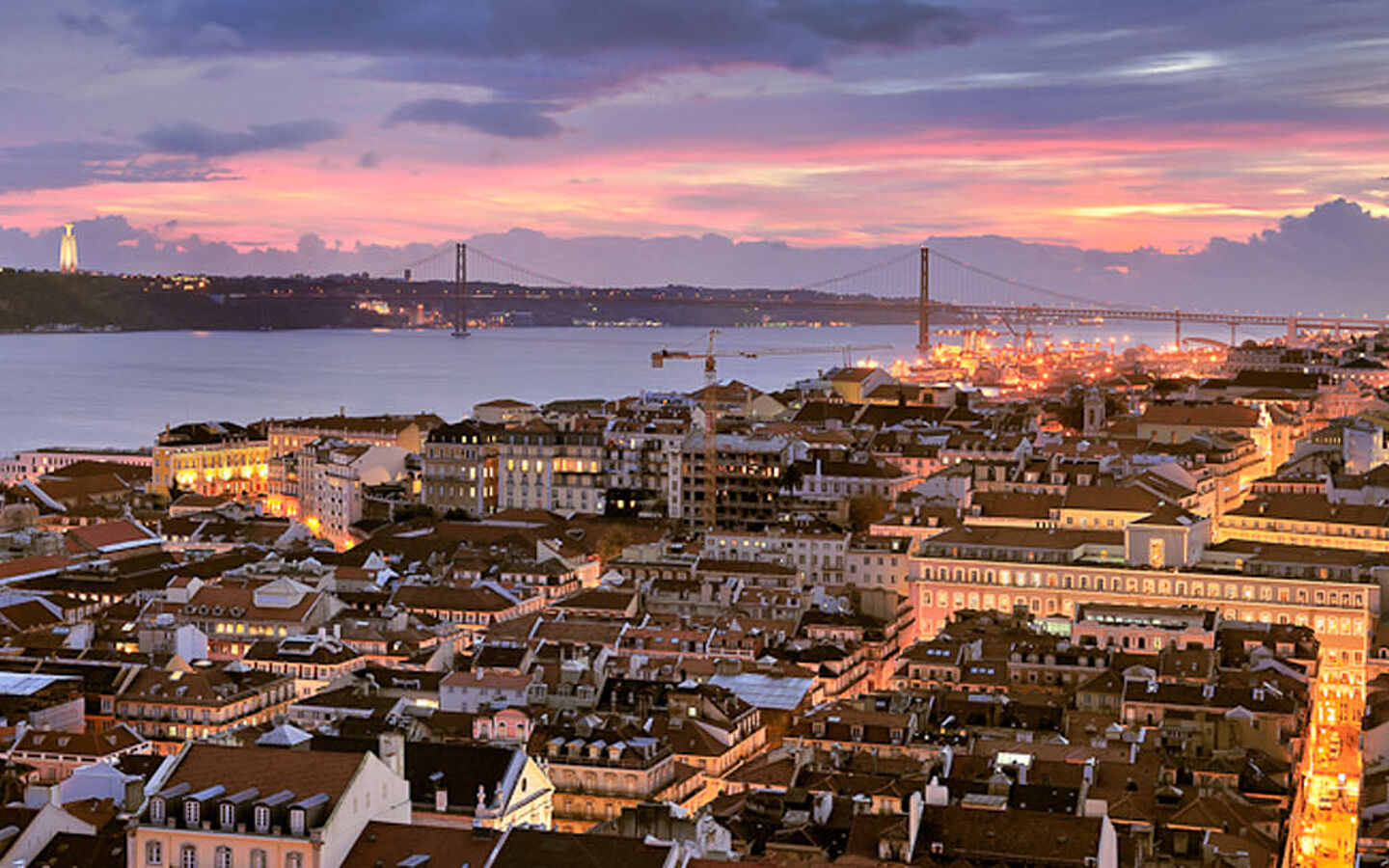
Lisbon
A city full of contrasts: sometimes elegant, sometimes dingy. A modern metropolis and yet also very old-fashioned. Sometimes cheerful, sad at the next corner, often melancholic. Cosmopolitan and open, a few streets away closed off like a village. Vibrant metropolis and tranquil pavement in one. But Lisbon is definitely romantic.
With its countless historic buildings, Portugal's capital is like a huge museum, even though modern, avant-garde architecture has long since found its way here. No wonder - its history dates back to long before the birth of Christ. And then there's that bright shimmer: the nearby Atlantic makes the city on the Rio Tejo shine in a particularly clear light during the day. This is why it is known as the white city.
Never lost in the maze
As Portugal's largest city with the most important port, the seat of government, the highest state and government authorities, six universities and the Academy of Sciences, Lisbon is the economic and cultural center of the country. Other European metropolises may be larger and more grandiose, but Lisbon has just under 600,000 inhabitants. But you never feel lost - even in the dense maze of alleyways in the old town. Most of the sights are easy and quick to find on foot or by bus and train. At the height of summer, when the Portuguese are on vacation, this gem shows its best side: the streets are pleasantly empty and there are hardly any traffic jams. Lisbon then shifts down a gear - the perfect time to succumb to the irresistible charm of the city with its many faces. In the east, for example, the medieval Castelo de São Jorge towers over the silhouette of the city. To the south, the Tagus with its ferries, ocean liners and sailing boats spreads out. In front of it are the Catedral Sé - Lisbon's oldest church - and the triumphal arch from 1873 on the Praça do Comércio. To the west, the Igreja do Carmo church nestles against the hillside. Almost at its feet, the magnificent Rossio square with its marble-white paving and large baroque fountains awaits amorous couples and strollers. Stores, cafés and small restaurants, from which the melancholy fado sounds every evening, are just a stone's throw away. Sip a bica (espresso) or a galao (latte) in peace and quiet, lean back, watch the bankers, lottery ticket sellers, shoe shiners and students - and you'll feel like a local. The heart of Lisbon beats on the Rossio. A few kilometers further on, in the suburb of Belém, the mighty Torre de Belém - another famous landmark - towers directly at the mouth of the Tagus. The watchtower was destroyed during the Napoleonic invasion and reconstructed in 1846. Like the nearby Mosteiro dos Jerónimos (Jerónimos Monastery), where the famous navigator Vasco da Gama is buried, it is now a Unesco World Heritage Site.
Eldorado for shoppers
The Elevador de Santa Justa, on the other hand, is a symbol of modern Lisbon. Built in 1902 by a student of Gustave Eiffel, the 45-metre-high cast-iron elevator connects the lower Baixa district with the elegant Chiado district higher up. A tiny open-air café beckons on its top platform - with live music and spectacular views of the bubbling city center, which is also an Eldorado for shoppers. Chic stores and hip designer boutiques can be found, for example, in the Baixa around the magnificent, black and white cobbled pedestrian street Rua Augusta. But even in the traditional entertainment district of Bairro Alto, the upper part of the city, there is nothing that is not there. Life comes to life there in the evening - people eat, party and dance outdoors. And the night is long. A ride on the Eléctrico 28 - the nostalgic streetcar with the yellow carriages rumbles through the entire city center at a leisurely pace - is of course a must for every Lisbon traveler. The warm breeze blows through the open windows as magnificent miradouros (viewpoints), magnificent churches and historic houses pass by. However, Lisbon is probably at its most authentic in the Alfama around the Castelo de São Jorge. Alfama is the oldest and probably the most romantic district of the city. The winding little people's quarter with its many stairs is home to countless crooked little houses and idyllic courtyards. Housewives in headscarves palaver across the narrow alleyways, the plaster crumbling from the centuries-old facades. In small bars, fresh sardines and delicious morcela, a type of black pudding, are cooked on charcoal grills.
Authentic cuisine
In general: Portuguese cuisine, although often misunderstood, is worth a trip in itself. It impresses less with variety and finesse than with freshness and authenticity. Freshly fried fish and seafood from the Atlantic on the doorstep are the best. Gourmet temples such as Gambrinus or Tavares also cater to haute cuisine lovers. Even in the accommodation sector - Portugal is not necessarily known for its top hotels - Lisbon has nothing to hide. The Four Seasons Ritz Lisboa or the Olissippo Lapa Palace, for example, are top hotels that leave nothing to be desired. They are ideal starting points for exploring the flair and unique rhythm of the city. All you need is good footwear - Lisbon is built on seven hills - and a warm summer breeze in the evening when you're sitting in an open-air café. Although the city is undoubtedly worth a visit all year round.
Heiko Reuter in December 2007 (updated 2017)
Lisbon's Golf Coast
The "Lisbon Golf Coast" has always had all the prerequisites for an outstanding golf region, even if the Algarve is considered a major competitor. This could now change, as the offer on this part of the coast is now just as attractive, but significantly cheaper. And with two awards at the IAGTO Awards 2016, the "Lisbon Golf Coast" was voted the best golf region in Europe by representatives of golf tour operators. There are 22 golf courses in Estoril and Sintra, on the Costa Azul and in Oeste, all of which stand out due to their scenic diversity and proximity to the capital city of Lisbon. It is above all the combination of golf and a city trip that is becoming increasingly popular with golfers. The quality of the golf courses is also confirmed by the fact that the Praia d'el Rey course in Çœbidos has been named the best golf resort in Europe. The course, designed by American Cabell B. Robinson, celebrated its tenth anniversary in 2008, while the associated Marriott hotel resort was only opened in 2005. Praia d'el Rey is only 50 kilometers from Lisbon and offers a fantastic backdrop for playing golf thanks to its proximity to the sea. From the blue coast to the wine country The Portuguese capital to the north, the white beaches of the Atlantic coast to the south and five fantastic golf courses as the icing on the cake. You should start here with the southernmost and most isolated of the courses, Troia - an 18-hole, par-72 links course that really tests your skills. Designed by Robert Trent Jones, the fairways are located on a karstic peninsula bordering a nature reserve. Despite the difficult course, the tranquillity here and the wild beauty of the surroundings are a joy to behold. The rustic-looking clubhouse with bar and restaurant was cleverly built between the pine trees and is friendly and inviting. Here you should also sample the gastronomic products of the region, which place particular emphasis on fresh fish and seafood.
The Aroeira - Clube de Campo de Portugal, considered by experts to be one of the best golf courses in Europe, is located just 20 minutes from the center of Lisbon near the Fonte da Telha in a favorable microclimate. Donald Steel has created a true championship course here on Aroreira I with six large lakes in a wonderful landscape. Aroeira I and II, both 18 holes (par 72), are excellently designed courses in a dense pine forest - a beautiful combination of tranquillity and golf. Not far from Troia , on the other side of the large bay of Lisbon, is one of the newest golf courses in the region - Quinta do Peru . It is nestled between the old castles of Sesimbra and Setubal and its difficult layout can be particularly frightening for golf beginners: the three opening holes - all par 5s - are tough, and it doesn't get any easier from there. In the Muscat wine country near Setubal, the region's newest course was built around a lot of water - the Montado . At least you can console yourself afterwards with the best wine from the barrel.
Sintra - World Heritage Site on the Atlantic
The romantic little town of Sintra is an incomparably paradisiacal place surrounded by mountains and forests bursting with palaces. With its palatial houses and centuries-old estates, the former royal seat has a summery, stately appearance. The Penha Palace, for example, is considered an outstanding example of Romanesque architecture and still exudes the flair of a royal residence to this day. It is a great place to play golf. We recommend the golf course Atlântico da Penha in the Sintra Mountains with its luxurious hotel, which used to be a monastery. The mountainous course, which offers wonderful and extensive panoramic views of the surrounding landscapes, the mountains and the sea, has already hosted various European Tour competitions.
Estoril- Golf between seaside resort and mountains
Estoril - fine sandy beaches, palm-lined avenues, magnificent villas, luxurious hotels and vibrant nightlife. Estoril is still the fashionable seaside resort of the Portuguese today. Long known as the destination of choice for royalty, billionaires, gambling addicts and Formula 1 aficionados, Estoril has now become a true vacation paradise for everyone, especially golfers. The oldest golf course - the Estoril Palacio Golf Course - was founded in 1945 and now offers 27 holes with the Estoril Sol. Long hitters have fewer chances here, as precision plays a greater role on the par 69 on uneven terrain with lots of trees and water. The same applies to the beautiful golf course at Belas , where the wind forces you to reconsider the natural direction of your shot. A few drives away from Cascais, in a gigantic pine grove, we find the Quinta da Marinha course, which stretches down to the beaches of Guincho Beach. Quinta da Marinha Golf is also a Robert Trent Jones product with every nook and cranny that is definitely worth playing. Also because there is a great five-star hotel and the venerable hunting lodge of the Portuguese kings is available to golfers as a clubhouse with bar and restaurant. Last but not least - the famous Penha Longa ! Founded in 1992, the course with its two courses "Atlantico" (18 holes) and "Mosteiro" (9 holes) has its roots in the foundations of a medieval castle. Mr. Trent Jones sr. has interwoven history and modern golf course architecture and created a golfing work of art that has been the venue for the Portuguese Open on several occasions. Actually a dream course, if the course wasn't too crowded and the 9th hole at the clubhouse. And - a cart is a must!
Elsa-Maria Honecker in December 2007 (updated 2017)
Portugal's metropolis of Lisbon is adorned with the irresistible charm of times gone by. At the same time, the pulse of the city beats with southern temperament.
! Photo: © www.clearlens-images.de/ pixelio.de!
DIPLOMATIC MISSIONS
in Germany
Portuguese Embassy
Zimmerstrasse 56, 10117 Berlin
Phone: +49 30 590063500
E-Mail: berlim@mne.pt
www.botschaftportugal.de
in Austria
Portuguese Embassy
Opernring 3, 1010 Vienna
Phone: +43 1 5867536
Fax: +43 1 586753699
E-mail: viena@mne.pt
www.botschaft-wien.com/portugiesische.html
for Switzerland
Portuguese Embassy
Weltpoststrasse 20, 3015 Bern
Phone: +41 31 3511773
Fax: +41 31 3514432
E-mail: sconsular.berna@mne.pt
www.botschaft-bern.com/portugiesische.html
Location
Portugal
Area
92 212 km² (Lissabon 100 km²)
Population
10.46 million
Capital city
Lisbon ( 530,847 inhabitants)
Religion
Roman Catholic
Weather
Lisbon has a short and mild winter, with temperatures rarely dropping below freezing. December to March is the coldest and rainiest time of year. The most sunshine can be found between May and October, but the cool Atlantic breeze means that evenings are sometimes cool in summer.
Best time to travel
May to October
Climate
| Jan | Feb | Mar | Apr | May | Jun | Jul | Aug | Sep | Oct | Nov | Dec | |
| Max. Temperature | 14 | 16 | 18 | 19 | 22 | 25 | 28 | 28 | 26 | 22 | 18 | 15 |
| Min. Temperature | 8 | 9 | 10 | 11 | 13 | 16 | 14 | 18 | 17 | 15 | 11 | 9 |
| Hours of Sunshine | 5 | 6 | 8 | 8 | 10 | 11 | 12 | 12 | 9 | 7 | 5 | 5 |
| Rainy days | 15 | 15 | 13 | 12 | 8 | 5 | 2 | 2 | 6 | 11 | 14 | 14 |
Time difference (to MEZ)
Mitteleuropäische Zeit (MEZ), Madeira MEZ –1, Azoren MEZ –2
Currency
Euro
Visa
Residents of EU countries can stay for an unlimited period without a visa. A valid passport is required, for a stay of up to 3 months a valid identity card is also sufficient. Information without guarantee. For more information, please contact your embassy.
Vaccinations
none
Food in Lisbon - simply refined
To this day, the prejudice that Portuguese cuisine is primitive and unimaginative persists. But this is no longer the case - in Lisbon you can sample the quality and finesse of local dishes in many good restaurants.
And even the dishes served in simple restaurants are often impressive: authentic local dishes with fresh ingredients. Incidentally, traditional cuisine is based on good home cooking using meat, fish, vegetables, rice and potatoes; stews and soups have always played a major role. Plenty of olive oil is used in the preparation. Anyone who has tried a sole from the charcoal grill or the famous morcela (fried black pudding) in one of the many small restaurants in the historic Alfama district will probably no longer long for a gourmet temple. And if you do - here is a selection of the best addresses in the city.
Casa da Comida (Travessa das Amoreiras 1, tel.: +351 213 860 889): Right in the heart of the city lies this first-class restaurant, whose origins date back to the 18th century. Owner Jorge Vale celebrates traditional Portuguese dishes. The extensive menu includes salted cod baked in olive oil and garlic, boiled pheasant in a red wine sauce and fresh foie gras with apple. €€€
Clube de Fado (Rua S. João da Praça 86-94, tel.: +351 218 8852704): A 300-year-old building is home to this wonderful fado house. Guests can indulge in the magical atmosphere to the melancholy sounds of traditional Portuguese dishes. €€
A Travessa (Travessa Convento das Bernardas 12, Tel.: +351 213 940800): This restaurant run by a Portuguese-Belgian couple is located in a former Cistercian monastery. They devote themselves entirely to Belgian cuisine and create specialties such as skate au beurre noir, tuna steaks or deep-fried mullet. On Saturday evenings, only mussels are on the menu. €€€
Fidalgo (Rua Barroca 27, tel.: +351 213 422900): inexpensive, family-owned restaurant. Portuguese specialties such as grouper casserole, octopus with bean rice, fillet steak with cheese or sautéed pork kidneys are served. There are also over 120 wines on offer, some of which are among the best in Portugal. €€
Gambrinus (Rua das Portas de Santo Antao 23, tel.: +351 213 421466): a Lisbon institution. The décor dates back to the 1960s and includes gems such as porcelain from the East India Company and tables and chairs made of Portuguese wood and leather. The cuisine is traditional Portuguese with many fish and seafood dishes. The wine list includes over 300 fine wines. €€
Tavares Rico (Rua da Misericordia 35, tel.: +351 213 421112): one of the oldest and finest gourmet restaurants in Lisbon with Portuguese cuisine. Its interior
with carved and gilded wood, mirrors and candlesticks exudes the opulent charm of a baroque sacristy. Lighter fare, especially cakes, is offered next door in the tearoom. €€€
Sightseeing in Lisbon - Our recommendations Lisbon is located on the Tagus and is one of the oldest cities in Europe.
In the 15th and 16th centuries, Lisbon was the gateway to the world and the starting point
numerous voyages of discovery. During this time, the so-called
Manueline style was developed, the best example of which can be seen today in
Belém, the westernmost district of Lisbon.
The Alfama district is particularly charming.
Lisbon is rich
monuments from its eventful history. These include the
Jerónimos Monastery, the Belém Tower, the Monument to the Discoveries and the
a tribute to the age of the great seafarers, the Comércio square
Comércio, São Jorge Castle and the entire Baixa Pombalina.
Shopping in Lisbon - variety in every respect
Time and again you will find nostalgic shops or traditional stores that seem to have been left untouched by time: for example antique dealers, milliners or bespoke tailors. If you just want to take a stroll or are looking for a new outfit, the Baixa, Lisbon's lower town, is the place to be. The pedestrian zone is a real shopping paradise. If you're looking for something a little more expensive, then the sophisticated Chiado shopping district with its designer boutiques is the place to be. Subway: Baixa-Chiado. In the upper town of Bairro Alto, on the other hand, you will find lots of quirky stores with funky fashion or fun accessories.
Hotels


![[Translate to en:] AMADEUS Riva (c) Lüftner Cruises](/fileadmin/_processed_/d/e/csm_AMADEUS_Riva_ebdf4c2c55.jpg "[Translate to en:] AMADEUS Riva (c) Lüftner Cruises")














































![[Translate to en:] AMADEUS Riva (c) Lüftner Cruises](/fileadmin/_processed_/d/e/csm_AMADEUS_Riva_64c1995e26.jpg "[Translate to en:] AMADEUS Riva (c) Lüftner Cruises")