


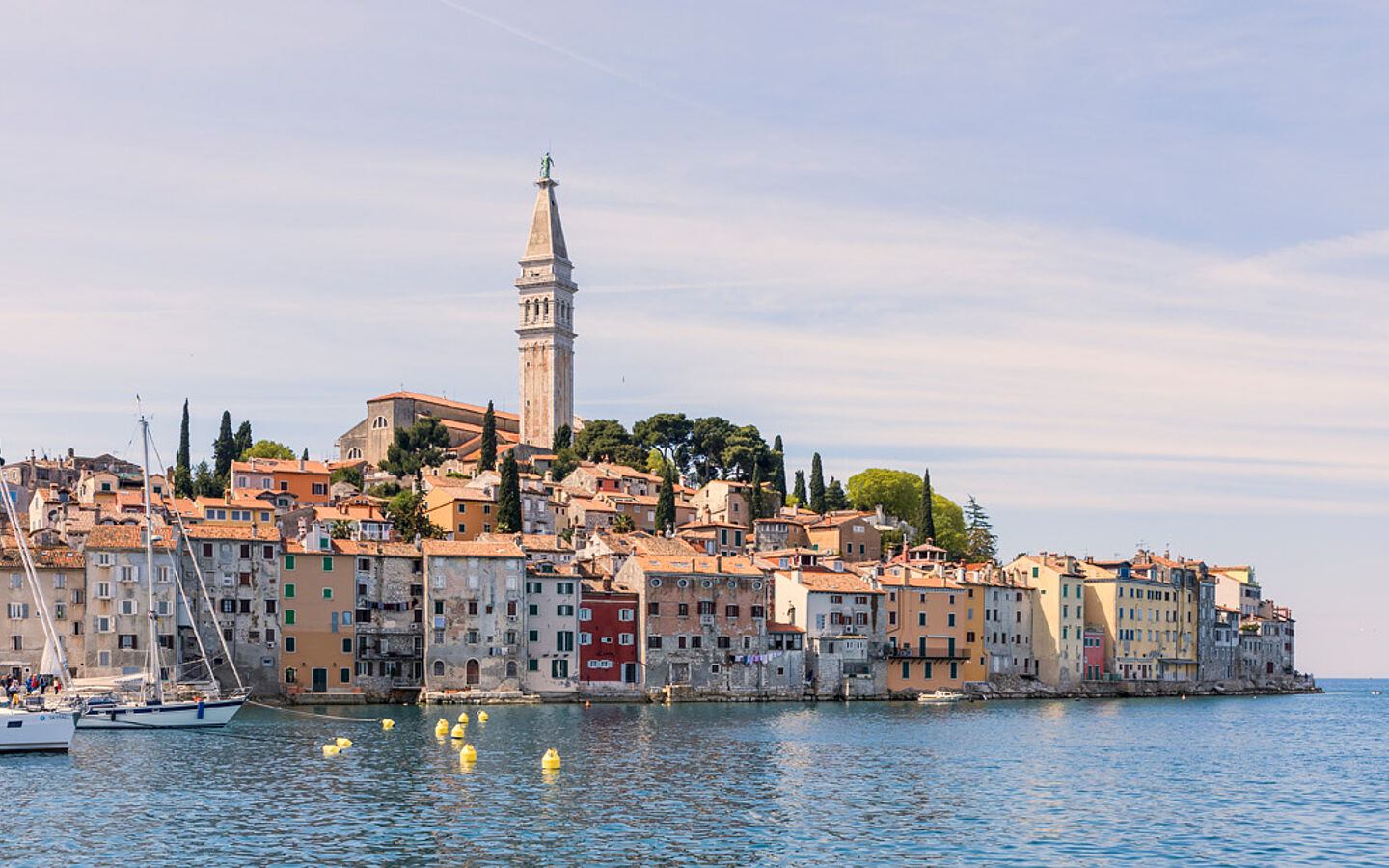
Istria
The artist Jeff Koons recently said in SZ-Magazin: "For me, a glass is neither half full nor half empty. Life is a well-filled glass into which I dip a spoon." The Croats in Istria and on the islands of Kvarner Bay seem to take a similar motto to heart. Relaxed and fun-loving, open and warm. Hospitable anyway. Every time I shake hands to say goodbye, be it to the patron of the restaurant or the winemaker after tasting truffles or olive oil, I feel as if I am leaving a friend. The well-filled glass could also symbolize land and sea. Richly endowed, people make the best of it with care - namely quality products. Admittedly, this came as a surprise. On the one hand, the region's reputation as a culinary Valhalla is still fragile, and on the other hand, I don't necessarily remember the local food from previous trips to Yugoslavia as exciting. Only the names have stuck in my mind, because they fizz like opening a beer can: Ćevapčići ("Schevabschitschi") and Ražnjići ("Raschnitschi"). Minced meat rolls and meat skewers are probably not completely extinct as national dishes. However, modern chefs are using their talents to create more sophisticated and varied dishes.
Search for the white gold
Let's start with truffles, or more precisely, the aromatic white ones. They thrive in the forests of Istria in high quality, which is why some of the treasures are bought up by Italians and marketed under the regional name Alba. Daniela Puh, the charming owner of natura tartufi, tells me that up until the 1930s, truffles were considered dog food at best. That only changed when truffle hunters from neighboring countries suddenly appeared. "People were surprised that, like the poachers, they didn't carry a gun and so they got talking." As soon as the value of the white gold was recognized, business took off. "My father smuggled the truffles across the border." Daniela is now the fourth generation to hold a truffle hunting license and has been scouring the surrounding forests since she was a child. Hardly any secrets are kept about where truffles are found. On the contrary, anyone interested can join in the search and follow the sniffer dogs. Of course, you have to be very careful when digging up the tubers so as not to damage them. If you do, its aroma evaporates and it loses its value and taste. The subsequent meal in natura tartufi's modern showroom is a kind of finder's reward for those who follow. The highlight is the buttery scrambled eggs with generous dabs of the little natural wonder. Truffles are available most of the year. Which explains why they spice up at least one dish in tasting menus in late spring. "But of course we find the best ones in the fall," says Daniela. Chefs heap large portions of spring truffles onto plates - at Konoba Čok, for example, one of the best fish restaurants in Istria. The fragrant giant shreds cover three crispy prawns so that only the tail end peeks out from underneath. Meanwhile, fresh wild asparagus, another seasonal specialty, was stirred into the delicious risotto with scallops. And I learn something else about Istrian gourmet gastronomy here: the decor may be simple, but the olive oil on the table is always of premium quality.
Aromatic olive oil
The fine oil has one drawback. It tastes so wonderfully aromatic that you don't just dip a slice of bread in it, but empty the whole basket before you even get started. This prelude creates an expectant mood, as it reveals the enthusiasm with which local produce is served even before the meal begins. In top restaurants, guests are even offered four types of olive oil. They have different tastes, with fruity, grassy, nutty, savory or peppery notes and always leave the palate slightly tingling. "If an extra virgin olive oil is not characterized by a certain spiciness when tasted, it is adulterated," says Tedi Chiavalon, owner of the production facility of the same name. Quite legally, as he explains, because EU laws permit the sub-mixing of inferior oils in the first quality class. Chiavalon oils, however, come exclusively from his own farm and are produced according to organic guidelines. I literally see liquid gold with a greenish tinge trickling into a flat tasting glass. "Put your hand on the opening and give it a quick shake," says Tedi. The bouquet that unfolds smells intensely of many different notes. It is not for nothing that Chiavalon's "Ex Albis" oil is one of the best in the world. The award goes back to the Flos Olei, the Michelin Guide of the industry. The olive oil bible also ranked Istria first as a production region in 2016 and 2017. Ahead of Tuscany! This is not least thanks to Tedi's younger brother Sandi. He is considered a pioneer of the quality-enhancing early harvest. Shaped like the tip of a lance, the Istrian peninsula is all about the number three. Three corners, three rivers, three quality products. Apart from truffles and olive oil, wine is one of them. Some of the finest wines in the region, from the Kozlović, Roxanich and Benvenuti wineries, accompany my menu at Monte, the only Michelin-starred restaurant in the province, run by chef Danijel Ekić and his Dutch wife Tjitske. You need a good head for heights and a sense of direction to find the pretty restaurant on the old town hill of Rovinj. The ascent through the charming alleyways whets the appetite. The "Amuse" menu consists of eight courses. The ingredients come from the region. Like beet, wafer-thinly sliced and wrapped around a delicate cube of tuna. Or monkfish flanked by a squid roe chain floating on black rice and sea foam. Suckling pig with lentils and brawn is also a pure delight. Cooked sous vide for 24 hours, the meat tastes intense and melts in the mouth. The wonderful olive oil on the table comes from the restaurant's own production, says the attractive hostess. And Tjitske reveals something else. "We freeze the fresh oil in small portions at -18°Celsius to use it thawed in the spring." Amazing, because the color and aroma are still very strong. "But don't tell anyone." Well, yes.
TEXT: KIKI BARON
Location
Halbinsel an der nördlichen Adria zwischen dem Golf von Triest und der Kvarner-Bucht vor Rijeka
Area
2.813 km²
Population
208.000
Language
Croatian and Italian
Arrival
■ Getting there: Depending on the starting point and season, there are flight connections to Pula, Rijeka and Zagreb.
■ Rental car: e.g. Sunnycars, www.sunnycars.de
■ Taxi boat: In the harbors you can take small motorboats to wonderfully secluded beach bays.
■ Bike & Boat: Istria and its charming harbor towns as well as the islands of Kvarner Bay are ideal regions for bike tours. Service partner for this is the agency "Inselhüpfen". It offers rides on 7-day trips on ships from its own fleet as well as full charters in the luxury class. You can choose from a wide range of the latest steel bikes, including e-bikes and e-mountain bikes. Tailor-made tours with a guide can be arranged on request. Ideal: if you cycle to the restaurant, you can be picked up again on four wheels after a meal and a drink. www.inselhuepfen.de
Largest city
Pula
Restaurants
■ Draga di Lovrana, Lovrana
The top cuisine of chef Deni Srdoc is paired with spectacular views of the forest and sea. A handful of stylish rooms are also available.
■ Monte, Rovinj
Everything from the local soil and sea is turned into creative dishes in this Michelin-starred restaurant. Danijel Dekic is also Croatia's GaultMillau chef 2017.
■ Spinnaker, Porec
Innovative Adriatic cuisine and regional wines turn a dinner at the harbour into a culinary delight.
■ Johnson, Mošcenicka
Draga
Initiates know: This small fishing village is home to the best scampi in Kvarner Bay. www.johnson.hrbr />■ Viking, Kanfanar
Pilgrimage site for oyster fans: the hotel's own farm is right on the doorstep in the flawless fjord.
Limski Kanal 1, Kanfanar,
T +38 552 448 119
Konobas (family-run
taverns), bars
■ Astarea, Brtonigla
Unspectacular from the outside, very cozy inside.
Fresh fish and meat sizzle on the open fireplace. www.konoba-astarea-
brtonigla.com
■ Konoba Cok, Novigrad
Simple, but oho. The finest fish and seafood dishes are served here. Delicious: octopus salad and sea bream. Ul. Sv. Antona 2, Novigrad,
T +38 552 757 643
■ Damir & Ornella, Novigrad
A cult address for Adriatic sashimi for years, the daily fresh catch is filleted right in front of your eyes. Nothing works without a reservation.
■ Stari Podrum, Momjan
Homemade pasta with truffles, Boškarin beef steaks and hearty soups are among the specialties.
■ Mondo, Motovun
Enchanting medieval village, rustic tavern. Truffles are generously heaped on carpaccio, tagliatelle and polenta. Barbacan 1, Motovun,
T + 38 552 681 791
■ Mediterraneo, Rovinj
A narrow corridor in the old town leads to the cozy terrace bar right down by the water. Sv.Križa 24,
T +38 591 532 8357 (mobile)
■ Spacio Grota, Rovinj
Sociable wine and cocktail bar right by the green market. And a prosciutto sandwich with your drink. Gradska tržnica, Rovinj,
T +38 598 85 4951 (mobile)
■ Rigo, Novigrad
A cheerful wine bar in a baroque palazzo. Ul. Velika 5,
T +38 552 758 681
Shopping
■ Chiavalon, Vodnjan
Top oil mill with tastings (reservation required) in a modern showroom. Top olive oil: "Ex Albis"
■ Natura Tartufi, Buzet
Truffle hunting, tasting and a wide range of truffle products from their own production
■ Albert & Nikola Benvenuti, Motovun
With numerous awards for their wines: you should definitely try those from the Teran grape variety.
■ Kozlovic, Buje
In one of the best wineries in Istria, the showroom impresses with its design ambience and dream view.
■ Roxanich, Kosinožici near Nova Vas
The famous winery is known above all for its orange wines, which mature on the skins in old wooden barrels.
Hotels





![[Translate to en:] AMADEUS Riva (c) Lüftner Cruises](/fileadmin/_processed_/d/e/csm_AMADEUS_Riva_ebdf4c2c55.jpg "[Translate to en:] AMADEUS Riva (c) Lüftner Cruises")

















































![[Translate to en:] AMADEUS Riva (c) Lüftner Cruises](/fileadmin/_processed_/d/e/csm_AMADEUS_Riva_64c1995e26.jpg "[Translate to en:] AMADEUS Riva (c) Lüftner Cruises")