


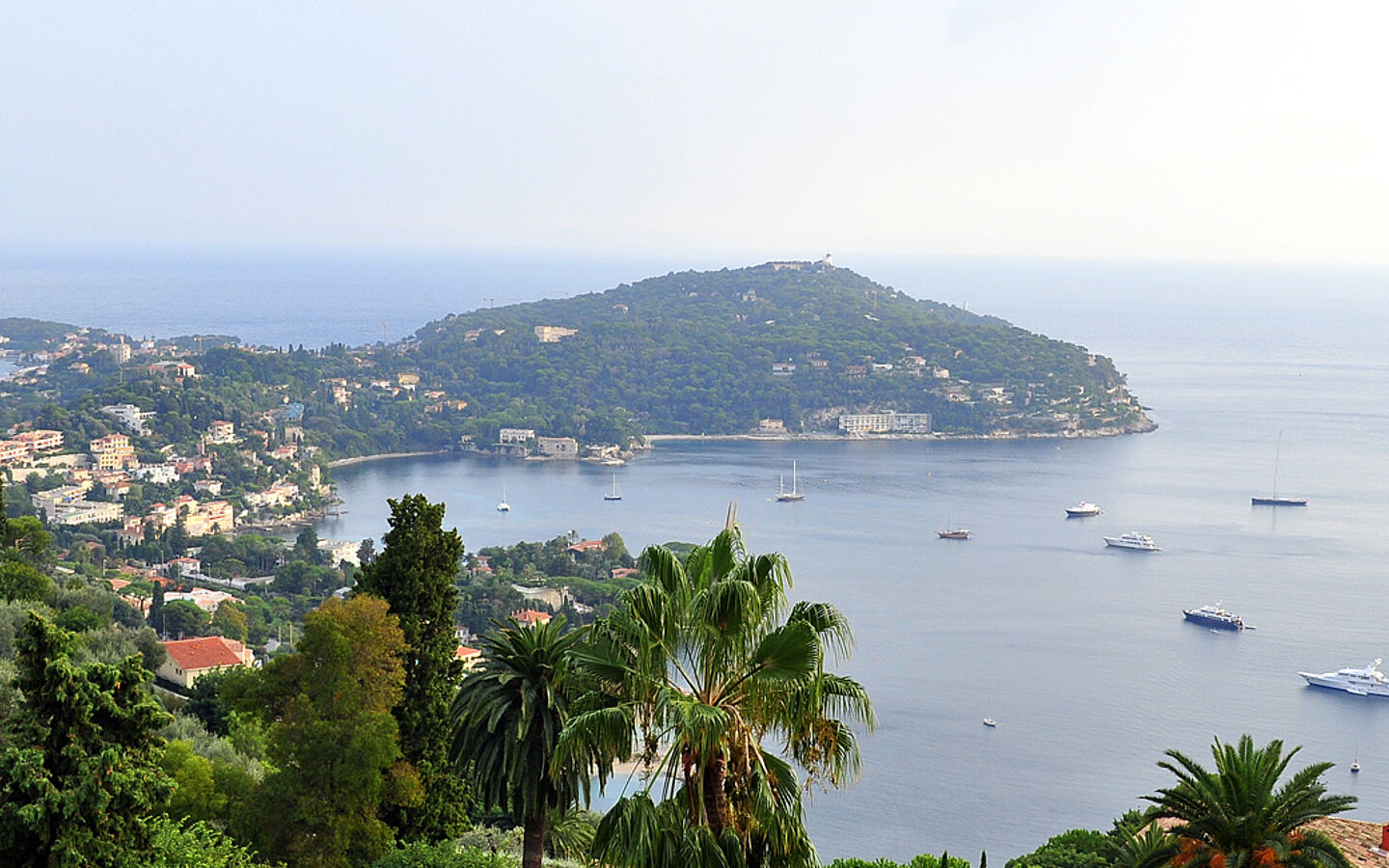
Côte d'Azur
Idyllic mountain villages near sophisticated coastal towns - the Côte d'Azur combines exceptional scenic charm with urban noblesse. Saint-Tropez, Cannes, Antibes and Nice, for example, shine like a string of pearls - star all around. Guests are increasingly finding the antechamber to paradise in the charming hinterland of the "blue coast". Hidden gourmet temples ensure discretion there.
Luxury and glamor on the coast
Tranquil peace in the hilly hinterland. Nostalgia is one of those things. Provence has also long since been discovered by tourism. But they still exist, the villages and hamlets in the hinterland of the Côte d'Azur, where men play boules in the shade of plane trees and dogs and cats loll around yawning in the sun. There is nothing better than sitting on the church square in Fayence with an ice-cold rosé and "Regarder la vie passer", watching the people strolling by - a wonderful pleasure, as is strolling through the small Provençal markets, which intoxicate the senses with their colors and scents. Between the purple fields of lavender, endless avenues of cypresses, shimmering silver olive groves and hills bathed in magical light, visitors repeatedly come across evidence that Monet, Matisse or Renoir, for example, succumbed to the visual charms of Provence before them. Here you can experience for yourself why this region continues to fascinate and attract artists and well-traveled globetrotters alike. It's fun to immerse yourself in the picture-book landscape that smells of wild rosemary, sage and thyme. The hinterland of the world-famous Côte d'Azur now also boasts classy, stylish hotels, Michelin-starred restaurants for the ultimate culinary delights, fantastic golf courses and, of course, museums such as the Fondation Maeght (Saint-Paul-de-Vence), galleries and artists' studios. You can golf like God in France on the two spectacular 18-hole courses "Le Château" and "Le Riou" at the Terre Blanche Resort near Cannes. The view of the surrounding hills and the picturesque medieval mountain villages of Fayence, Tourrettes and Callian is simply magnificent. The famous village of Saint-Paul-de-Vence near Nice begins to glow in the evening light. It has always attracted numerous artists with its magical light. Even today, visitors come in droves. Especially in the summer months, they crowd through the narrow cobbled streets past dozens of galleries and small shops. Or try (usually in vain) to get a seat in the famous "La Colombe d'Or". Enjoy an entrecôte under a Picasso. The restaurant and small hotel is an institution that has been a meeting place for all the big names for decades. It all started with Paul Roux and his wife Baptistine, who renamed the dance hall "Chez Robinson" "Colombe d'Or" in 1931 and transformed it into a Provençal inn with three rooms and a huge terrace. First came painters, writers, artists, and later actors and directors. They came and went, met to work, but even more to celebrate themselves and life. Famous couples, such as Yves Montand and Simone Signoret, met and fell in love here. The art elite from Picasso to Miro, Matisse and Chagall to Yves Klein were among the regular customers, sometimes paying their bills with a painting and thus contributing to the hoteliers' extraordinary private art collection. Incidentally, Grasse - the undisputed center of perfume production - is just a few kilometers away.
Artists under the spell of light
Côte d'Azur - the epitome of glamor and luxury for more than 100 years and a popular meeting place for the international jet set. But its sound also resonates with the lavish splendor of the flora, its picturesque coastline, spanned by an eternally blue sky over sea and land. The genius behind the term "Côte d'Azur" was the poet Stephen Liégard in 1887, who thus gave the French Riviera, already popular with wealthy Britons and Russians, the ultimate image. Whether tsaresses, industrialists or Hollywood stars - "tout le monde riche" celebrates itself and the myth of the Côte d'Azur to this day. However, this region has also always cast a spell over artists. Fascinated by the extraordinary light, which makes colors glow so intensely, and the mild climate, the artistic productivity of painters such as Picasso, Renoir, Chagall and Matisse was inspired. "When I realized that I would now see this light every morning, I could hardly believe my luck." (Matisse after his move to the Côte)
And even today, the magic of the famous "blue coast" still exists, currently topping the list of the world's most exclusive residential regions. A house on the Côte d'
Azur or in the enchantingly idyllic hinterland of Provence has the aura of one of the most coveted status symbols of our time.
Rough building sins are rare, and mass tourism has not established itself here either.
From "Brangelina" to Elton John, from Karl Lagerfeld to Johnny Depp, they have all fallen for the allure of this "anteroom of paradise" (according to the Dutch writer Cees Nooteboom). Many of the most beautiful spots on the coast are privately owned or belong to the most exclusive hotels. For luxury travelers and the international jet set, the Côte is a favorite location during the summer months. Above all the elite fishing village of St. Tropez with an image of casual coolness at the highest level of moneyed nobility. Who hasn't heard of the extravagant parties on Pamplonne beach, the legendary "Club 55", where you can sip Pouilly Fuissé at a rustic beach hut? Yachting celebrities stroll along the harbor, order a café au lait at the "Sénéqier", the "place to be", where even Karl Lagerfeld shows off his noble pallor from time to time. What's impressive is that you can explore the small town on foot. You stroll through narrow alleyways. The old, picturesque houses are home to great boutiques, charming galleries and charming little restaurants with cozy courtyards. People like to linger at the Place de Lice with the boules players or browse through the art and kitsch on the countless stalls there on Sundays.
One of the most beautiful roads in Europe, which leads from Menton to Nice, offers sensational views. To be more precise, there are three of them: the Basse Corniche lies down by the sea and winds its way through pretty coastal towns. The Moyenne Corniche runs parallel to it, a little higher up, and the most famous, the Grande Corniche at the top of the cliffs, where many a spectacular film scene has been shot (James Bond on Her Majesty's orders ...).
When talking about the Côte d'Azur, places like Cannes, Nice, Cap d'Antibes and Cap Ferrat are a "must be" and "must see". Nice, the metropolis with the famous Promenade des Anglais, where magnificent Belle Epoque palaces, such as the legendary Hotel Negresco, shine, a 10-kilometre-long beach and a lively old town with irresistible charm, has a relaxed and unpretentious feel.
Cannes, with its world-famous film festival held every May, offers an even more magnificent promenade, the Croisette, which stretches along a very well-kept beach.
Cap d'Antibes and Cap Ferrat are the most elite spots in this region.
Cap d'Antibes is home to the famously exclusive Hotel Eden Roc, where Madonna, George Clooney and Leonardo di Caprio appreciate the guaranteed privacy and a number of major industrialists and stars from all sectors own spacious, secluded properties. Typical Provencal life takes place in the idyllic alleyways of the old town of Antibes. A stroll through the market will enchant you with the aromas of the concentrated range of French-Italian products and the irresistible joie de vivre of southern France.
The Snow White question "Who is the most beautiful (in this case also the most elite) region in this country?" cannot be answered unequivocally. Whether Cap d'Antibes, Cap Ferrat or perhaps Cap Martin near Monaco, they are all on a par with each other in terms of nobility and scenic charm. Thanks to their peninsular location, the caps are spared the bumper-to-bumper traffic of the coastal resorts and reveal undisturbed dream views of the azure blue sea and the seasonally snow-capped Maritime Alps in the background.
Côte d'Azur vacation - The azure coast of France
The Côte d'Azur has been a popular tourist destination since the 18th century, thanks to its beautiful landscape and pleasant Mediterranean climate. Even on sunny winter days, it can be between 15 °C and 20 °C. This is one of the reasons why well-heeled senior citizens like to spend the winter here. Many celebrities also have their residences here. They enjoy the chic beaches and boulevards of the world-famous towns of Cannes, Nice and Staint-Tropez. The hinterland of the Côte d'Azur also enchants vacationers and has inspired many famous artists: Matisse, Renoir, Chagall - to name just a few. How about a little refreshment? Order a typical, bright green menthe à l'eau: water with a dash of mint syrup.
Photo: © Manfred Walker / pixelio.de
Weather
In summer, temperatures rarely climb well above 30 °C. The Côte d'Azur has around 300 days of sunshine a year.
Climate
| Jan | Feb | Mar | Apr | May | Jun | Jul | Aug | Sep | Oct | Nov | Dec | |
| Max. Temperature | 13 | 13 | 15 | 17 | 20 | 24 | 27 | 27 | 25 | 21 | 18 | 13 |
| Min. Temperature | 4 | 5 | 7 | 9 | 13 | 16 | 18 | 18 | 16 | 12 | 8 | 5 |
| Water Temperature | 14 | 13 | 13 | 14 | 17 | 21 | 23 | 24 | 22 | 20 | 15 | 17 |
France Côte d'Azur - The fine French cuisine
The French Riviera is a real treat for foodies who want to indulge in the authenticity and creativity of amazing sun-drenched cuisine. From organic and savory snacks to gourmet masterpieces, the French Riviera will indulge your senses and leave your taste buds asking for more...
A traditional dish of French cuisine comes straight from the colorful market stalls - ratatouille. The dish is usually served as a side dish, but can also be served as a meal in its own right, accompanied by pasta, rice or bread. Tomatoes are a the main ingredient and are flavored with garlic, onions, zucchini, eggplant, peppers, carrots, marjoram and basil, bay leaf and thyme or a mixture of green herbs such as herbes de Provence. There is much debate about how to make a traditional ratatouille and each cook has their own recipe. Some cooks, insist on a layering, where the eggplants and zucchinis are sautéed separately, while the tomatoes, onions, garlic and peppers are stirred separately in a sauce. The ratatouille is then layered in a casserole dish and baked in the oven. No matter which recipe is used to make ratatouille, it tastes best with a good glass of local wine!
Le Club 55 - is said to be the most famous beach restaurant in the world. It all began with the filming of the movie "Und immer lockt das Weib" with Brigitte Bardot. With her came the jet set and Club 55 became its meeting place. It has remained so to this day. Thanks to Patrice de Colmont, who took over the club from his father in 1955 and still runs it today. With a bit of luck, you can get a table in the beach bistro, sit under taut sails and gaze pensively at the anchored yachts. 43 Boulevard Patch, Ramatuelle.
Tel.: +33 4 94 55 55 55, www.club55.fr
www.lesvoilesdesaint-tropez.fr
Cannes:
Cannes is considered the real star of the Côte d'Azur. This is of course also due to the famous International Film Festival, which has been held annually in May since 1946 and attracts world-famous A-list celebrities. But Cannes also has many tourist attractions: the elegant and very well-kept Boulevard de la Croisette by the sea, an equally well-kept sandy beach, top hotels, luxury boutiques and, last but not least, a picturesque old harbor and the "Le Suquet" district, the heart of the old town.
Pampelonne - the famous beaches of Saint-Tropez. The trendy beach clubs are lined up here over a length of five kilometers: Tropezina, Tahiti, Bora, Bora, Moorea, Pirata, Le Club 55,
Key West, Bagatelle, Aqua, Tropicana ...
The Provence-Alpes-Côte-d'Azur region, between the Mediterranean and the mountains of the Alps, is a rich area with a glorious past. The Ligurians were the first inhabitants and the Phocéens marked the coast. The mixture of different Mediterranean populations gives the region its individuality and makes up a large part of its charm. The Provence-Alpes-Côte d'Azur region is therefore an area of exceptional cultural importance. In fact, wherever you go, you will discover the many sides of the region and the fantastic art of living. Multiculturalism is very important here.
Palais des Festivals et des Congrès:
The red carpet is laid out all year round in front of the "Bunker", as locals call the festival theater built in 1983 at the end of the Boulevard de la Croisette. Star feeling for everyone: along the building is the "Walk of Fame", on which the handprints of famous film stars are immortalized.
www.palaisdesfestivals.com
Les Puces de Nice:
This small antiques market is a great place to browse for "objets trouvés" (Tue-Sat). Smart fashion can be found (apart from the luxury labels near the Promenade des Anglais) around the Rue de la Liberté and in the Rue Masséna. The best olive oil in the famous yellow-blue bottle can be bought at Alziari in Rue Saint-Francois-de-Paule No. 14
Cote d'Azur shopping - handicrafts with charmOne of the main economic sectors of the Côte d'Azur is perfume production. In the town of Grasse, affectionately known as the "capital of perfume", but also in many other places, you can visit museums and factories that can provide you with interesting information about perfume production.
Some small towns are dedicated almost exclusively to craftsmanship. For example, the town of Vallauris is a world-renowned center for ceramic arts and in Biot you can visit and admire Provençal pottery studios. Another well-known craft in the region is the production of "santons", small clay figurines.
Hotels



![[Translate to en:] AMADEUS Riva (c) Lüftner Cruises](/fileadmin/_processed_/d/e/csm_AMADEUS_Riva_ebdf4c2c55.jpg "[Translate to en:] AMADEUS Riva (c) Lüftner Cruises")














































![[Translate to en:] AMADEUS Riva (c) Lüftner Cruises](/fileadmin/_processed_/d/e/csm_AMADEUS_Riva_64c1995e26.jpg "[Translate to en:] AMADEUS Riva (c) Lüftner Cruises")