


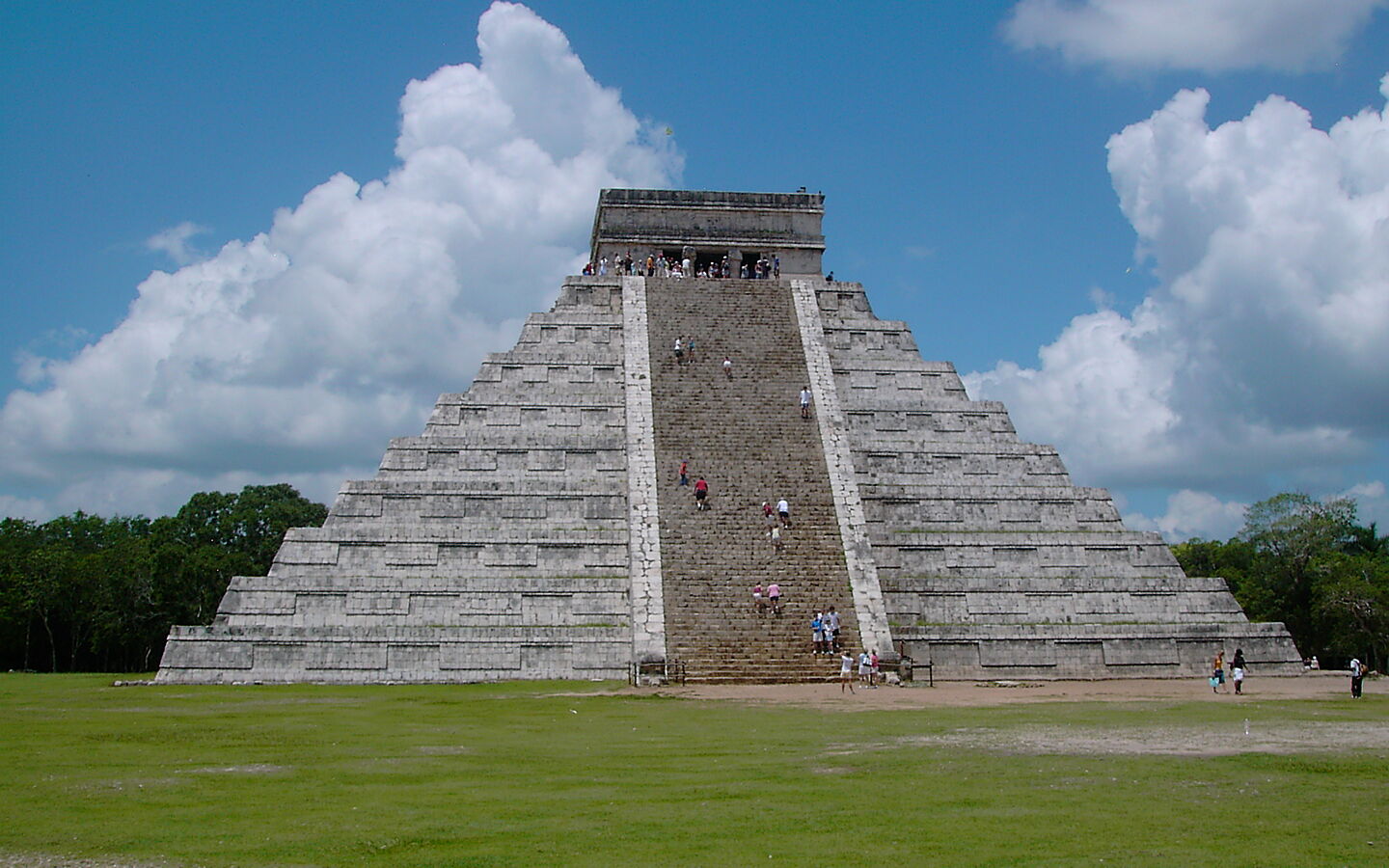
Cancún
Four decades ago, Cancún was a deserted island and few knew of its existence. The coast was surrounded by swamps, mangroves, jungle and unexplored beaches. Even the name of the island was not clear: some maps called it "Kankun", the "pot of snakes" or "snake's nest".
However, in the first documents, the island was spelled with two words: "Kan Kun," and sometimes "Kann Cún" (in the Spanish form). The current name "Cancún" is a natural evolution that makes it easier to pronounce... or maybe it's just a coincidence.
! Photo: © skeiwoker / pixelio.de!
Mexican dishes - a delicious mix
Mexican cuisine is one of the most popular cuisines in the world. So where better to enjoy Mexican delicacies than in Cancún!
The Yucatan Peninsula has a unique style of food that you can find and try in many restaurants in Cancún. The culinary delights of typical Yucatan cuisine consist of a delicious mix of European and Mexican flavors. Many of the dishes from this region are not spicy but are absolutely delicious. Try the typical Mexican dishes with delicious grilled meat and a variety of different sauces;
Cancún has many excellent fish and seafood restaurants. Many restaurants offer fresh lobster as a specialty. If you like fish, you must try ceviche, a tropical Mexican specialty made with fish or seafood such as shrimp or squid and topped with finely chopped onions, cilantro and tomatoes. All the ingredients are dipped in fresh lemon juice, resulting in an unexpected explosion of flavor.
Cancun nightlife - dancing and relaxing
Whether you want to dance the night away in one of Cancún's many nightclubs or spend a relaxing evening with friends in one of the many bars, Cancún's nightlife will not disappoint. An eclectic selection of music fills the evening air and you can enjoy the nightlife on the streets of Cancún until the sun comes up.
Holidays in Mexico - a paradise for true golf fans
All golfers dream of the golf courses in Cancún! Apart from the fact that they are located in beautiful surroundings, the golf courses in Cancún and Riviera Maya offer the highest standards of professional golf tournaments and professional golfers.
A magical landscape and great weather attracted numerous world-renowned golf course designers to create some of their masterpieces in Cancun and the Riviera Maya, creating one of the most competitive golf courses in the world.
The golf courses in Cancún and the Riviera Maya offer challenging fairways, with rolling hills and distinctive curves, framed by colorful tropical vegetation. Some have even been built around ancient Mayan temples. From the tee to the green, a fascinating view extends over the turquoise waters of the Caribbean and the white beaches in the distance.
Mayan culture - a journey back in time
The Mayan civilization is one of the original cultures of the New World and spans more than 3,000 years. The
Mayas lived mainly on the Yucatan Peninsula in the eastern third of
third of Mesoamerica and at their peak they were one of the most densely
most densely populated and culturally dynamic societies in the world.
The Maya culture
is known for its spectacular art, impressive architecture and sophisticated
and the sophisticated mathematical and astronomical systems.
Mayan architecture
Mayan architecture spans many thousands of years. The
most dramatic and easily recognizable are the fantastic step-shaped
stepped pyramids at the sites of Chichen Itza and Coba. A year ago
a year ago, Chichen Itza was named one of the Seven Wonders of the World and a UNESCO World Heritage Site for 20 years.
The Mayan calendar
The
Mayan calendar was not the original Mesoamerican calendar,
but with the intricacies of the Mayans it became the most sophisticated. The
Mayan calendar, along with the Aztec calendar, is the best documented and most
documented and most fully understood Mesoamerican calendar.
Mayan writing and Mayan art
The Maya script is the only fully developed written language of pre-Columbian America. Mayan art is considered by many to be among the most sophisticated and beautiful of the ancient New World.
Maya Tree of Life
The
Mayan civilization recognized the four primary cardinal directions and assigned them
each a color - red to the east, white to the north, black to the west and yellow to the south. They also had a fifth "direction", which designated the center and wore a blue-green color. The center was represented by a large Ceiba tree, which became known as the Maya Tree of Life. This tree connected the center of the earth with both the underworld and the sky.
Mayan gods
There were thirteen Mayan gods belonging to thirteen cardinal points of the Mayan religion and nine gods from the nine underworlds. Natural
elements such as the stars and the planets, plants, numbers, days of the week
and time periods each had their own gods. The mood of the Mayan gods changed according to the days in the Mayan calendar or the position of the sun, moon and stars. Some
of the most important gods are Chaac - God of Rain and Thunder, Ixchel - Goddess of Childbirth and Ah Puch - God of Death.
Hotels


![[Translate to en:] AMADEUS Riva (c) Lüftner Cruises](/fileadmin/_processed_/d/e/csm_AMADEUS_Riva_ebdf4c2c55.jpg "[Translate to en:] AMADEUS Riva (c) Lüftner Cruises")






































![[Translate to en:] AMADEUS Riva (c) Lüftner Cruises](/fileadmin/_processed_/d/e/csm_AMADEUS_Riva_64c1995e26.jpg "[Translate to en:] AMADEUS Riva (c) Lüftner Cruises")