


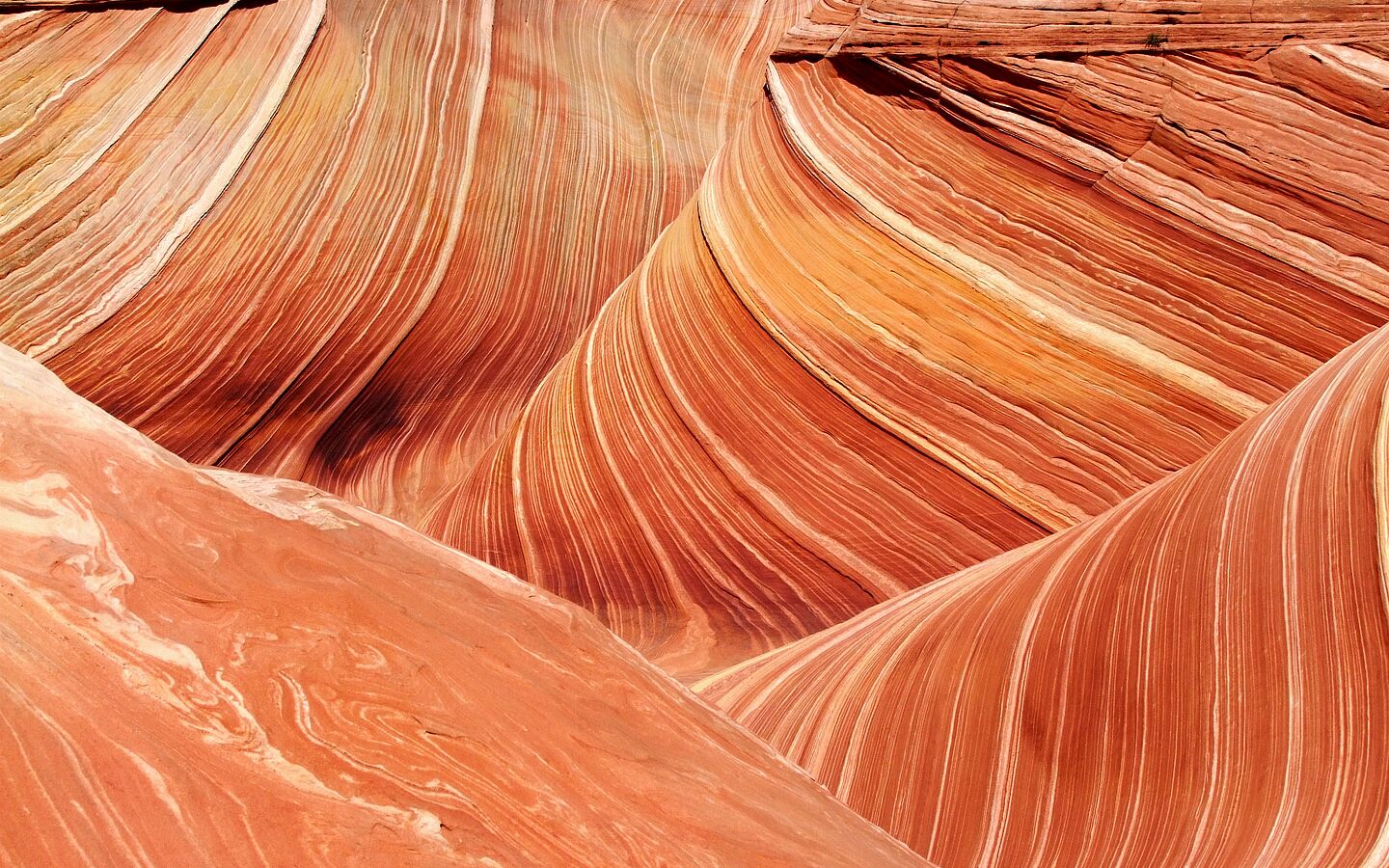
Arizona
"It's hard to believe that we live here in Scottsdale in the middle of the Sonoran Desert," remarks Ace, our tour guide. We sit on the terrace of the Valley Ho Hotel and enjoy the view of lush banana trees, palm trees, tropical flowers and the pool behind it, where very handsome people of both sexes are lolling in the sun. In fact, we associate this Garden of Eden with the building surrounding us, which has a sleek 1950s architecture, more with Florida than Arizona. "We divide Arizona's tourist era into BC and AC," we are then told. "Excuse me, after Christ?" "After air conditioning!" The fact is that the invention of air conditioning in the mid-1950s was probably the most significant event in Arizona's tourism history. And the Valley Ho was the first hotel to use this innovation.
One of the early discoverers of the Sonoran Desert was the American architect of the century Frank Lloyd Wright: when he built his private retreat and architectural center "Taliesin West" out of the desert in the middle of the no man's land of the McDowell Mountains in the late 1930s, he was still considered a genius crank. But his far-reaching reputation, the students and artists who followed his ground-breaking building project, also in ecological terms, as well as his influence on the architecture of the Biltmore and the Valley Ho Hotel have probably contributed to this place developing into what it is today: the coolest hot spot in the Sonoran Desert.
Hot spot Scottsdale - The South Beach of the desert
If you drive through Scottsdale, it is difficult to tell where the city begins or ends. The communities around Arizona's capital Phoenix have merged too much into one metropolis, which the locals refer to simply as "Greater Phoenix" or, because it sounds nicer, as the "Valley of the Sun". And this "Valley of the Sun" is home to the densest concentration of luxury hotels, guest ranches and golf courses imaginable. More than 200 golf courses in the area ensure that the luxury hotels are full, especially in the winter months. And anyone who thinks that this place is only for older people is completely wrong: the wide range of accommodation, from sophisticated to design, spa and family resorts, brings people of all ages here. The range of leisure activities also caters to all tastes: In addition to golf, hiking, climbing, jeep safaris, horse riding and hot air balloon rides are all on offer. Furthermore, urban entertainment such as sophisticated shopping centers, trendy bars, live music, casinos and lots of fantastic restaurants ensure a lively nightlife in the Valley. Gourmet, fashion and art festivals have created such a lively scene that the New York Times even described Scottsdale as the "desert version of South Beach".
As you stroll along 5th Avenue in downtown Scottsdale, there is nothing at all reminiscent of the avenue of the same name in Manhattan in these meticulously clean streets with their low buildings housing small boutiques, restaurants and Indian craft stores. The wooden buildings in the Old Town District with the "Rusty Spur Saloon" and the oldest blacksmith's shop still in operation create a real western flair, while a professional art scene has established itself around the corner on Marshall Way and Main Street, where galleries and antique stores line up side by side.
Scottsdale, which now has a population of almost 250,000, has put together an almost excessive public art program compared to its size. With over 70 sculptures in public places and around 100 galleries and museums, the town is almost like a single open-air museum. The fact that architecture is a major theme in Scottsdale is reflected both in the homes, some of which are reminiscent of Tuscan villas, in shopping malls thematically inspired by Italy or the American Southwest and in the futuristic building of the Scottsdale Museum of Contemporary Art by Will Bruder: a former theater that the award-winning architect encased in a grey, minimalist steel shell resembling an eggplant. The mix of styles from modern European, American Southwest and Adobe architecture is also celebrated by the numerous luxury resorts in the area. The InterContinental Montelucia, which opened in 2008, is built in the style of a Spanish Alhambra, the Four Seasons and the Boulders Resort accommodate their guests in adobe buildings, while the seven-storey W Hotel is a modern "skyscraper". So you can easily spend several weeks here and check in somewhere different every day; the Valley probably has the largest number of resorts in continental America. And yet, in the high season from January to April, you will hardly get a room here without a reservation: The guaranteed sunshine, spectacular nature, challenging golf courses, top restaurants and world-class hotel spas are too tempting for many winter-weary guests.
The Valley is easily accessible via Sky Harbor Airport in Phoenix, and its central location in the middle of the state makes it easy to take trips to the attractions in northern and southern Arizona.
Sedona - beyond the Grand Canyon and Co.
Tourists come to Arizona mainly for the most impressive canyon in the world, the 257-kilometre-long and 16-kilometre-wide Grand Canyon, and the equally impressive national parks such as the globally unique rock formations of Canyon de Chelley, the Petrified Forest or Monument Valley. These spectacular natural sites are all located in northern Arizona, which many visitors often travel to from nearby Las Vegas. This part of the state is also home to the largest Native American reservation in North America, the Navajo Indian Reservation. Exploring Northern Arizona, its national parks and Native American culture is worth the trip alone, and unfortunately many visitors don't think to visit Central or Southern Arizona due to time constraints.
100 miles south of the Grand Canyon is Sedona, a town nestled in the spectacular Oak Creek Canyon and lined with flame-red cliffs. The sight of the mountains is so breathtaking that it is fair to say that this is one of the most spectacular places in the USA. The splendor of the red rock mountains called Bell Rock, Cathedral Rock or Boynton Canyon earned the region the name Red Rock Country. Hiking and jeep tours are among the biggest attractions here, and understandably so, because you simply can't get enough of this landscape surrounded by forests and the almost mythical surroundings cast a spell over every visitor. This has brought Sedona a special following: countless new-age tourists want to visit magical places called "vortexes", which are said to have healing powers. Anyone driving through Sedona will be almost overwhelmed by the offers of New Age disciples offering tarot reading, palm reading, crystal healing, reiki, aromatherapy and more. If you just want to enjoy the beautiful landscape, this can be quite annoying. The Enchantment Resort, located directly on Boynton Canyon, offers a good escape. There, admirers can experience this landscape intimately on their private terrace. The adjoining magnificent Mi Amo Spa, which is one of the best in the country, offers a far better alternative for those seeking relaxation than many of the pseudo-therapies advertised in the resort.
Tucson - wild west, mariachi and wine
Tucson, located an hour and a half south of Phoenix, is a proverbial Eldorado for western fans. At first glance, Arizona's second largest city may not offer quite as many attractions as the Valley, but because Tucson is home to Arizona State University, it has developed a lively nightlife with many trendy bars, mariachi music and good restaurants. And because the city is located in the middle of the southern Sonoran Desert not far from the Mexican border, cactus and salsa are celebrated here. The Saguaro National Park is divided into two parts by the city, where you can hike through a real cactus forest, which is home to the largest and oldest specimens, or drive along the 13-kilometre trail. If you have already grown fond of the prickly desert dwellers, it is best to visit the Arizona Desert Museum - a huge park and zoo - outside the city. Here you can get a real insight into the flora and fauna of the Sonoran Desert and find out just how alive it is. The stately saguaro cacti demand respect: at the age of ten they are no bigger than a fingertip, at the age of 70 they grow their first arm, and they can grow 13 meters high and live up to 250 years.
After a few miles along the road, we reach the Old Tucson Studios. This site was the backdrop for many classic westerns such as "Rio Bravo" or "Tombstone" and, when not filming, serves as a western amusement park that is really great fun: can-can shows, staged shoot-outs and dashing cowboys swinging lassos on the dusty road in front of the saloon are on offer in this old western town.
And now for an insider tip: around an hour's drive south of Tucson near the Mexican border, a wine-growing region has been developing near the town of Sonoita since the 1970s. On the hills of Elgin County, around 20 winegrowers now run their businesses and invite visitors to wine tastings. The Kief Joshua winery, whose architecture is reminiscent of Tuscany, is particularly popular with young hipsters from the city: they sometimes drive up in stretch limos with a bodyguard and enjoy the cooler temperatures and the view of rolling hills where grass and vines grow side by side for a whole day. And if anyone needs a break - there aren't any cacti in sight.
Arizona - A state for all seasons
In principle, Arizona can be visited all year round - even in the summer months. Winter offers pleasant temperatures of up to 25 degrees during the day, and the cool nights are spent in front of the open fire. The Arizonans have an effective recipe for the hot months of July and August: they play golf or hike from six to nine in the morning. Afterwards, they retreat to air-conditioned rooms or enjoy museums, shopping and spa treatments for a fraction of the high season prices. In the evening, people sit on the terraces of the restaurants under the spray of the "misters" and succumb to the fascination of starry desert nights. The sky above the desert? - even the pragmatic architect Frank Lloyd Wright became a poet: "The desert, with its fringe of barren mountains dabbed on a leopard's skin and tattooed with the fantastic pattern of creation, is in truth a desert garden such as is found nowhere else in the world in its pure beauty."
Hot spot Arizona: The "Grand Canyon State" - Hollywood's most beautiful western movie set and home to the saguaro cacti - is also making a name for itself with its world-renowned golf and spa resorts. And in central Arizona, the small town of Scottsdale with its lively art and culture scene proves just how mega-cool the desert can be!
Photo: © Olaf Schneider / pixelio.de
Location
Vereinigte Staaten von Amerika
Area
295.254 km²
Population
6.731 million inhabitants
Language
74.1% of the population speak English as their mother tongue, 19.5% Spanish and 1.9% Navajo. Only 0.5% of the population speak German and 0.6% speak another Native American language.
Largest city
Phoenix
Capital city
Phoenix
Religion
The religious communities with the largest number of members are Catholic churches; four-fifths of Arizona's population describe themselves as Christian,
Weather
Arizona has a dry desert and semi-desert climate and a steppe climate in the north. Depending on the altitude, you can therefore expect relatively mild winters and hot summers. Due to its proximity to the Rocky Mountains, there are significant temperature differences between day and night.
Best time to travel
Spring or fall
Climate
| Jan | Feb | Mar | Apr | May | Jun | Jul | Aug | Sep | Oct | Nov | Dec | |
| Max. Temperature | 19 | 21 | 24 | 28 | 33 | 38 | 38 | 37 | 36 | 30 | 24 | 19 |
| Min. Temperature | 3 | 4 | 6 | 9 | 13 | 18 | 23 | 22 | 19 | 12 | 6 | 3 |
| Hours of Sunshine | 7 | 7 | 6 | 6 | 4 | 3 | 4 | 4 | 4 | 6 | 7 | 7 |
| Rainy days | 8 | 7 | 8 | 7 | 7 | 8 | 8 | 7 | 7 | 8 | 8 | 9 |
Time difference (to MEZ)
MEZ: -8 Stunden
Currency
Dollar (USD)
Restaurants in
Arizona - Our insider tips for Arizona
Dining out in Arizona is a sensual and comparatively inexpensive pleasure. The influences of different cultures and the presence of world-class chefs have brought the gastronomic standard to the top of the USA.
History of Arizona - Legends and Native Americans
The history of Arizona is characterized by numerous legends of Old West America. The great Indian leaders Geronimo and Cochise led their peoples against the frontiersmen. Arizona today has one of the largest U.S. Indian populations; more than 14 tribes are spread across 20 reservations.
Today, manufacturing has become a major industry in Arizona. The main products include electrical, communications and aerospace products. The state produces over half of the country's copper. Agriculture is also very important to the state's economy.
Shopping Arizona -
the best places to shop
Scottsdale has developed into a real lifestyle metropolis. Shopping is best done in the Old Town around 5th Avenue or in the numerous shopping centers. Here are just a few examples:
- Scottsdale Fashion Square
- El Pedegral
- The Borgata of Scottsdale
- The SHOPS at Gainey Village
Hotels




![[Translate to en:] AMADEUS Riva (c) Lüftner Cruises](/fileadmin/_processed_/d/e/csm_AMADEUS_Riva_ebdf4c2c55.jpg "[Translate to en:] AMADEUS Riva (c) Lüftner Cruises")


















































![[Translate to en:] AMADEUS Riva (c) Lüftner Cruises](/fileadmin/_processed_/d/e/csm_AMADEUS_Riva_64c1995e26.jpg "[Translate to en:] AMADEUS Riva (c) Lüftner Cruises")