


Sicily
Beyond the boot
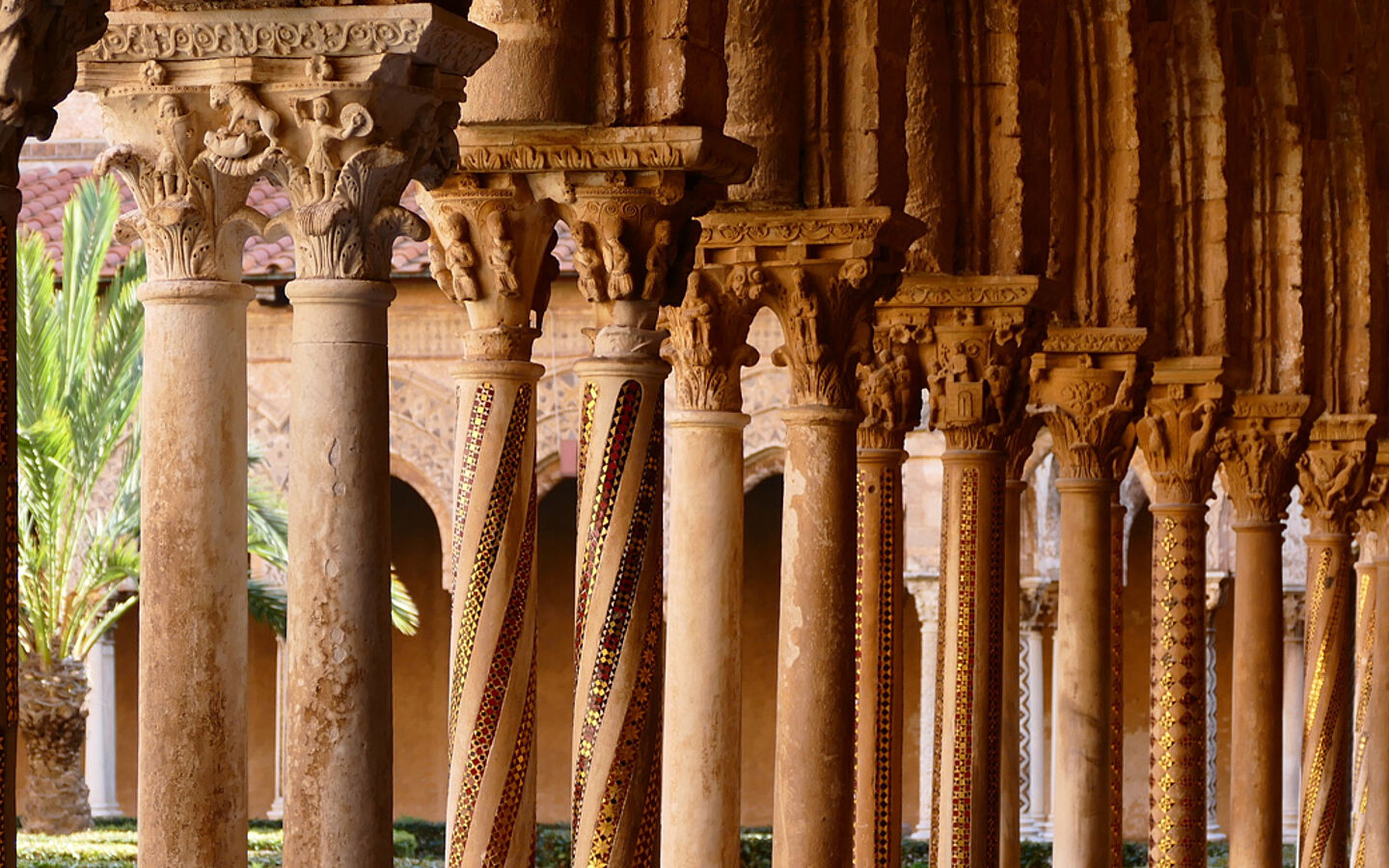
They were all there. Whether Greeks, Arabs, Romans, Phoenicians, Venetians or Normans - Sicily was once a vital crossroads for all of them due to its central location in the Mediterranean. The traces that these peoples left behind over many centuries make the largest Mediterranean island an outstanding pilgrimage destination for fans of cultural history today. Few places on this earth attract visitors with such an atmospheric concentration of mythology and world history. This is where the Normans built Arabic-style cathedrals, where Archimedes shouted "Eureka!" and where the Sirens sang in vain for Odysseus.
Palermo - not for beginners
Of course, you don't have to brush up on - in the truest sense of the word - historical school knowledge to have fun in Sicily. The pleasant climate, the varied landscape, the diverse vegetation, the deliciously light food and the diverse wines make the island an ideal vacation destination in summer, even for the most idle traveler.
Most visitors start their journey in Palermo, and if you don't have the misfortune of having to meet the unfriendly gentleman behind the Alitalia lost-and-found counter at the airport in the Sicilian capital, then there's really nothing standing in the way of a successful vacation. After all, tourists in Palermo have plenty to choose from. It is a city where even agnostics become churchgoers. Both the number of places of worship and their art-historical quality often take your breath away.
But Palermo is also a city for adventurers, which is not so much due to the world-famous crime syndicate. Rather, it is often uncertain whether the museums are actually open when you want to visit them. Opening hours vary greatly and often change from one day to the next. Who would suspect that the Sicilian Regional Gallery, which is well worth a visit, closes its doors in the early afternoon on most days and doesn't even open again after the siesta? Sometimes, even during regular opening hours, you find yourself standing in front of closed doors.
So there's plenty of excitement, especially as it's easy to get lost while exploring the narrow streets. There are often no street signs, and a leisurely stroll is prevented by the fact that, in the absence of sidewalks, cars and similar vehicles are constantly honking and insisting on their right to share the road. This can sometimes be stressful. As almost everywhere in southern Italy, a basic knowledge of Italian is a great advantage.
As interesting as Palermo is, the most popular destination in Sicily is at the "other end" of the island and is called Taormina. As early as the 18th century, this small town perched above the cliffs that drop precipitously into the sea was part of the "Grand Tour". The main reason for this was the ancient theater, whose incomparable view of the Ionian Sea and Mount Etna still attracts crowds to this day.
The journey is the destination - heading for Catania
It is best to hire a car for the journey from Palermo to Taormina, as the five-hour train journey (if the railcar doesn't break down again) is usually nerve-wracking. Driving by hand initially poses certain challenges for Central Europeans. In Sicily, both traffic lights and stop signs are merely recommendations, and the zipper system is, of course, completely unknown. Nevertheless, the highway (A19), which runs right across the island and connects Palermo with Catania (from where it is not far to Taormina), leads past numerous scenic and cultural sights and is one of the most beautiful routes in Europe due to the (as yet) lack of noise barriers.
You should turn off at the town of Enna and plan a stop in nearby Piazza Armerina. Not far from this picturesque hilltop settlement is perhaps the island's greatest treasure: the late Roman Villa del Casale, which is considered to be the best-preserved building of classical antiquity. The lively floor mosaics in the 30 or so rooms are almost completely preserved. But beware: opening times vary due to renovation work. Sometimes it can only be visited at weekends.
In Taormina at the latest, where some of the best restaurants on the island are located, you should immerse yourself in Sicilian cuisine. The traditional preparation of fresh fish, lamb or the indestructible "arancini" (breaded rice balls) is sure to provide lasting culinary delights. And: be sure to try a glass or two of Etna Rosso from the nearby wine region on the north side of Mount Etna!
Whether a treat for the palate or a feast for the eyes: Sicily is full of them: In Syracuse (Siracusa), it is worth visiting the island of Ortygia, on which the meter-thick fortified old town extends. Another must is a tour of the archaeological Parco della Neapolis.
Agrigento should also be mentioned at this point. The "Valley of the Temples" near this city on the south coast of the island contains amazingly well-preserved sacred buildings from antiquity and would justify the trip to Sicily alone. Of course, not all of Sicily's architectural treasures date back to antiquity: "Sicilian Baroque" is a common term among art historians. The hilltop town of Noto, not far from Syracuse, is considered to have the best-preserved late Baroque ensemble on the island.
Regardless of how many places you visit in Sicily: There is no way around wine. The northern slope of Mount Etna is considered the most up-and-coming wine region in Sicily. So be sure to try an Etna Rosso or two. Outstanding producers include the Tenuta delle Terre Nere, the Passopisciaro winery and the natural winegrower Frank Cornelissen.
After all, wine is also part of the soul of Sicily - and if Goethe is to be believed, then "Italy without Sicily ... makes no image in the soul".
Stephan Burianek
"Here is the key to everything", it says about Sicily in Goethe's "Italian Journey". To this day, travelers are amazed by the rich history, culture and culinary delights of this island. And it is not uncommon for them to conclude that this is where the original Italy is at home.
Highlights
Connoisseur special tip:
Side trip to Bagheria
This tranquil suburb a few kilometers east of Palermo is worth a visit due to its collection of baroque villas, some of which can be visited. The most interesting is probably the Villa Palagonia, which is best known for the grotesque tuff sculptures on its boundary wall. Goethe described them in detail in his "Italian Journey". Afterwards, you should plan a visit to the Villa Cattolica, which houses the municipal Museo Guttuso. In addition to paintings, photographs and sculptures by local and international artists from the last few centuries, you can also see "carettos" from Bagheria. These brightly painted horse-drawn carts were still used on the bumpy roads of Sicily in the second half of the 20th century.
Villa Palagonia:
www.villapalagonia.it
Villa Cattolica / Museo Guttuso:
www.museoguttuso.it
DIPLOMATIC MISSIONS
Italian Embassy in Germany
Hiroshimastraße 1, 10785 Berlin
Phone: +49 30 254400
Fax: +49 30 25440116
E-mail: segreteria.berlino@esteri.it
www.ambberlino.esteri.it
Italian Embassy in Austria
Rennweg 27, 1030 Vienna
Phone: +43 1 712 51 21
Fax: +43 1 713 97 19
E-Mail: ambasciata.vienna@esteri.it
www.ambvienna.esteri.it
Location
Italien
Area
25.711 km²
Population
5.082 million
Language
Italian
Capital city
Palermo
Religion
Predominantly Catholic
Weather
Mediterranean climate with hot, dry summers and mild, humid winters. The rainiest months are October to February, with hardly any rainfall from May to September. In the south of the island, the Scirrocco sometimes causes temperatures to rise to over 40°C.
Best time to travel
Spring
Time difference (to MEZ)
keine - MEZ
Currency
Euro
Visa
Entry and residence requirements:
Citizens of all EU member states do not require a visa for entry and stay. Passports must not be more than 5 years old at the time of entry. Entry is also possible with an identity card.
Vaccinations
No vaccinations are required to enter Italy. There is a medium risk of infection for hepatitis A and hepatitis B in some regions of southern Italy. For more information, please contact your doctor or pharmacist. Information without guarantee.
Sicilian cuisine - an unmistakable exoticism
The cuisine of Sicily is one of the most varied and
most extravagant cuisines in Italy. The magic of fragrances, flavors
and colors clearly shows the influence of various conquerors and rulers
conquerors and rulers, who have influenced their culture, civilization, way of life and eating habits
as well as their diverse variations of culinary preparation.
have left behind.
Simple food preparation is based on the Mediterranean tradition of the Greeks
tradition of the Greeks, which has remained closely linked to the eastern part of the
island has remained. Added to this are the various refinements of the
French chefs "i Monsí", who delighted the Palermitan nobility of the 17th century.
century and, last but not least, the colorful and aromatic
sweets of the Arabs and the tradition as well as the tasting
around various Jewish-style offal. All this
together gives Sicilian cuisine an incomparably varied
diverse, unusual and crazy exoticism and a varied
richly varied magic of delights.
Excursions in Sicily - Places to visit The city of Catania has particularly beautiful buildings and streets to offer.
Via Etnea is a kilometer-long shopping street with stores,
cafés and gelaterias. This is the meeting place in Catania. Worth seeing is
also the Piazza Università. This is a square on the Via Etnea and
dates back to the Baroque period. Another beautiful sight is Piazza Stesicoro,
These are the remains of an amphitheater.
You should also not miss the Castello Ursino. This
is a castle with a museum in the center, where admission is free.
is free.
The city park in Catania is also worth a visit.
The tour continues in Taormina. If you walk along the long promenade
you reach the Piazza IX Aprile halfway through. This is one of
of the largest squares, where you will also find the old church of Sant'
Agostino, which houses the city library.
In the middle of the square there is a viewing platform from
from which you have a great view of Mount Etna. In Piazza IX Aprile, there is
a lot going on all day and there is always a colorful hustle and bustle.
If you want to see something very interesting, you should visit the Cave di
Cusa. This is an old Greek quarry. It was used to make
columns for a temple.
Shopping in Sicily - The most exclusive shopping areas in Sicily A wide range of shopping opportunities awaits every holidaymaker in the major cities of Sicily.
Major cities such as Palermo, Catania and Syracuse offer a colorful mix of international
mix of international clothing stores. Traders in the traditional street
traditional street markets selling home-made goods. Whether in
small stores or in the little stalls, the choice is huge.
You will find tailors, hat makers, candle merchants and rope makers who
and sell their wares directly from their workshops.
When it comes to fashion, there is a wide variety of international traders,
for high-quality Italian fashions, such as Stefanel. From accessories,
bags, shoes, men's and women's clothing, the choice is enormous and
and can be found in boutiques all over the island.
An insider tip for the fashion-conscious is the boutique Barbara
Sangiorgio, located at the foot of Mount Etna.
Hotels




![[Translate to en:] AMADEUS Riva (c) Lüftner Cruises](/fileadmin/_processed_/d/e/csm_AMADEUS_Riva_ebdf4c2c55.jpg "[Translate to en:] AMADEUS Riva (c) Lüftner Cruises")














































![[Translate to en:] AMADEUS Riva (c) Lüftner Cruises](/fileadmin/_processed_/d/e/csm_AMADEUS_Riva_64c1995e26.jpg "[Translate to en:] AMADEUS Riva (c) Lüftner Cruises")