


Laos
So this is supposed to be the capital! If you step out of the airport in Vientiane and expect a modern, vibrant city like Hanoi or Kuala Lumpur, you will be disappointed. Or be pleasantly surprised by the pleasant tranquillity that prevails here, even at the airport. Although the "Hello, cab?" awaits us here too, it is much less insistent than in Thailand, for example. The Laotians appear to be more gentle or even wait-and-see friendly, and the number of tourists arriving is manageable. The lack of access to the sea and the rather poor infrastructure have ensured that Laos has so far been largely spared from mass tourism. In addition to the three main streets, Vientiane is criss-crossed by a network of narrow alleyways with mostly low-rise buildings. Small cafés, stores, food stalls and snack stands with plastic chairs around them, massage parlors, colonial buildings with crumbling plaster and old temples line the streets. Flowers and fruit are offered at the shrines. Clouds of incense drift into the sky. In contrast to this, the promenade along the Mekong a few kilometers away presents itself as an urban planning disaster of grey asphalt and concrete. An impression that is reinforced by the more than one kilometer long "First Friendship Bridge", which connects Laos with Thailand. There is no sign here of the fascination and beauty of the legendary "river of rivers". However, it is clear that the Laotians actually use the Mekong as a kind of floating "highway". After all, only a few of them own a car. Most travel short distances on mopeds or tuk-tuks. If possible, longer distances are preferably covered by water.
French flair on the Mekong
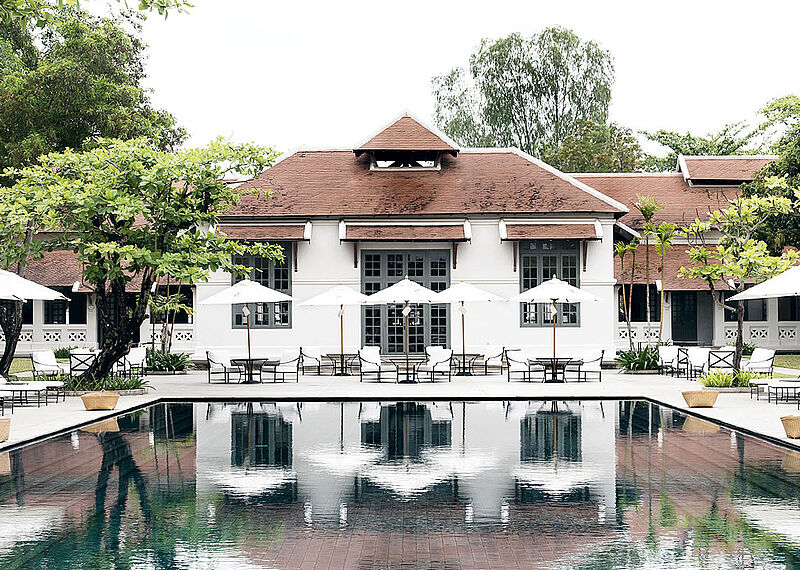
Vientiane (pronounced Vientschan), with its 210,000 inhabitants , has three "must-sees": the 45-metre-high That Luang Stupa, whose name translates as "great holy relic" and which is considered the most important national monument in Laos. With the ancient temple complex Wat Si Saket, which houses a magnificent Buddha collection. And with the replica of the French triumphal arch, which reminds us of Laos' French past, which can still be felt with all our senses today. Many Laotians still speak French better than English. You can still find bakeries selling croissants and baguettes on the street corners. And behind some of the colonial-style façades are some pretty decent French restaurants, which attract many Thais across the border because the fine Bordeaux wine is much cheaper here. In view of its colonial past, the Settha Palace Hotel is particularly recommended as accommodation. Back in the 1930s and 1940s, the mini palace owned by a French hotelier family was the most fashionable address in Vientiane - and a real magnet for wealthy Laotians and Europeans who wanted to treat themselves to a little luxury. Nothing has changed since its reopening in 1999. To this day, Settha Palace is home to state guests, pop stars and well-traveled guests who appreciate polished rosewood floors, opulent four-poster beds and a beautifully landscaped swimming pool in the middle of a small tropical garden. What's more: so much ambience is available at a low price! And what's more, the number of luxurious accommodations in Laos' capital is quite limited anyway. Many people are therefore eagerly awaiting the opening of The President Hotel in the neoclassical building of the former trading post, which has been postponed again due to a massive government veto. Since the collapse of the Eastern Bloc, the Laotian government has been pursuing a course of reform that opens the doors wide to foreign companies (primarily from China and South Korea). Although the Lao People's Democratic Republic is currently experiencing a rapid economic upswing with growth rates of around seven percent, tourism is still in its infancy and is concentrated almost exclusively in the north, while the south is lagging far behind. But the days of calm seem to be numbered. Vientiane's blue-blooded counterpart is the old royal city of Luang Prabang, whose reputation for being a piece of unadulterated Southeast Asia has spread far beyond Laos - especially since the city became a World Heritage Site in 1995. It is framed by green hills, criss-crossed by the brown ribbons of the Mekong and Nam Khan rivers. Then there are the old stilt houses by the water, the stucco-decorated colonial villas - and of course all the historic temples and golden stupas gleaming in the sun. Luang Prabang is characterized by ancient Theravada Buddhism. There are more temples here than skyscrapers. There are 32 of them, all in perfect red and gold, newly renovated or with a morbid charm that creates a mystical atmosphere.
1,200 monks ensure peaceful karma An early morning exploration is particularly recommended, when the many monks have their offering bowls filled with rice and fruit by the locals, children in neat uniforms go to school, tourists from overseas eat their first croissants on the verandas of the charming guest houses and the housewives sweep outside their doors with Mekong grass fronds. A real picture-book Asia! We cycle to the morning market, which, with exotic goods such as python meat, giant Mekong catfish and fruits of paradise, seems far more authentic and tranquil than the night market, whose bric-a-brac mostly comes from China and Vietnam. There is still an air of magical tranquillity and royal atmosphere, especially in the district where the two rivers meet. After all, the palaces of the royal family were also located here. In addition, many French people settled here in colonial times and built impressive magnificent buildings. After the end of the Vietnam War, which also severely affected Laos, and the takeover by the communists, the last Laotian king and his family were sent to a re-education camp. Luang Prabang sank into a deep sleep from which it has not really woken up to this day. However, another bridge to Thailand will soon bring more hype and crowds of people here too. In addition, a new expressway and the train connection to China expected in 2019 will probably give the city a rude awakening and ensure rapid expansion. However, Luang Prabang is still successfully resisting any change - from the ban on driving the deafening longtail boats within the city to the strict building regulations that prohibit modern houses in the historic city center. New hotels are only being built here and there. For example, the Rosewood Hotel near the golf course or the brand new Avani Luang Prabang. Since 2009, there has also been a breathtaking Aman Hotel in the middle of the World Heritage city: the Amantaka is a world of its own. Overwhelmingly luxurious and purist at the same time, it is the perfect place to digest the flood of impressions. Contemplative silence sets the tone. Accommodation is provided in 15 colonial buildings spread over three hectares of eucalyptus, frangipani and calliandra trees. The 24 suites, each of which is larger than an average three-room apartment, impress with their clear and simple design with local furniture made of reddish-brown rosewood and teak - just as is customary in northern Laos. As a colonial contrast, there are mud-green shutters, high ceilings, filigree louvered doors, four-poster beds framed by fine cotton and wonderfully old-fashioned bathtubs that stand freely in the room. A very special place is our enchanting veranda and the small courtyard with its own pool. Several times a day, the suites are tidied by invisible spirits and the starched linen bathrobes are changed. The general manager also looks after you with a little more love than in other Amans.
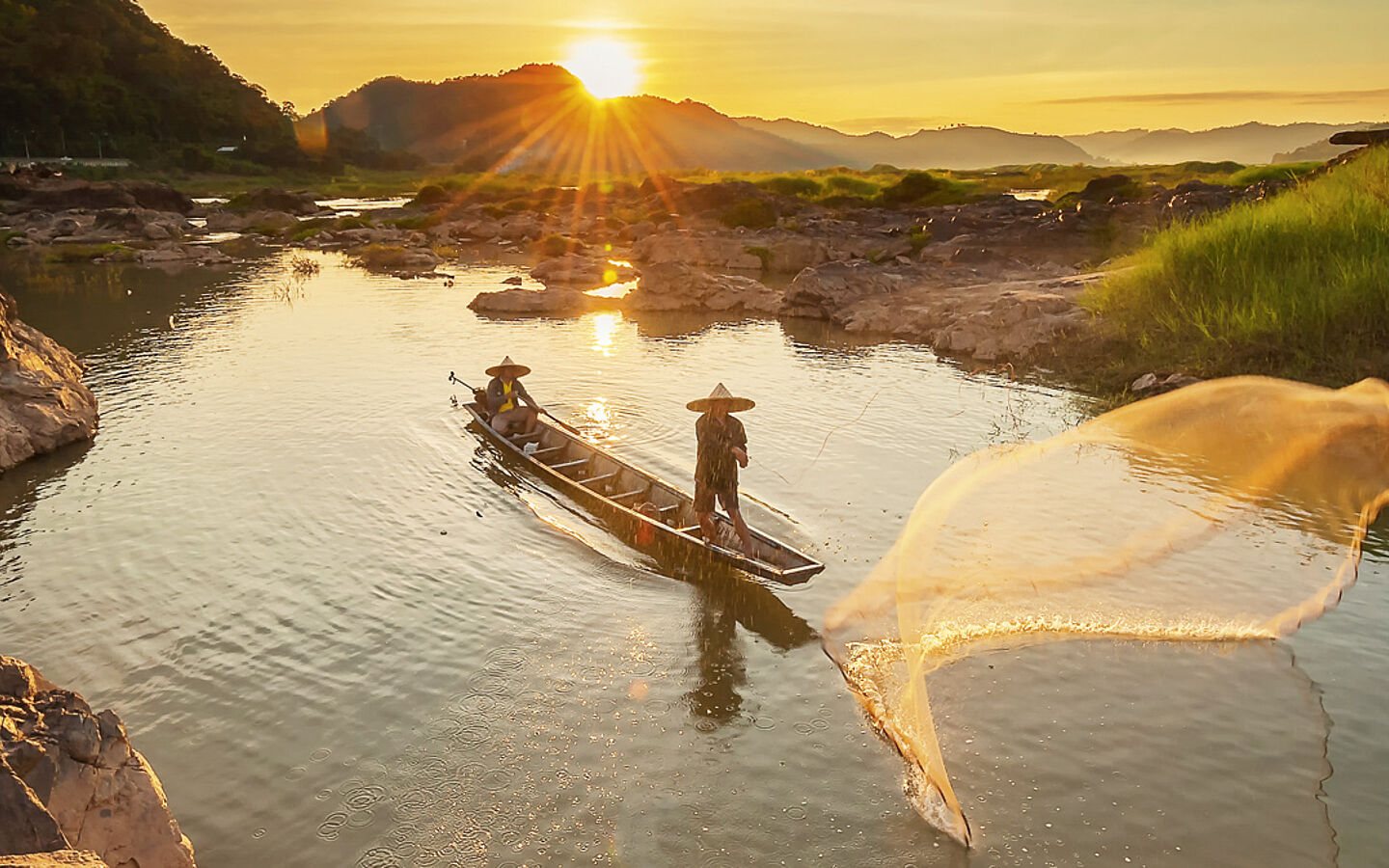
Where life is in the river An evening Mekong cruise on the Aman longboat also offers great cinema : While the last rays of sunshine are reflected in the water, we cruise through a dreamlike water landscape and enjoy the hustle and bustle on and by the river with a cup of lemongrass tea: Lonely fishermen casting their nets to catch fish. Farmers watering their vegetable gardens and drying river algae on bamboo racks. Children somersaulting into the water on sandbanks ... It is images like these that transport us to another time and another, long-forgotten world. Another must-do tip: the ascent to the 150-metre-high rocky hill of Phousi. The best time to climb what feels like 400 steps is early in the morning, when the heat is still bearable and the morning mist covers the city and the mountains. From Luang Prabang, there is also a short detour to the savannah-like plateau of the clay jars, where 300 enigmatic vessels weighing up to a ton raise questions. On the way there, we pass a landscape characterized by waterfalls and rice fields, which still seems completely untouched by the changes in the country. No wonder, as Laos has a low population density and there are still many undiscovered jungle areas and countless small villages with indigenous inhabitants, some of which can only be reached on foot or by boat.
Of buffalo skin and grasshoppers
If you visit this incredible country , you should definitely take part in a cooking course. One of the best is offered at the Belmond La Résidence Phou Vao, two kilometers outside of Luang Prabang. After a joint visit to the herb garden, the sous-chef not only explains a few things about Laotian spices and dishes, but also that the mortar is the most important kitchen utensil and that mashed jeow pastes form the basis of almost all dishes. "Thailand's cuisine may be a little more refined, but who can resist our specialties such as roasted grasshoppers, ground buffalo skin, mekong grass crackers or scrambled eggs," says Ms. Sengchanh with a wink. "But don't worry, we only cook classics like khausoy, a rice noodle soup with minced meat, mint, tomatoes, hot chillies and fish sauce.
fish sauce, which for us Laotians is both our favorite dish and our favorite food." Incidentally, Résidence Phou Vao, one of the best hotels in the whole of Laos, has also chosen one of the most spectacular locations: Thanks to its elevated position, it not only overlooks the green hilltops, but also the old town and the famous Phousi Temple. The veranda of the colonial house is particularly panoramic and stylishly reflects the tranquil pace of life and vibrant culture of this country, where change and speed are (still) of little importance.


![[Translate to en:] AMADEUS Riva (c) Lüftner Cruises](/fileadmin/_processed_/d/e/csm_AMADEUS_Riva_ebdf4c2c55.jpg "[Translate to en:] AMADEUS Riva (c) Lüftner Cruises")














































![[Translate to en:] AMADEUS Riva (c) Lüftner Cruises](/fileadmin/_processed_/d/e/csm_AMADEUS_Riva_64c1995e26.jpg "[Translate to en:] AMADEUS Riva (c) Lüftner Cruises")