


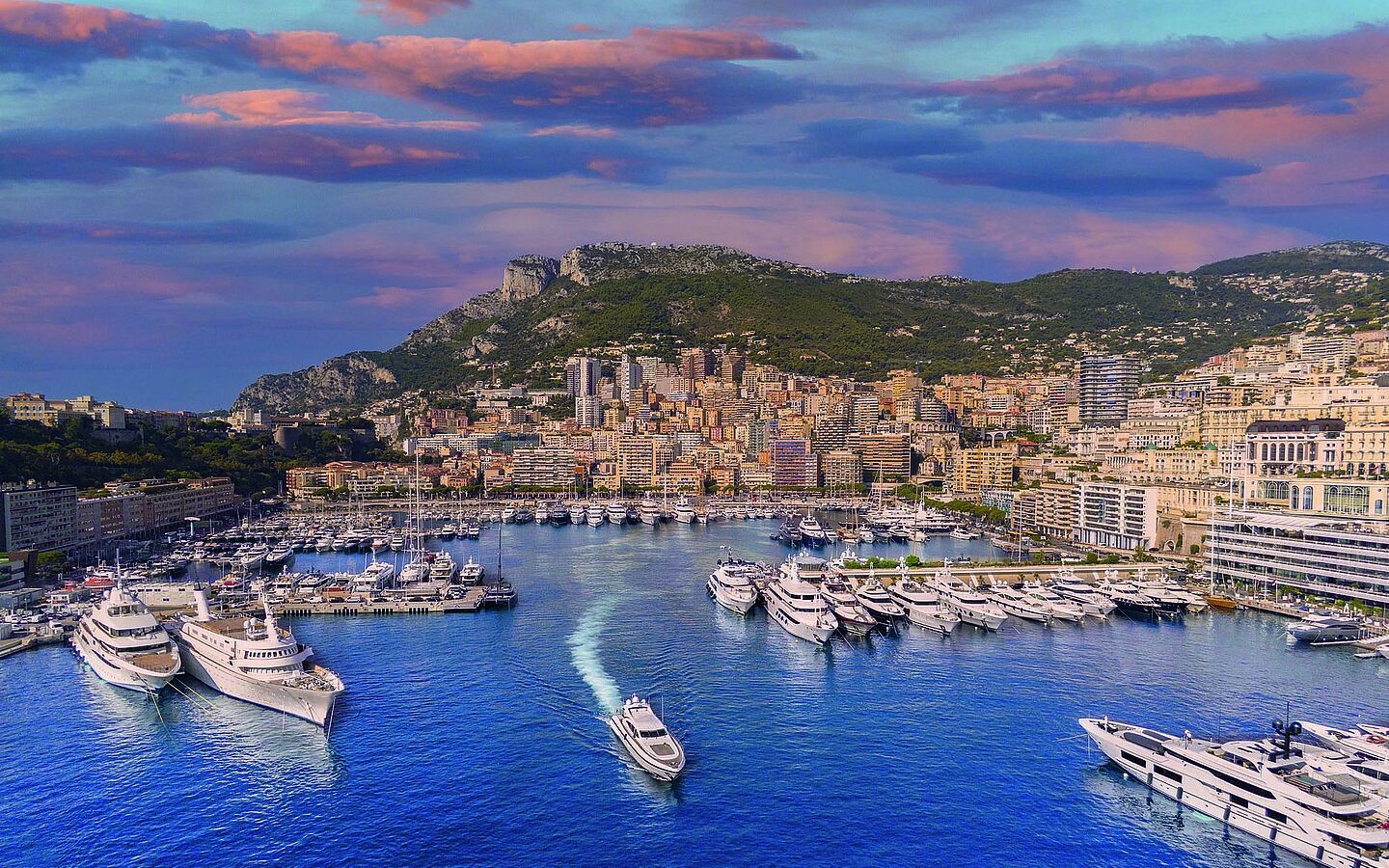
The Concentrated Power of Culinary Art
Within just two square kilometers, more than a dozen Michelin stars and world-class markets await: Monaco is best discovered through its cuisine.
09/22/2026 Reading time: 2 Minutes
Two square kilometers, 139 nationalities: In Monaco, the cuisines of the world are more closely clustered together than anywhere else. What’s on the menus reflects this mix—it’s often just a few minutes’ walk from a market stall to a three-star restaurant. No fewer than 13 Michelin stars are spread across a select handful of establishments in the Principality. Leading this movement is Le Louis XV-Alain Ducasse at the Hôtel de Paris Monte-Carlo. Opened in 1987, it became the first hotel restaurant to earn three stars less than three years later. Today, the selection is vast: at Le Blue Bay Marcel Ravin in the Monte-Carlo Bay Hotel & Resort, for example, Caribbean and Mediterranean flavors come together, with vegetables sourced from the hotel’s own organic garden and fish from the Mr. Goodfish Charter. A classic is the Café de Paris Monte-Carlo: the quintessential Monegasque brasserie upholds French cuisine in all its glory. At the Lacoste Café in the Méridien, the lemon tart is presented in the shape of a tennis ball—a dessert that playfully lightens the mood of fine dining. Simplicity, too, has its place in the Principality’s allure: along the Port Hercule, bars and restaurants grace the waterfront, accompanied by fireworks in summer and ice skating in winter. At Fontvieille Harbor, Perles de Monte-Carlo serves oysters from Monegasque farms, with the Oceanographic Museum just across the way. Under the pine trees at Place du Palais, Castelroc features Stocafi on its menu—a dish older than any Michelin star.
In Monaco, culture and cuisine go hand in hand.
In the courtyard of the Prince’s Palace, the Monte-Carlo Philharmonic Orchestra has been performing its summer concerts since 1959; at the Opéra Garnier, the biggest names in opera have graced the stage ever since the Salle Garnier was built. In 1984, Prince Rainier III had a rose garden laid out for Grace Kelly. And on the roof of the Fairmont Monte-Carlo, there’s a restaurant called Amù—which means “love” in Monegasque. www.visitmonaco.com/de
700394

700394

700394

700394

700394



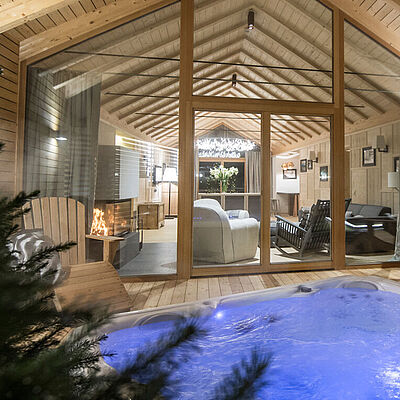
![[Translate to en:] AMADEUS Riva (c) Lüftner Cruises](/fileadmin/_processed_/d/e/csm_AMADEUS_Riva_ebdf4c2c55.jpg "[Translate to en:] AMADEUS Riva (c) Lüftner Cruises")

































![[Translate to en:] AMADEUS Riva (c) Lüftner Cruises](/fileadmin/_processed_/d/e/csm_AMADEUS_Riva_64c1995e26.jpg "[Translate to en:] AMADEUS Riva (c) Lüftner Cruises")