


The Wow in the Desert
Nowhere else can you experience star glamour and architecture, wellness oases and desert chic in such an Oscar-worthy way as in Palm Springs, California: jaw-dropping moments guaranteed.
06/15/2026 Reading time: 11 Minutes
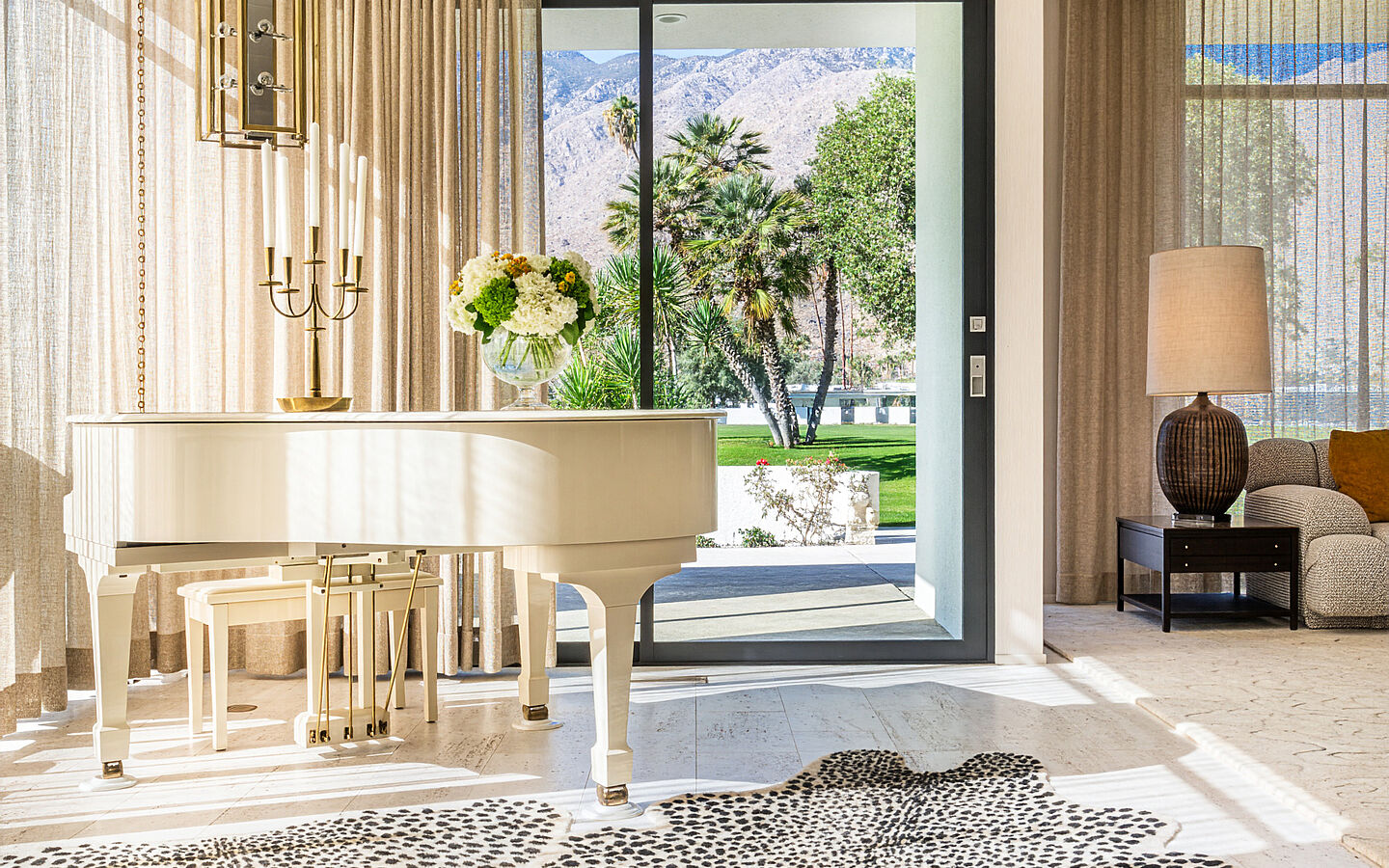
When private doors open during Modernism Week, a visit to the home of Michael Ostrow and Roger Stoker is an experience that goes far beyond a typical architectural tour. Their Palm Springs estate is a living testament to what contemporary luxury living can be today: a harmonious blend of space, art, and personality. Naturally, the hosts do not open their home to just anyone 365 days a year. Yet those fortunate enough to be admitted as registered visitors to Modernism Week in Palm Springs, California, will discover precisely what desert modernism is.MODERNISM WEEK IN PALM SPRINGSExclusive home visits with designers
700394

700394

UP ABOVEHere, everything truly revolves—including the Doppelmayr cable car.
700394

700394

Architecturally, the house adheres to Palm Springs principles: Targeted “wow” factors with art objects, transparent structures, and a fluid interplay of indoor and outdoor spaces. Ostrow and Stoker have personally contributed to every detail over decades of work. Here, color is a statement; art is not mere decoration, but a narrative. During Modernism Week, which Palm Springs hosts twice a year in October and February, the philosophy of intellectual exchange becomes particularly palpable. Visitors move not through a staged setting, but through a living environment—one animated by open conversations, spontaneous encounters, and an almost salon-like atmosphere. The hosts regard their invitation as an art form: less about displaying, more about sharing. What once began as a niche event for architecture enthusiasts has perhaps evolved into a global gathering place for collectors, designers, curators, and discerning travelers through Modernism Week: Among the most sought-after program highlights have always been the exclusive home tours of otherwise inaccessible private residences. Legendary, for example, are the glimpses into the Frey House II, Albert Frey’s spectacular manifesto of Desert Modernism carved into the rock, which hovers over the city like a minimalist statement.
Equally iconic are the excursions to Richard Neutra’s Kaufmann House—an icon of American Modernism whose clean lines and fluid transitions between interior and exterior continue to set standards to this day. In recent years, these architectural excursions have become increasingly curated—supplemented by discussions with historians, designers, and eyewitnesses. Another highlight is the “Signature Home Tours,” where several residences open to the public in a single day—often accompanied by classic car exhibitions, cocktail stations, and live music. These events are less traditional tours and more social gatherings: a tribute to the glamour of the Rat Pack era, reinterpreted for a cosmopolitan, design-savvy audience.
FRESH ON THE PLATEPalm Springs is home to California’s most creative chefs
The desert is alive—and how!
Storytelling and personalities have shaped Palm Springs for decades. During Hollywood’s golden age, the desert became a sometimes more, sometimes less discreet extension of the dream factory. Frank Sinatra’s “Twin Palms” estate became the epitome of California jet-set life. Not only did legendary parties take place here, featuring impromptu concerts by the pool and guests like Dean Martin or Sammy Davis Jr. Sinatra had the obligatory pool specially designed in the shape of a piano—a tongue-in-cheek statement, whether self-deprecating or self-assured, who knows?
WATCH OUT, UFOThe Reset – a hotel like something from another planet
700394

700394

Elvis Presley also made history in Palm Springs. His “Honeymoon Hideaway” became a symbol of a new, youthful pop culture. The residence’s futuristic architecture still reflects the spirit of the 1960s today. Marilyn Monroe, on the other hand, gave Palm Springs a glamorous aura that still resonates today. Stars like Leonardo DiCaprio, who reside in private villas and throw exclusive parties, ensure that Palm Springs is not merely a nostalgic backdrop. After all, Palm Springs was never loud. The most spectacular moments took place behind closed doors—by the pool, at sunset, among a select circle of guests. Greater Palm Springs, as the “Fabulous 9”—a collection of nine towns in the region—likes to call itself, is, however, an extremely diverse region even outside of the art weeks: Its towns are Desert Hot Springs and Cathedral City, Rancho Mirage and Indian Wells, La Quinta, Indio, Coachella, and—of course—Palm Springs. Each town stands out on its own with natural beauty, outdoor adventures, a thriving arts scene, or ultra-luxurious wellness resorts.
A fairy-tale world of water and light
Together, they market themselves as a trendy year-round destination. Just two hours from Los Angeles and San Diego, guests enjoy sunshine in every season and nature’s dramatic scenic playgrounds—desert, mountains, water, and light—that coalesce to create a dream destination.
California’s boldest hotel concept
While Palm Springs has always attracted the rich and famous, the innovative and daring, the hedonists and art lovers, the city is far more than just a travel destination for Americans: a promise of freedom, sunshine, and laid-back, accessible luxury. “360 days of sunshine” is not just a marketing slogan, but reality. Sunlight here translates into a elevated quality of life—an endless outdoor existence. Those seeking self-expression without social pretence, and flip-flops alongside designer sunglasses and minimalist architecture, will find this to be the place par excellence. Even today, curious visitors from around the globe indulge in this relaxed yet refined exclusivity at the region’s hotels and resorts. These authentic sweet spots of Palm Springs are discovered on the outskirts. In downtown, a hotel from the Hyatt Group comes highly recommended. Just a few steps from designer boutiques, galleries, and the iconic Palm Canyon Drive, it presents itself as an urban all-rounder with a touch of resort atmosphere. The big stage, however, is just a short drive away. Set amid 450 hectares of lushly landscaped gardens, the JW Marriott Desert Springs Resort & Spa comes into view: this expansive oasis of well-being is one of the Coachella Valley’s iconic resorts—an ambassador of the lightness of being, bringing a tropical paradise right into the heart of the California desert.
SUN & FUNThe JW Marriott Desert Springs Resort & Spa is Palm Springs’ premier destination for a spectacular spa experience.
700394

700394

700394

Best views: stargazing in a whole new dimension
. About an hour from Palm Springs, in the small town of Joshua Tree near the national park of the same name, the scenery changes completely. Small boutiques sell handmade ceramics, vintage clothing, or desert art. Cafés serve soul food and vegan cuisine, often accompanied by conversations about art, music, or life in alternative communities. Music is a central part of the scene. Places like Pappy & Harriet’s are legendary—a roadhouse, concert venue, and bar all in one. Lovers of extreme aesthetics will discover a dearth of conventional hotels, instead encountering private retreats that blend bohemian chic, minimalism, and confidently raw charm: often unassuming structures elevated by design flair—concrete, wood, glass, plus outdoor bathtubs, fire pits, and hammocks—all delivering an experience that is unpolished, atmospheric, and intimately close to nature.
TRENDY AND LOUDPappy & Harriet’s is the place to go for intense music and hearty drinks
For most visitors, the national park itself is the main attraction. Rugged granite formations rise from the ground like frozen waves, interspersed with the bizarre silhouettes of Joshua trees—plants stretching their arms toward the sky as if seeking a foothold in infinity. Hikers traverse well-maintained paths over gigantic boulders, such as in Hidden Valley, climb granite blocks, or follow quiet trails where every step stirs up red dust. Climbing is part of the park’s DNA. Sunrises bathe the rocks in cool pink, and sunsets swiftly lower the temperature in this desert sea of stone, captivating adventurers around the clock. Many remain out into the night—not least for the unobstructed starry sky, among the most spectacular in North America. Here, stargazing is not merely an activity but a ritual.
The Reset Hotel embodies these ideals—a refuge on the edge of Joshua Tree National Park that does not strive to impress, but rather to slow the pace of life. Nestled into the desert landscape, everything here diverges from the conventional resort formula. The architecture adheres to a radical notion: reduction as luxury. The 65 units, inspired by modular structures, are designed to be clear, functional, and deliberately understated. Materials such as concrete, steel, and dark wood echo the colors of the desert, allowing the interior and exterior spaces to blend almost seamlessly. The “container-style” rooms appear minimalist at first glance—and it is precisely this that gives them a special quality. The true center of each “box” lies outside its four walls. Private patios with fire pits, daybeds, and—in select categories—freestanding outdoor bathtubs transform the desert into a living space. In the evening, the sky becomes the ceiling: telescopes for stargazing, flickering fires, and a silence that is almost physically palpable.
Reset is the perfect way to conclude a journey. It is not a place for grand gestures, but for subtle perception—and an alternative to traditional luxury resorts. Reset feels radical. It reduces the world to the essentials—and makes it all the more intense as a result. “Quiet Luxury” in its purest form: space, light, stars, silence—and the feeling of having completely fallen out of the world for a moment. Connoisseurs are in good hands at these properties. HYATT PALM SPRINGS
All-suite accommodations open via floor-to-ceiling windows and private balconies to the backdrop of the San Jacinto Mountains, embodying a classic California interpretation of luxury: ample space, light-colored materials, separate living areas, and a subtle mid-century vibe that aligns perfectly with the city’s architectural legacy. Anyone seeking to experience Palm Springs—especially during Modernism Week and just a stone’s throw from the Palm Springs Art Museum—will find an ideal base here, sans fanfare.
JW MARRIOTT DESERT SPRINGS RESORT & SPA
Waterways, lagoons, palm-lined avenues
,
and above all a family-friendly idyll define the scene; small boats glide through man-made lakes; at night, an almost surreal atmosphere hangs over a sea of lights. The suites are classically elegant, with spacious layouts, high-quality materials, and terraces offering views of the golf courses and water features. In terms of gastronomy, the resort offers an impressive variety with ten restaurants—from relaxed poolside dining to ambitious fine-dining concepts, there is something for every palate. What sets the JW Marriott Desert Springs & Spa apart from many other gems in the Valley, however, is its “heart”: the expansive spa, one of the largest and most renowned in California. Two championship golf courses and a world-class tennis center round out the extensive offerings. With approximately 38,000 square meters of space and over 40 treatment rooms, the Desert Springs Spa ranks among the largest wellness facilities in the Palm Springs area. At its core is a classic American spa concept, enhanced by modern, science-inspired treatments and locally sourced ingredients. The range of options is correspondingly diverse: In addition to therapeutic massages, body wraps, and high-end facials, signature rituals are offered that specifically incorporate the local environment. The “Desert Journey” treatment is particularly popular—a 90-minute ritual featuring a scrub made from dates, brown sugar, and citrus notes, combined with a hot stone massage and a paraffin foot treatment. Equally distinctive are modern facials such as the Pro-Collagen Red Light Facial, which specifically stimulates skin regeneration. The Spa at Desert Springs is the only resort in the desert to offer this red-light phototherapy treatment: by stimulating collagen and elastin production, as well as tissue oxygenation, it delivers highly effective skin rejuvenation. The spa’s facilities extend well beyond classic treatments: an aromatherapy hammam, a sauna, a wellness lounge, the expansive fitness area, and a saltwater lap pool provide the setting for holistic rejuvenation.
SENSEI PORCUPINE CREEK RESORT
Wellness of the highest caliber is also a top priority at the Sensei Porcupine Creek Resort. The resort is not a traditional hotel—rather, a discreet microcosm for guests who place the highest value on discreet, personalized care for body and soul. Picturesquely nestled within 230 hectares of desert landscape at the foot of the Santa Rosa Mountains, this former private estate combines architectural clarity with an uncompromisingly holistic wellness approach—and this is definitely reserved for a select few: Only a handful of accommodations—casitas and villas—are scattered across the grounds. Each room is a sanctuary, characterized by tranquility and light in a meditative design that deliberately leaves the outside world at the door. At the center is the “Sensei Way” philosophy: scientifically grounded, individually curated, and supported by a team of doctors, trainers, and therapists. Exercise, nutrition, and regeneration intertwine seamlessly—a concept that goes far beyond traditional spa offerings. The culinary anchor is Sensei by Nobu—a refined, health-focused interpretation of the iconic Nobu cuisine that combines indulgence with nutritional science. Guests who seek not merely to relax but to recalibrate—physically and mentally—in absolute privacy will find this ultra-luxury property to be the ideal sanctuary.
AT THE HEART OF THE CITYAt the Hyatt Palm Springs, you’re right in the thick of it.
700394

700394

700394





![[Translate to en:] AMADEUS Riva (c) Lüftner Cruises](/fileadmin/_processed_/d/e/csm_AMADEUS_Riva_ebdf4c2c55.jpg "[Translate to en:] AMADEUS Riva (c) Lüftner Cruises")
















































![[Translate to en:] AMADEUS Riva (c) Lüftner Cruises](/fileadmin/_processed_/d/e/csm_AMADEUS_Riva_64c1995e26.jpg "[Translate to en:] AMADEUS Riva (c) Lüftner Cruises")