


Where the Night Shines
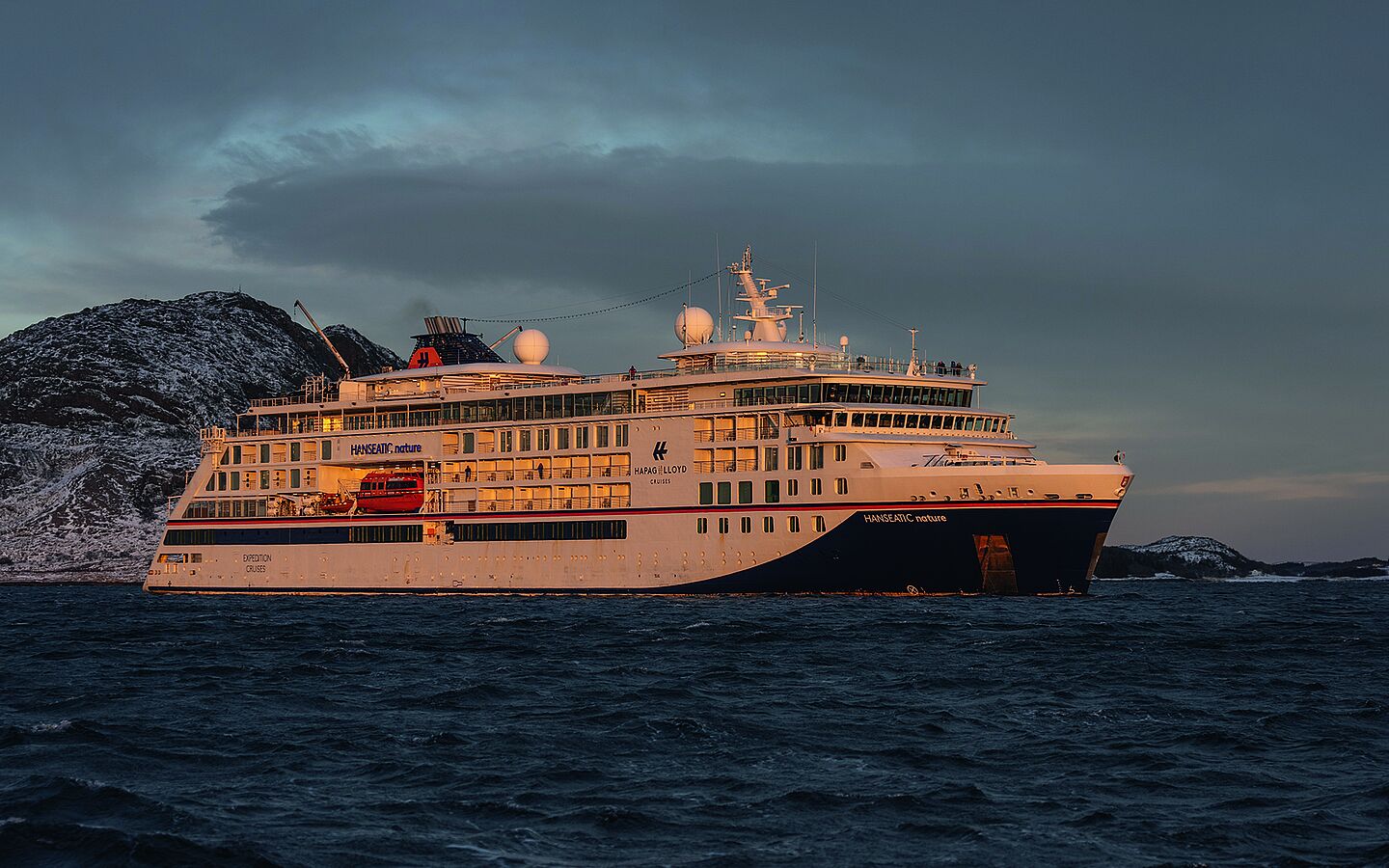
Darkness, biting cold, and a sky bursting with color: During the Norwegian winter, the Arctic Circle becomes the stage for a fascinating natural spectacle. Hanseatic nature offers the best seats in the house—on an expedition from Hamburg all the way up to the North Cape and back again.
06/17/2026 Reading time: 8 Minutes
Tromsø, a Saturday in January. Although it’s only 2 p.m., a deep midnight blue already hangs over the “Gateway to the Arctic.” My stroll to the Hanseatic nature takes me along icy sidewalks and past houses and shops that—as everywhere in Norway’s icy north—glow with countless strings of lights from November through March. And yet, one wonders why so many tourists—swathed in thick down coats at -18 °C—still fail to notice it. The “beautiful glow,” the very reason I, too, have journeyed here, does not reveal itself in Tromsø’s streets and alleys at this time of year, but rather paints the sky above the city. Just as I am about to step onto the gangway and glance up one last time, it finally happens: At first, it’s merely a faint green streak rising above the ship’s funnel, steadily intensifying, beginning to glow, and finally dancing like a veil in the wind—my first aurora!
BEAUTIFUL GLOWIn the past, people believed the auroras were signs from the gods—anyone who’s ever experienced them in person still understands that today.
Later, as I share the tale with my fellow travellers over guinea fowl essence, lobster with smoked hollandaise, and lime mousse, they can only muster a weary smile. Unlike me, they have been sailing north on the Hanseatic nature for a few days longer—and have long since become “aurora pros.” They now venture out onto the deck or step onto their private balconies only when General Expedition Manager Nadine Armbrust announces especially vivid and dramatic “glimmers of light” over the ship’s public-address system.
HEADING TOWARD THE FAR NORTHThe Hanseatic nature will once again set sail for Norway in the winter of 26/27.
700394

700394

Heading to the North Cape at -22 °C
Since the weather on the 30-km stretch to the North Cape can shift from a winter wonderland to a snowy maelstrom within minutes at this time of year, the ascent to the slate plateau above the Arctic Ocean is permitted only in a convoy escorted by a snowplow. Today, however, our burly companion proved entirely superfluous. The road remains tranquil—on Europe’s northernmost thoroughfare and, a little later, in front of the world-famous steel globe, around which crowds throng in summer. Since 1978, it has braved every conceivable weather condition—serving as a landmark and, on this day, as a Northern Lights hotspot. “Even we rarely witness the sky glowing as brightly as it did during your visit,” the guide remarks later, during our return journey.
For us passengers, the North Cape is not merely a high point but also a turning point. From here on, we head south—to Alta with its iconic Northern Lights Cathedral, for a brief call in the Lofoten Islands, to the vibrant coastal cities of Trondheim and Stavanger, or to the impressive Svartisen Glacier, accessible only via the ship’s Zodiacs.
Another highlight is the cruise through the Geirangerfjord. At a snail’s pace, we glide through the 15-km-long fjord, which narrows to just 600 m—past snow-capped mountain giants, frozen waterfalls, and picture-perfect mountain farms. The two retractable glass-floor balconies on the pool deck and the wraparound Nature Walk at the bow serve as observation platforms of a singularly distinctive kind. My personal favorite retreat, however, is the Observation Lounge, where hot cocoa and cookies are served as the landscape glides past and the onboard pianist performs works by Edvard Grieg. What a treat—for all the senses!
The finest “hygge” feeling pervades the cabins and suites—this is precisely how one wishes to spend one’s days at sea.
That same exquisite “hygge” feeling also envelops my balcony cabin, which, at 27 m², offers an astonishing amount of space and storage, along with thoughtful amenities such as wall-mounted heating for drying expedition parkas and an indirect, individually adjustable lighting system that creates exceptionally pleasant atmospheres. In such an atmosphere, one is happy to spend a day—or even several days—at sea, indulging in in-room dining and, thanks to Starlink, marathon viewings of Netflix series. Alternatively, you might attend lectures by the scientists traveling with you, become a researcher yourself at the Ocean Academy, join a fitness class, indulge in a massage, tour the vessel to admire the nearly 200 works of art gracing every deck, or scan the horizon for whales and count wave crests from the panoramic sauna. Though the intimate Hanseatic nature does not host headline entertainment, the two-page daily programme presents an array of relaxing, exhilarating and enlightening experiences. The shore excursions during our voyage are equally diverse: Should horseback riding, ice fishing, snowshoeing or snowmobiling appear too adventurous, one can instead choose a reindeer sleigh ride, a visit to the Ice Hotel, or a nighttime Northern Lights excursion into the mountains culminating in dinner at a Norwegian farmhouse.
Wiener Schnitzel on the Waves
Which brings us to the cuisine: While the menu at the aforementioned farmhouse is limited to salmon or meatloaf with mashed potatoes, the choices on board are far more exquisite—though not quite at the standard I enjoy on the Europa or the Europa 2, the two larger sisters in the Hapag-Lloyd Cruises fleet. Whether it’s veal liver with apples and onions, saddle of venison with cranberries and bacon, trout fillet with an almond crust and spinach, or Wiener schnitzel with potato and cucumber salad: The evening menu at the Hanseatic Restaurant often features classics of German and Austrian cuisine—prepared with a certain twist and sure to satisfy any gourmet palate—which are also offered in a slightly adapted form at the more casual Lido buffet restaurant. For an international dining experience—or, more precisely, one with “the maritime flair of the U.S. East Coast”—head to the intimate specialty restaurant Hamptons, which can be visited at no extra charge but requires a reservation. Whatever you choose, the service is first-class in all restaurants as well as in the bars and lounges.
At the Hamptons restaurant,you dine just like on the U.S. East Coast. The last evening on board: On the way to Hamburg, it’s “Aurora borealis in sight” once again. This time, however, not north of the Arctic Circle, but south of Heligoland, whose rocky coastline looms on the horizon. Shimmering in every shade of red—from bright magenta to pale mauve—it glows over the island. Such a spectacle is absolutely extraordinary at these latitudes—and fits perfectly with this journey, which I will remember for a long time to come.
700394

700394

HANSECATIC NATURE
CABINS & SUITES
: 120 in total, cabins 21–27 m², junior suites 42 m², grand suites 71 m².
CCIRCLE TIP
:
A retreat on Deck 6 with swift access to the Nature Walk for aurora or whale sightings
. STYLE & AMBIENCE
Bright, high-quality interiors, relaxed atmosphere—this is what understated luxury looks like on the world’s oceans
. FACILITIES
Three restaurants and lounges, Ocean Academy, a pool, expansive deck areas, a shop,
and
24/7 room service
. SPORTS & SPA
: Spacious spa and gym with top-tier class offerings
SERVICE:
First-class and consistently attentive
CONTACT
:
www.hl-cruises.com
TECHNICAL SPECIFICATIONS
: Commissioned: 2019 Length: 139 m Decks: 9 Passengers: max. 230 Crew: 247 Onboard language: German



![[Translate to en:] AMADEUS Riva (c) Lüftner Cruises](/fileadmin/_processed_/d/e/csm_AMADEUS_Riva_ebdf4c2c55.jpg "[Translate to en:] AMADEUS Riva (c) Lüftner Cruises")












































![[Translate to en:] AMADEUS Riva (c) Lüftner Cruises](/fileadmin/_processed_/d/e/csm_AMADEUS_Riva_64c1995e26.jpg "[Translate to en:] AMADEUS Riva (c) Lüftner Cruises")