


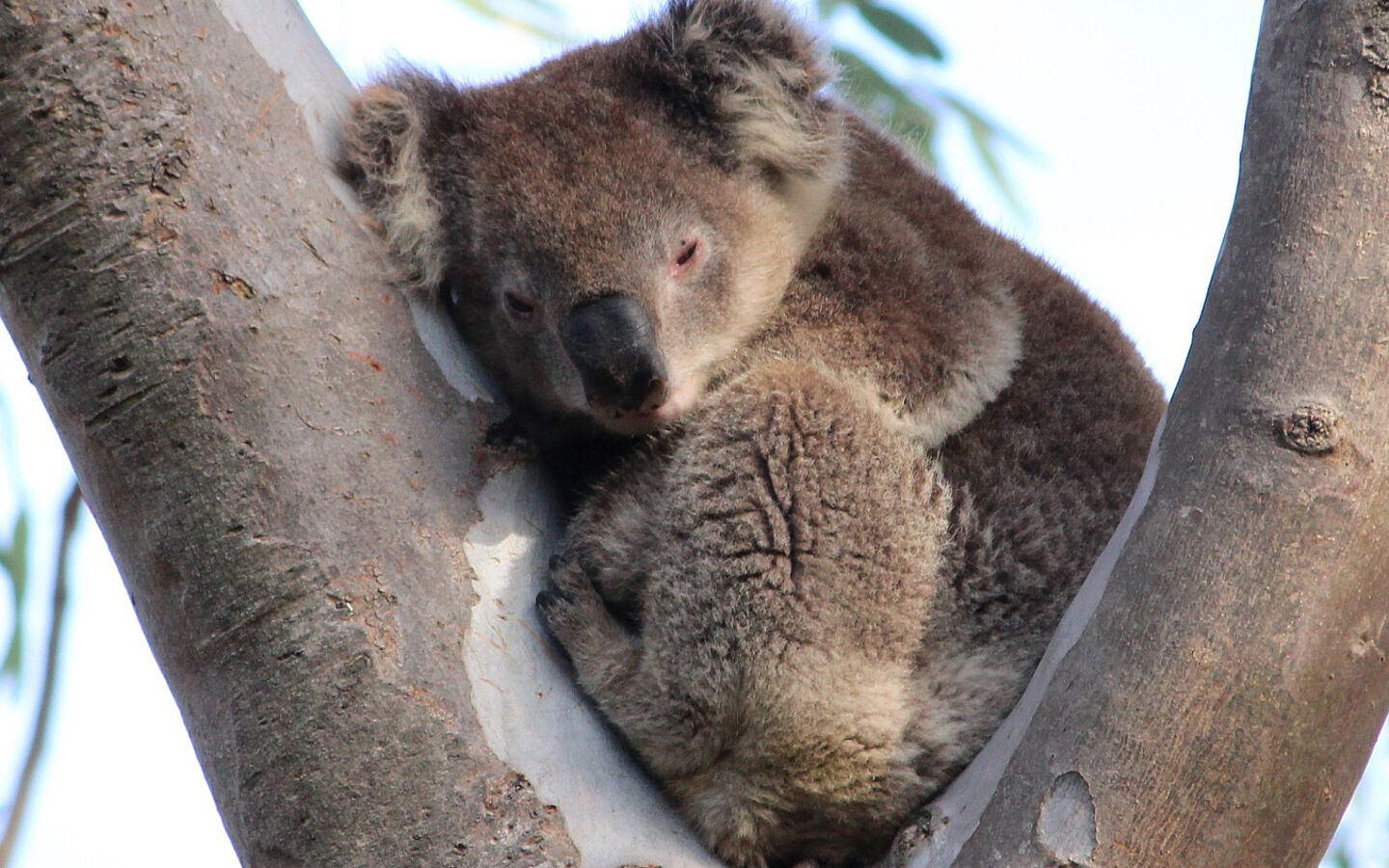
Watch koalas in the wild: Off to Victoria!
The state of Victoria is a pioneer in koala conservation and offers the best opportunity to see these cuddly animals live.
05/22/2019 Reading time: 6 Minutes
The koala is one of Australia's best-known ambassadors and is at the top of the Down Under checklist. In some states and regions, the popular marsupial is now severely threatened by climate change, shrinking habitats and epidemics. To generate more awareness for the protection of the animals and their habitats, the Koala Clancy Foundation and tour operator Echidna Walkabout Tours from Melbourne have proclaimed May 3 Wild Koala Day. Across continental borders, a koala named Clancy virtually sensitizes the world to the protection of his fellow species.Unlike other Australian states, Victoria has a large population of koalas, making it the best region to spot these popular animals. In many places, travelers encounter the popular marsupials in the wild. To ensure that this remains the case, Victoria plays a key role in koala conservation. This includes the necessary resettlement and recolonization of abandoned areas. The sustainability-oriented tour operator Echidna Walkabout Tours and the non-profit Koala Clancy Foundation are highly committed to this. The current focus is on planting trees in river valleys to provide new habitat and food. They are also caring for sick animals. In order to raise awareness of their efforts and the importance of koala conservation beyond the borders of Victoria, the dedicated stakeholders launched Wild Koala Day in 2016. Koala Clancy became the day's animal ambassador. May 3 is his birthday. He is also the namesake of the Koala Clancy Foundation.
With more than 44,700 Facebook fans, the cuddly little beast is now a real social media star. And that's not all: visitors can meet him live in real life. His home is the You Yang Ranges, a national park just outside Melbourne. It was here that Clancy willingly allowed himself to be studied for research purposes as a baby. In contrast to his sluggish colleagues, Clancy is very interested in people. Janine Duffy, owner of the Melbourne eco-organizer Echidna Walkabout, has known Clancy for years as the most photogenic of all koalas. "Clancy seems to enjoy the limelight," she enthuses. Meanwhile, Clancy's son, one-year-old Bunyip, is also attracting all the attention. Patient observers can also enjoy a rare interaction with his two-year-old half-sister Lakorra when they do gymnastics together in the "climbing forest".
Echidna Walkabout is the biggest supporter of the non-profit Koala Clancy Foundation.
In addition, over 50 percent of the profits are invested in koala research, habitat improvement and public relations. Tourism to Victoria is therefore an important pillar for the conservation of koalas - as long as it is carried out carefully and with sustainable partners.
The best places to see koalas in the wild
The chances of seeing koalas in action are particularly good in the morning and at dusk: While feeding, changing trees or performing personal hygiene. Koalas spend most of the day in the forks of the eucalyptus trees - and up to 21 hours of that time sleeping.
Raymond Island
Raymond Island is located in the middle of the Gippsland Lakes (300 kilometers east of Melbourne). The largest koala population in Victoria lives here. A ferry takes guests from Paynesville to the island. The Koala Trail takes you into a eucalyptus forest. In addition to koalas, kangaroos live here. With a bit of luck, nature lovers can also get a glimpse of rare possums and echidnas.
Budj Bim National Park
About four hours from Melbourne is Budj Bim National Park - a long inactive volcano with a tranquil crater lake surrounded by bushland. The tranquil setting makes the park a pleasant place for wildlife spotting. Hiking along a variety of nature trails, such as the nature trail along the old crater rim, koalas can always be spotted.
Great Otway National Park
The Kennett River area of the Great Otway National Park is about a 2-hour drive from Melbourne and 20 minutes from Lorne. The famous Great Ocean Road runs through the middle of this natural paradise of eucalyptus trees, rainforest and bushland. Near the Cape Otway lighthouse, nature lovers have the best chance of spotting koalas. It can get quite windy and cold on Victoria's coast, so Victorian koalas have longer, thicker fur than their Queensland relatives.
French Island National Park
At Stony Point, just over an hour from Melbourne, the ferry crosses over to French Island National Park. There are so many koalas here that some were moved to Kinglake National Park to increase their numbers after bushfires decimated the population. French Island can be explored by bus, bike or on foot. There are a number of full-day, half-day and shorter walks and a good network of public roads and administrative tracks.
River Murray Reserve
The River Murray Reserve stretches from the east coast to Malle. A koala hotspot is on the section between Cobram and Ulupna and on Ulupna Island. There is much more nature to marvel at along the Murray: the lagoons of Barmah State Park and the forests east of Echuca are ideal for spotting Australian wildfowl. Gunbower Island near Echuca is home to kangaroos, emus and pine martens. The backwaters around the Murray are also home to the shy platypus, which likes to hide in the dense reeds. A special experience: explore the Murray from a houseboat or a nostalgic paddle steamer.
Tower Hill Wildlife Reserve
If you follow the Great Ocean Road westwards, the Tower Hill State Game Reserve nestles in an eleven-kilometer crater shortly after Warrnambool. The extinct volcano is home to koalas, kangaroos, emus, wild geese, waterfowl and beaked hedgehogs. Aboriginal guides explain the sensitive ecosystem on a bush survival tour. Alternatively, various self-guided walks offer the opportunity to get close to wild animals. The Aboriginal cultural sites are also worth a visit.
Melbourne, Australia's second largest city with a population of four million, is considered the trendsetter of the fifth continent.
Reflective skyscrapers and Victorian mansions, expansive parks and winding laneways form an impressive backdrop for world-class events such as the Australian Open, Formula 1 and the Food and Wine Festival. Designers and artists also love the unconventional metropolis on the Yarra River - the cultural and restaurant scene is buzzing. According to studies by the British newspaper Economist, this combination makes Melbourne one of the most liveable cities in the world. Just a few kilometers outside Melbourne, the state of Victoria offers Australia's scenic diversity in the smallest of spaces: long sandy beaches next to cliffs, dense rainforest in front of fertile wine regions and snow-capped peaks in the alpine highlands. In the north, the Murray River forms the gateway to the outback, while the Twelve Apostles Rocks rise out of the ocean on the Great Ocean Road in the south. Victoria takes up just three percent of the continent, but is home to 30 percent of Australia's endemic animals. Encounters with koalas, kangaroos and the like, which feel particularly at home in the 54 national parks, are everywhere. The German-language website for Melbourne & Victoria offers further information. Brochures can be ordered at www.australien-info.de/vic.
de.visitmelbourne.com




![[Translate to en:] AMADEUS Riva (c) Lüftner Cruises](/fileadmin/_processed_/d/e/csm_AMADEUS_Riva_ebdf4c2c55.jpg "[Translate to en:] AMADEUS Riva (c) Lüftner Cruises")










































![[Translate to en:] AMADEUS Riva (c) Lüftner Cruises](/fileadmin/_processed_/d/e/csm_AMADEUS_Riva_64c1995e26.jpg "[Translate to en:] AMADEUS Riva (c) Lüftner Cruises")