


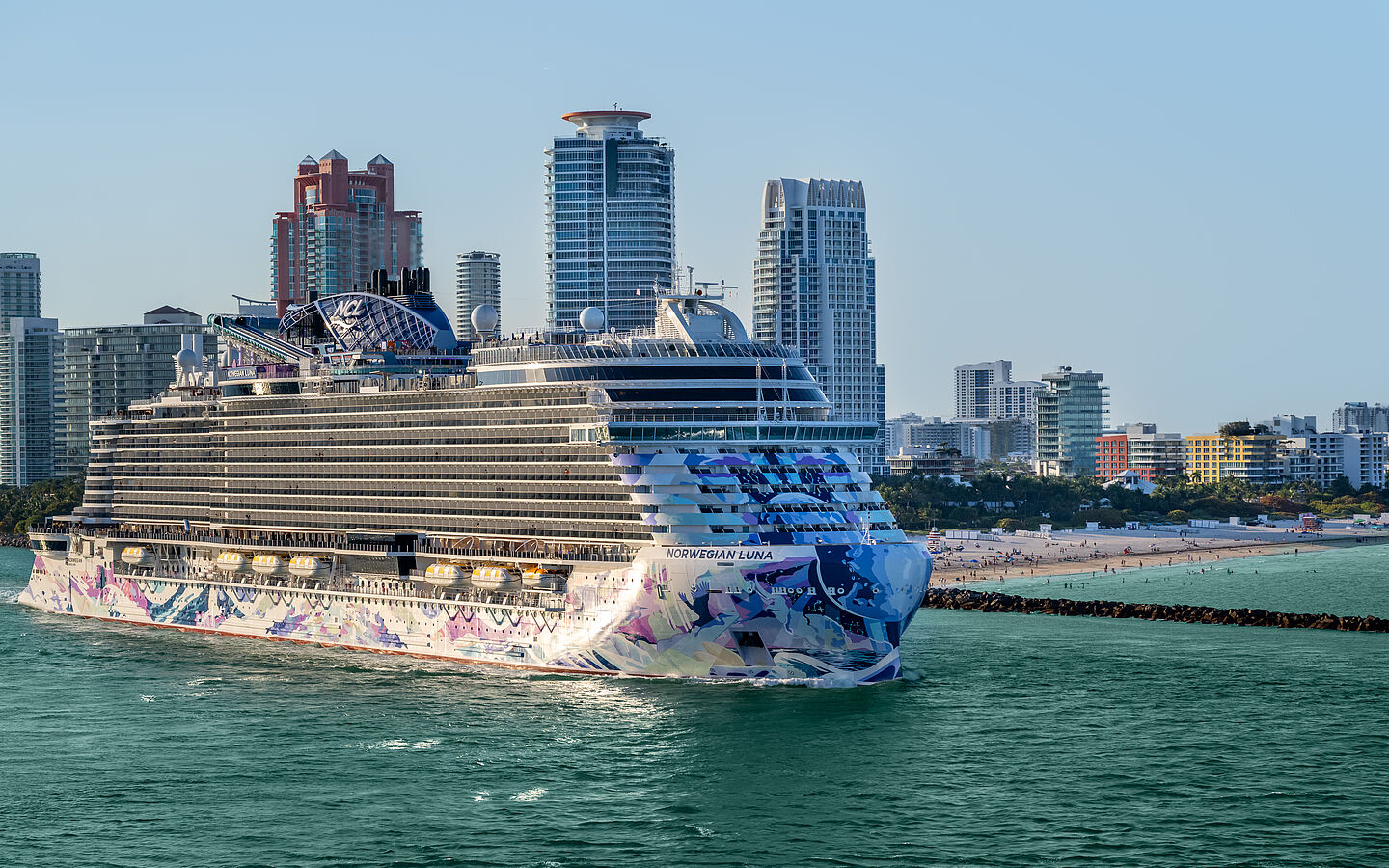
The Haven on the Norwegian Luna – the “ship within a ship”
CC Interview with Kevin Bubolz
05/04/2026 Reading time: 7 Minutes
Norwegian Cruise Line has launched the Luna, the newest and largest Prima-class ship to date— 322 meters long and with capacity for around 3,500 passengers. CC cruise expert Jörg Bertram was on board for the maiden voyage. On the way from Miami to the cruise line’s private island, Great Stirrup Cay, in the Bahamas, he spoke with Kevin Bubolz, Vice President & Managing Director for Central Europe, the Middle East, and Africa, about the product that sells out first on all NCL ships: The Haven—an exclusive area designed for guests who want both: luxury at the highest level and the lifestyle of a large cruise liner.
700394

700394

700394

700394

700394

700394

700394

###
CC: With its 17 restaurants, an impressive spa, and incredible entertainment offerings, the new Norwegian Luna is undoubtedly a ship that is as innovative as it is impressive. But let’s talk today about “luxury on board.” Where does the focus lie? ###
Bubolz: Clearly on The Haven, an exclusive area that we like to call “a ship within a ship” and which is accessible exclusively to Haven guests. You can only enter with the appropriate keycard. There, you have your own restaurant, your own pool deck, as well as butler and concierge service. The standard at The Haven matches that of a classic five-star-plus luxury ship—but at the same time, as a guest, you have access to everything a large ship can offer: Broadway shows, for example, or restaurants and bars that simply wouldn’t be possible in this quantity and quality on smaller ships. It’s “the best of both worlds,” so to speak.
How exactly is this concept implemented on board? What can I expect as a Haven guest?
Haven guests always have access to everything on offer. If a show in the theater is sold out, for example, there are still reserved Haven seats available. Another example is tendering ashore, where long lines can sometimes form. In that case, the Haven guest is escorted to the front by the butler or concierge so they don’t have to wait. And if your favorite restaurant is fully booked at 7 p.m., you’ll still get a table. It’s a consistent first-class experience, every moment of the journey. I like to compare it to business or first class on a plane: You pay more, stand in a different line, sit in a different lounge—and that’s accepted because it’s transparent and part of the concept.
And this preferential treatment really doesn’t bother the other guests?
Honestly: No. In over 20 years, I haven’t seen anyone get seriously upset about it. After all, nothing is hidden—the butlers stand at the front of the line with a sign, and in the theater there’s a clearly designated section for Haven guests. That’s part of the concept; everyone can see it, and in theory, anyone is free to book this offer.
Who is the typical Haven guest?
There isn’t just one type. We see couples who want to enjoy romantic evenings together and then catch a show. But we also see families who appreciate the full comfort of the Haven—my own kids, for example, absolutely loved being able to ask the butler for M&Ms. And we’re seeing more and more multigenerational groups: grandparents who appreciate their quiet retreat in Haven while their children and grandchildren explore the ship on their own, before everyone meets up again in the evening. On a cruise ship, this can be combined wonderfully—you’re separate yet still close to one another at all times.
In this context, there’s also talk of the “next generation of luxury travelers.” Who or what does that refer to?
There is a growing group of younger luxury travelers who say: I want the quality, but I don’t want to be on a quiet, small ship with an older crowd. I want vibrancy, variety, entertainment—and still my luxury. That’s exactly what The Haven is designed for. It’s our strongest growth segment right now.
How has demand for The Haven evolved over the years?
Dramatically! I’ve been with NCL for over 20 years now; I started in 2005. Back then, we sometimes gave away the top suites as free upgrades to very good customers or high rollers in our onboard casinos because they weren’t selling on their own. Today, The Haven is the first thing to sell out on every ship. Word has spread about the concept, and the market for exactly this kind of luxury is growing.
Is The Haven on the Luna different from that on other NCL ships?
The design is always unique—there are commonalities, but also ship-specific elements in terms of materials and layout. Within the Prima class, the Havens are very similar. The Luna is about 20 meters longer overall than the Viva, with about 11 of those meters allocated to the Haven area—so it has grown even larger. On the older Breakaway class, for example, there is a separate Observation Lounge exclusively for Haven guests at the very front of the ship—a nice touch that doesn’t exist in this form on the Luna. And on the smaller, older ships, The Haven is also significantly scaled back: only about twelve suites, no dedicated restaurant. Starting with the Epic and up, however, it’s the full concept as we know it today.
The parent company NCL also owns Oceania Cruises and Regent Seven Seas. Doesn’t The Haven actually compete with these two in-house luxury brands?
There are guests who sometimes sail with Oceania and then come to us—or vice versa. But at their core, they are different types of guests. The Oceania guest seeks a quieter, more intimate experience, more of a country club atmosphere, adults-only, with ships carrying 1,200 to 1,400 passengers. Regent is even more classic, ultra-luxurious, with a full all-inclusive concept—even shore excursions are included there, which of course is reflected in the price. In a direct comparison, however, The Haven can certainly be more expensive than Oceania at times, if the demand is there: An Oceania ship carries 1,200 guests, while The Haven on the Luna might have 200 to 250. Those spots sell out faster. But the decisive factor isn’t the price, but whether it’s a good fit: The right guest has to be on the right ship—otherwise, in the end, nobody wins.
How do you view the importance of the German-speaking market for NCL?
The DACH market is our largest single market within continental Europe, and we actively market to it. But you have to view it realistically: The largest group on board is almost always Americans. On a typical Caribbean cruise, perhaps 10 to 15 percent of guests on the Haven come from German-speaking countries. In the Mediterranean, that shifts significantly. But what I observe time and again: You’ll find Germans on all our ships, on all routes, worldwide. They are the explorers among our guests—and are disproportionately often found on board at exotic destinations like Asia, Australia, or the South Seas.
A very personal question: Which routes do you prefer to travel on?
As employees, we naturally travel at a discount—and we’re happy to take advantage of that. This summer, the family chose the Viva, sailing from Istanbul to Civitavecchia, with stops at some Greek islands, Malta, and Sicily. But our absolute dream destination is Hawaii. NCL is the only international cruise line that operates a ship under the American flag. That means we don’t have to enter international waters on Hawaii voyages, which all other ships are required to do under the Passenger Vessel Services Act. That sets us apart from all our competitors. You drop anchor in Maui in the morning, rent a car, and park it back in front of the ship in the evening. Every island is completely different—volcanoes, rainforests, observatories… An experience I’ve only ever had by ship.
Finally, a very timely question: How is the current geopolitical situation affecting business?
Our itineraries aren’t affected because we deliberately withdrew from regions near conflict zones a year and a half ago—not because we’re clairvoyant, but because of a sober assessment of risk. What’s keeping us busy operationally are flight connections: For cruises in Asia or Australia, up to 60 percent of the usual capacity with Gulf carriers is missing due to closed airspace. We had to rebook guests with flight packages—that was a lot of work. In North America, I see growing reluctance toward travel to Europe. My continental European markets, on the other hand, are performing excellently. And anyone who books flexibly now will find truly attractive rates in the Mediterranean this summer—as a direct result of American guests being a bit more hesitant at the moment.
700394



![[Translate to en:] AMADEUS Riva (c) Lüftner Cruises](/fileadmin/_processed_/d/e/csm_AMADEUS_Riva_ebdf4c2c55.jpg "[Translate to en:] AMADEUS Riva (c) Lüftner Cruises")











































![[Translate to en:] AMADEUS Riva (c) Lüftner Cruises](/fileadmin/_processed_/d/e/csm_AMADEUS_Riva_64c1995e26.jpg "[Translate to en:] AMADEUS Riva (c) Lüftner Cruises")