


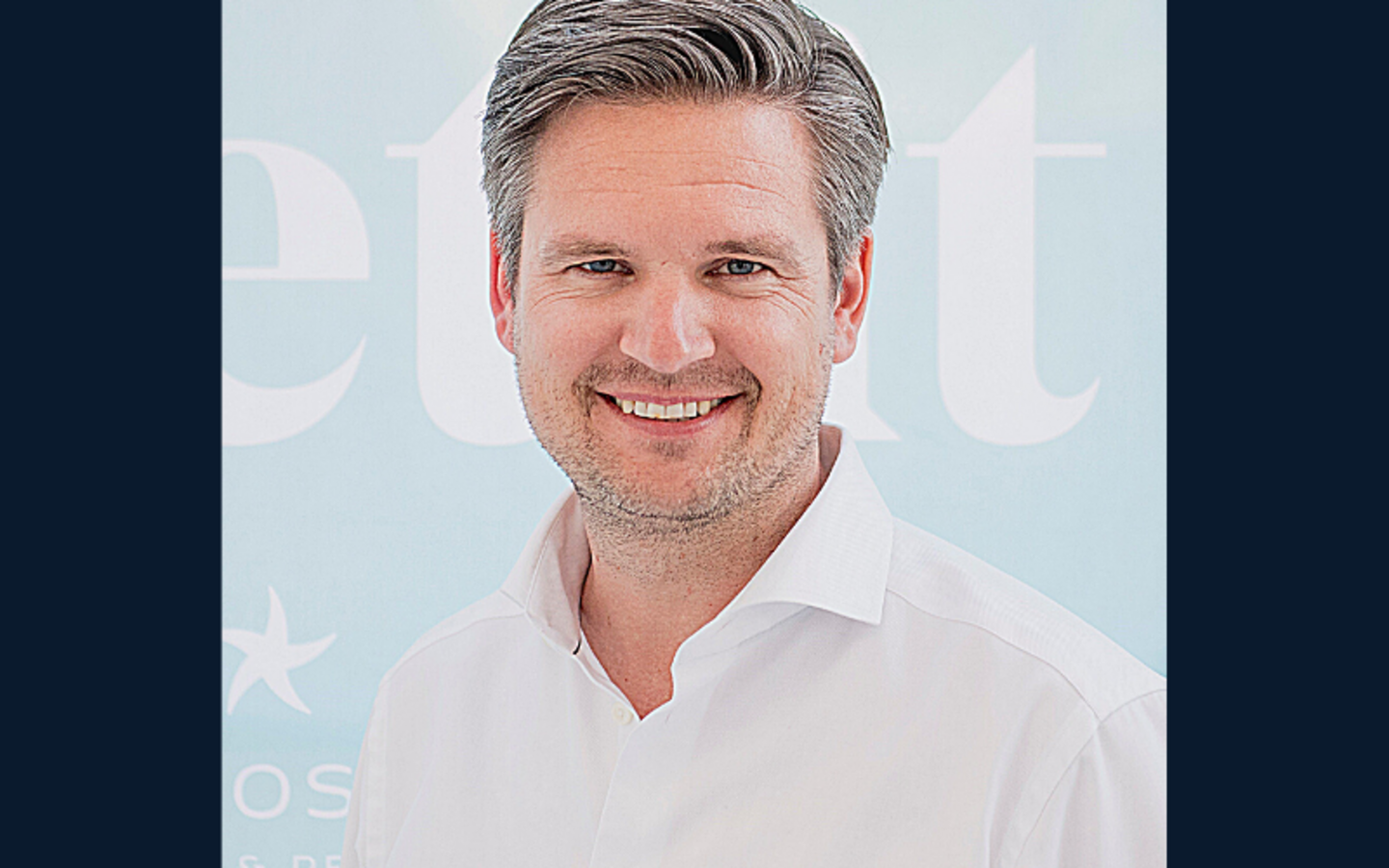
Industry talk with Finn Ackermann, Global Commercial Director Iberostar
"The luxury segment is working brilliantly!"
07/19/2021 Reading time: 9 Minutes
With over 100 hotels in 16 countries, the Iberostar Group has been hit particularly hard by the pandemic. Finn Ackermann, Global Commercial Director, nevertheless looks to the future with confidence. He spoke to CC VIP about the changes in the travel market and the important topic of sustainability, which he believes should finally be democratized.Mr. Ackermann, the pandemic seems to have been averted for the time being and the tourism industry is breathing a sigh of relief. Are you doing the same?
We definitely are. We've been in lockdown for almost 16 months since March last year, even though we've been able to breathe a sigh of relief from time to time. That made the whole thing particularly tough, because we were always able to reopen and then had to close again. What is particularly nice is that many people believe in a genuine and sustainable opening. That is what we all expect at the moment, which is why we are naturally breathing a very, very happy and confident sigh of relief.
You live on the Balearic island yourself. Has life there changed since the pandemic?
Well, my observation - and very personal opinion - is that life has of course changed during the pandemic, in many ways. I believe that we have all reflected on many things as a result of this enforced lockdown and perhaps also evaluate them differently. This naturally leads to you observing things about yourself or your job from a certain distance, which makes you rethink certain areas. That was certainly the case for me. I normally travel a lot. And my firm intention now is to reduce this travel activity if possible. The longer break was good for me personally.
In other words, you also believe that business trips will not return to the way they used to be?
I believe that the business travel segment as a whole will be the hardest hit, even in the long term. We've all learned to do a lot of things via video conferencing that would otherwise have required travel. In my case, it's actually more the case that I look for face-to-face meetings with the teams, customers and partners in the various destinations in order to exchange ideas. And in my opinion, that doesn't work particularly well online. I see two trends. The first is that typical business trips will probably be reduced in the long term. The second: new incentive trips. I believe there is a danger that we will become alienated from each other if we only communicate via video. That's why face-to-face meetings need to be made up for in large companies. For example, through one or two annual events that are then celebrated in a hotel. Meetings could be organized that were perhaps not so common before. And then the team aspect will also be more in the foreground. I personally believe that companies definitely need to and will work on something like this. This would be a good vehicle for incentive trips, which can then also be combined with workshops. Such trips will probably experience an upswing.
Iberostar operates worldwide with over 100 hotels in 16 countries. Have most of them reopened yet?
We are now open in all 16 countries. In terms of our entire portfolio, we will probably have 95 percent open by the end of June. Our properties in America, the Caribbean, Brazil, Jamaica, the Dominican Republic and Mexico are all open. By the middle/end of June, we will also have opened almost our entire portfolio in Spain. My expectation is that we will actually be 100% open by the beginning of July.
High-quality vacations are very popular. But sustainable travel is also a huge topic. How is the Iberostar Group responding to this?
At Iberostar, we really do see ourselves as pioneers when it comes to sustainable travel. That sounds immodest at first, and we mean it that way. We know that our sustainability initiatives put us well ahead of the market. Our core initiative is called "Wave of Change" and has become part of our DNA. This is the program with which we are driving the overall sustainable development of the company. It is primarily based on the protection of the oceans and seas. We are therefore very much moving in this direction in accordance with UN guidelines. Our main focus is on oceans and marine protection because 80 percent of our properties are located directly by the sea and because we are based in Mallorca, on an island in the sea. So of course it makes a lot of sense for us to take care of exactly that.
What are the key points of your strategy?
This is concretized in three important initiatives. One is the reduction of single-use plastic. And when I say reduction, I mean elimination. We have already eliminated all single-use plastic in all our hotels worldwide since 2020. And I'm not talking about the straw in the glass, I'm talking about all processes in the front and back office. In fact, we no longer use single-use plastic anywhere. So much so that the bin liner in the guest room is made of potato starch rather than plastic. In the meantime, our goals have expanded beyond plastic avoidance to include promoting a circular economy. In other words, an operating model in which waste and residual waste are completely avoided or not generated in the first place. And within this framework, we have established our own "Agenda 2030". One of the goals is to no longer produce any residual waste in any of our hotels worldwide by 2025, i.e. to be "wastefree".
The second pillar of the "Wave of Change" is the protection of coastal regions. To this end, mangrove forests are being planted around our hotels to naturally protect the coasts from erosion. Mangroves also have a positive effect on CO₂ sequestration. We also have a marine biology team that has set up a coral station at our complex in the Dominican Republic, where we also manage a genetic database. There, together with renowned universities and scientists from all over the world, research is being carried out into how coral bleaching can be prevented.
The third pillar of the Wave of Change is our sustainable seafood. Here too, our goal is to generate one hundred percent of our seafood consumption in a completely traceable and sustainable way by 2025. So we are really trying to keep our footprint as small as possible. Just a quick word about the 2030 Agenda: I think it's an extremely important goal that we want to operate in a climate-neutral way by 2030. We will achieve 2030. And we are working on it.
Pretty ambitious for a hotel group as large as Iberostar?
It is important to democratize environmental protection and sustainability, to get them out of the niche of the eco-lodge in Bali, because this is not a product for the larger market. It is important to demonstrate that this is also possible on a much larger scale. With a portfolio of over a hundred hotels, some of which have 200 to 700 rooms, this is of course a completely different challenge. This allows us to make a sustainable vacation model like this accessible to the average person. And that is a very important aspect.
You just mentioned that some Iberostar hotels have a lot of rooms. We hear that travelers are now looking for more privacy or private villas. Do you sense this in the demand?
Basically, the higher the standard, the more space there is for the individual guest. This could explain why there is currently relatively strong demand in the luxury market as far as our portfolio is concerned. So our "Iberostar Grand" luxury hotels - our five-star-plus hotels are all smaller, of course. To stay on Mallorca: Our Iberostar Grand Portals Nous only has 66 suites and is more of a boutique hotel. And it is now extremely popular, probably for this very reason. But even within the larger complexes, we have room types that guarantee this level of privacy or seclusion. Even with private villas.
Which Iberostar hotels offer private villas?
For example, the Iberostar Grand Paraiso in Mexico.
How do you see the future of tourism? Do you think that travel will return to normal next year or the year after, or will it change permanently? Will people continue to book at shorter notice and stay longer, as is the trend now? Or will there soon be overtourism again?
I actually believe that we can quickly return to relative normality. There will certainly be initiatives somewhere in the medium and long term to limit certain types of tourism or maximize certain other types. But this is more of a medium or long-term process, which also requires very specific and targeted action by politicians in the destinations. I believe that we will have a good tourism year next year. It is really interesting to observe that there is a similar trend in every country at the moment - towards higher-quality products, towards short-term bookings, towards the travel boom itself. This is not a German phenomenon. And when this comes together globally, it creates a relatively strong surge in demand, which I believe will lead to a good tourism year next year. Even as early as next winter - provided everything continues as we see it at the moment and no new virus variants get in the way. But let's not assume that's the case right now.
Which is your favorite Iberostar hotel?
Oh, that's a difficult question. But I'll take up the challenge. Well, I think my favorite Iberostar hotel is the Iberostar Selection Andalucía Playa near Cádiz. Because the area, the beach and the hotel are beautiful.
You also have a few hotel properties in the trendy destination of Montenegro ...
Yes, that's right. It's a very exciting country. It has also become a bit of an insider tip in the last two or three years. And there's a lot going on there. The wonderful Bay of Kotor, which is so reminiscent of an Italian lake landscape, and then there are these old Venetian palaces that have been renovated to perfection. One of them is our Iberostar Grand Perast. I could have named it as one of my favorite hotels. It is an absolute gem. A lot is happening in the luxury segment in Montenegro at the moment, which is of course very exciting for the international market. For example, there are suddenly a lot of Americans who now know where Montenegro is.
Interview: Simone Dressler



![[Translate to en:] AMADEUS Riva (c) Lüftner Cruises](/fileadmin/_processed_/d/e/csm_AMADEUS_Riva_ebdf4c2c55.jpg "[Translate to en:] AMADEUS Riva (c) Lüftner Cruises")











































![[Translate to en:] AMADEUS Riva (c) Lüftner Cruises](/fileadmin/_processed_/d/e/csm_AMADEUS_Riva_64c1995e26.jpg "[Translate to en:] AMADEUS Riva (c) Lüftner Cruises")