


Home
Friends of the Caribbean
Adventure Belize
The bucket list destination Belize still has some catching up to do when it comes to luxury hotels, but if you are looking for great adventures, this is the place to be.
10/13/2024 Reading time: 15 Minutes
Hardly any other country in Central America offers such authentic experiences and an omnipresent commitment to the sustainable use of its resources. And with a multi-ethnic "good-humored population", Belize simply stands for pure joie de vivre!Hello guys, welcome to Belieeeeze" is how you are welcomed at Philip S. W. Goldson International Airport in Belize City after an admittedly very long journey. It's good to know that Belize, which was still a British colony until 1981 and was called British Honduras, is the only country in Central America where the official language is English. There are countless other languages spoken in this small country of just under 23,000 square kilometers: Creole, three different Mayan languages, Spanish, Mandarin, German, Garifuna and many more. Belize, which has a population of just 440,000, is so diverse with its Mayan culture and countless natural treasures on land and in the water that explorers' eyes and souls are bound to glaze over.
Island kingdom with superlatives: "Blue Hole" and "Barrier Reef" are the best-known destinations visited in the country. We are talking about a circular underwater doline with a diameter of 300 m in the Lighthouse Atoll and the 300 km long Belize Barrier Reef, which is the second largest reef in the world and a UNESCO natural heritage site. Three atolls and around 450 partially inhabited islands (cayes) lie off the coast of Belize. The largest of these, Ambergris Caye, located directly in front of the Barrier Reef, is a hotspot for divers, snorkelers, anglers and other water sports enthusiasts. The island's capital San Pedro, with over 12,000 inhabitants, located to the south of Ambergris Caye, has long attracted numerous US citizens, Canadians and European tourists.
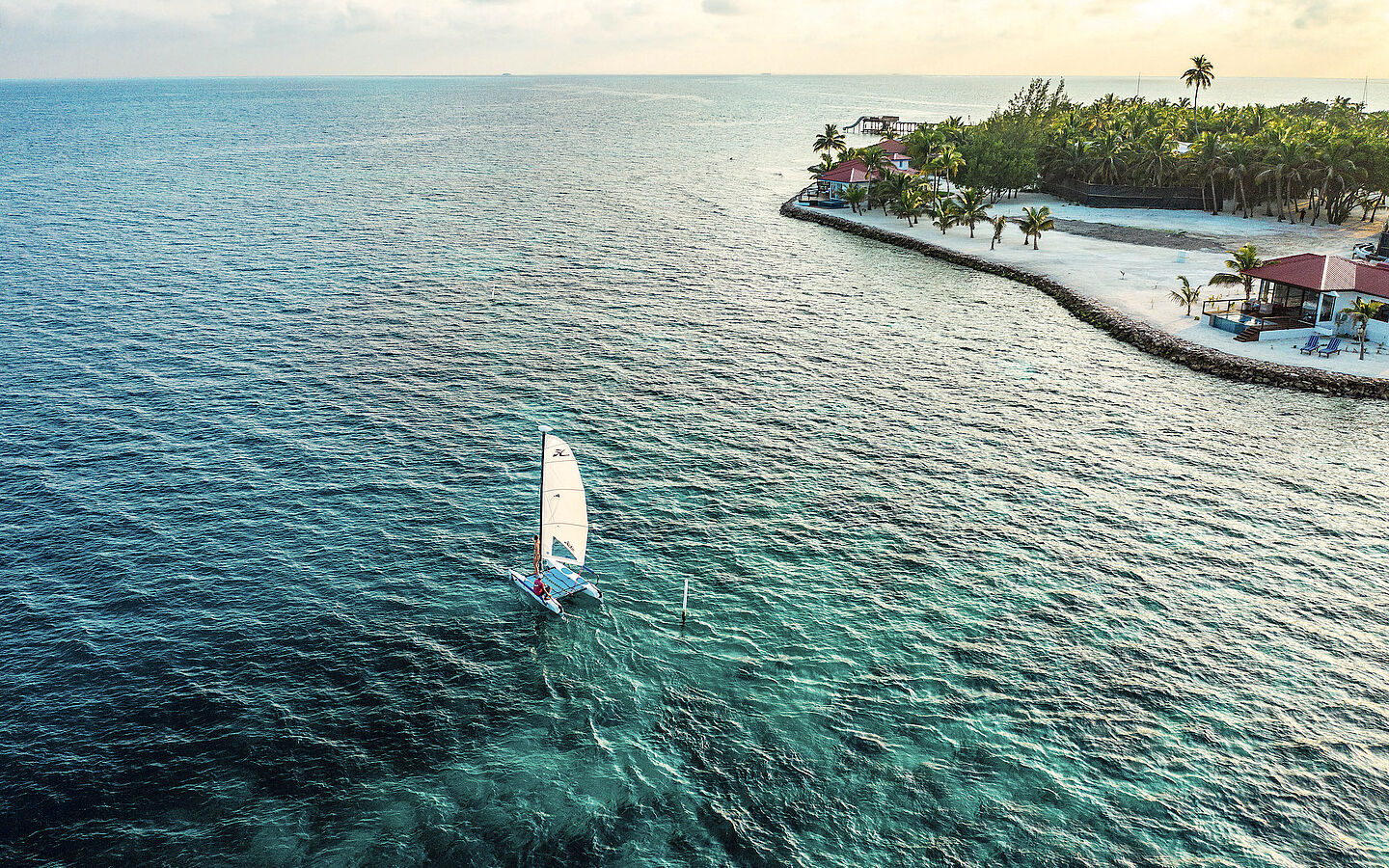
A short flight on a propeller plane takes us from Belize City to the south of the country to Placencia, a peninsula known for its miles of sandy beaches. From here, a one-hour, very picturesque boat trip takes you directly to Ray Caye. This private island resort with just 20 rooms, villas and beach cabanas is located on the edge of Gladden Spit and the Silk Cayes Marine Reserve and has a reputation for being run in a particularly sustainable way: Among other things, solar power is generated here using Tesla technology and drinking water is produced using a desalination plant. The island is also popular because of the Lionfish Bar and Grill restaurant, which is often visited by yacht owners who anchor nearby. And indeed: the shrimp ceviche we are served is one of the best we have eaten in a long time! We only hold back on the advertised lionfish tacos. We have absolutely no appetite for the poisonous lionfish. But we should, service staff William tries to convince us: the lionfish is an invasive, foreign species in Belize that threatens the corals of the reef.
Many NGOs and restaurants have therefore decided to hunt the fish and simply put it on their menus. The aim is to get rid of the "beast" more quickly. A practical plan that also reflects the casual attitude of Belizeans to dealing with problems. "Belizeans are completely unbiased towards other ethnic groups," explains Ray Caye hotel manager Dasha Shivers. Dasha is an American who has spent a large part of her life in Belize and has nevertheless retained an "outsider's" view of the country's culture. Belize sees itself as a kind of "mini-cosmos of cultures from all over the world". In addition to the main group of Mestizos, there is also a Mayan tradition, Mennonites with German roots, Indians, Chinese, Arabs and Garifuna, who are of Afro-Caribbean origin. Island guest John gives us a Belize 1-dollar bill depicting the Mayan ruin of Xunantunich. The self-confessed Belize fan advises us to go to San Ignacio in the west of the country: "There are great Mayan ruins there, and the island of Cay Caulker, off Belize City, is the best place to chill out," he promises.
Culture, Mayan chocolate and Mennonites: We will first chill out with Kim and Bobby in the small village of "Seine Bight", on the Placencia peninsula, with a population of 1,000. Like most people here, Kim and Bobby belong to the Garifuna people. They live in a rather dilapidated wooden hut and supplement their income with Garifuna cooking and drumming courses for tourists. But the two are also brilliant entertainers: while Bobby grills the snook fish on the open wood fire, he tells us the story of the Garifuna, a people that emerged from the mixing of stranded West African slaves and the indigenous Arawak Caribbean people on St. Vincent. Kim, meanwhile, shreds coconuts to make coconut milk and mashes plantains in a vat. This is hard work, which the sturdy Kim has to do every day, as the two of them have to provide meals for four children as well as the tourists. The snook fish and the platano porridge with coconut milk taste delicious. During the subsequent punta drumming course, we are constantly out of time with Bobby's beat, which makes him, Kim and us laugh out loud. A happy day - when we say goodbye, it feels like we are leaving good friends.
From Placencia to San Ignacio, we first head north. To our left is the Cockscomb Basin Wildlife Sanctuary, which was declared the first protected area for jaguars back in 1986. The jaguar population in Belize is said to be the highest in the world. However, we are told that it is extremely rare to see these beautiful wild cats. A short stop at Che'il Mayan Chocolate in Maya Center is worthwhile. Julio Saqui opened an organic chocolate factory here in 2010 and sells, among other things, chocolate bars in 14 different flavors. Che'il means "wild", and to emphasize this, a larger-than-life jaguar graffiti adorns his house wall. The master chocolatier, who is only 1.20 meters tall, explains to us that in ancient Mayan cultures, cocoa was never processed into chocolate bars, but the bean was used to make drinking chocolate, which only the nobility were allowed to enjoy.
Fortunately, times have changed, haven't they? Shortly before San Ignacio, in the small town of Spanish Lookout, the street scene changes: suddenly you see horse-drawn carriages, fair-skinned men with shaggy beards, dungarees and wide-brimmed hats, women with heavy, long woollen skirts and girls with straw-blonde plaits on the street. This does not fit in at all with the colorful, Caribbean-like appearance of the country: Mennonites, descendants of German immigrants, make up four percent of Belize's population, live strictly according to the laws of the Bible, speak Low German and enjoy a high reputation because they produce a large proportion of the country's agricultural produce.
Adventure realm: Mayan ruins, jungle and jaguars. The distance from San Ignacio to the Mayan temple ruins of Caracol, which lie directly on the border with Guatemala, is just 80 kilometers, but can take up to three hours or longer on the mogul road that leads through the Maya Mountains. Not too many tourists make the trip, instead they visit the Cahal Pech ruins in the middle of the town of San Ignacio. Mayan guide Abi tells us that the dense, tropical forest we are crossing is also a favorite hunting ground for jaguars. The 40-year-old has only ever seen three of these noble wild animals in his life, he says. But then a magnificent specimen suddenly stands in front of us on the slope, blinks at us and quickly disappears into the vegetation again. Bingo: Abi's jaguar number four and our first contact with one of the wild cats of prey!
When the Caracol ruins emerge from the tropical jungle , we are stunned. At the height of the Mayan culture, in the 5th to 9th centuries, around 120,000 people are said to have lived here. The highest building is the 43 m high Caana pyramid, which can also be climbed by visitors with a head for heights. The climb is tough, but the view from the top over the vast jungle area as far as Guatemala is far more than a reward. The archaeological site, which was only discovered by loggers in 1937 and is said to cover around 88,000 km², has only been partially uncovered: "The country of Belize simply doesn't have the money for such a project," says Abi, lamenting the lost cultural heritage of his ancestors. On the way back, it is worth making several stops in the Mountain Pine Ridge forest reserve - an 11,000 km2 nature adventure playground where the Rio Frio Cave stalactite cave, the natural granite swimming pools of the Rio Frio and an outdoor shower under the Big Rock waterfall will get your adrenaline pumping.
Beach kingdom in Go Slow mode: Cay Caulker is a coral island only 8 km long and 2 km wide, located about 7 km south of San Pedro and Ambergris Caye and has no paved roads. The motto here is: "Go slow!". Electric golf cart cabs provide transportation, or the tourists and around 1,200 residents of the island stroll barefoot through the sand at a snail's pace. Front Street, which runs directly along the sea, is lined with colorful Caribbean-style wooden houses, boutique hotels, hostels, souvenir stores, a ferry dock and beach bars serving fresh seafood, corn and kebabs from the grill. The atmosphere is extremely casual and it's hard to tell visitors and locals apart, as the Caye Caulker spirit seems to take over everyone who visits the island.
The main attraction is located at the northern end of Front Street and is called "The Split". This is where Hurricane Ida is said to have split the island in two in 1961. While the northern part is mainly a nature reserve and sparsely populated, the southern part with Cay Caulker Village is considered an attractive fun spot. There is a large, wide sandy beach in front of the split, where bathers and locals meet in simple beach bars such as the Lazy Lizzard over a bottle of local Belkin beer. Those who prefer luxurious accommodation are best advised to check into San Pedro on Ambergris Caye, where the hotel and leisure facilities are of a much higher standard. A half-hourly ferry service offered several times a day or water cabs make uncomplicated day trips to Cay Caulker possible.
But we want to get out to sea first, after all, Caye Caulker is just around the corner from the Belize Barrier Reef, which is why there are countless diving and snorkeling excursions on offer. The Belize Barrier Reef is home to around 350 different species of fish and 60 known coral species. A trip to Shark Ray Alley, where you can swim and snorkel with stingrays and nurse sharks, is great fun. Even more fascinating is observing the numerous manatees that live here. The lumbering manatees, which can be up to four meters long, love the warm, shallow waters of the Hol Chan Marine Reserve off Cay Caulker. Belize therefore has the largest population of these strictly protected mammals in Central America. However, like its big brother in Australia, the second largest reef in the world also suffers from increased water temperatures and is also plagued by hurricanes. This is why many environmental projects are focusing on the conservation and restoration of the reef. Fishing with trawlers was banned back in 2010, oil drilling in the sea has no longer been permitted since 2015 and a ban on single-use plastic has been in force throughout the country since 2017.
The Belizeans have now developed a great awareness for a sustainable way of life, even if it doesn't always work: At the iconic beach restaurant "Kareems unbeleizable Food", the freshly grilled lobsters from the sea are unfortunately packed in polystyrene. On a guided "Caye Caulker Food Walking Tour", you can visit around five restaurants for around 50 Belize dollars (25 USD). Food is a very big topic in Belize, as the country's many cultures ensure that fresh and tasty dishes based on fish and seafood or Asian and Creole recipes are on offer everywhere. It is actually surprising that there is still no McDonald's branch here, as a large proportion of the incoming tourists clearly come from the USA and Canada. In fact, the fast food giant made an attempt years ago. In vain, the Belizeans simply could not be convinced by Big Mac and Co.
In the rooftop restaurant of the Coral View Hotel , one of a few multi-storey buildings in Cay Caulker Village, we meet Matthew Shocklee, a retired American who is now a senior consultant for the Taste of Cay Caulker tours. At his side is a stunningly beautiful woman with pinned-up hair, beguiling eyes and a lightning blue gown with floral patterns on light brown skin: Destiny Wagner was the first Belizean to win the international "Miss Earth" beauty contest in 2021 and is a celebrity in the country. But she is not only beautiful and articulate, she is also very committed: Together with her family, she founded a non-profit organization against child hunger, wrote a book and invented a card game to preserve the Creole language during the pandemic. She now serves as a sustainability ambassador for the island of Cay Caulker. She finds nearby San Pedro too expensive for locals. "Belizeans are very strong women and have a lot of entrepreneurial spirit," says Matthew. He then points south to the island of Cay Chapel, 5 km away. A sophisticated Four Seasons luxury resort is due to open there in 2024, with 50 private building plots, 35 private residences, 100 hotel rooms and suites, a golf course, restaurants and its own marina. "This will also enhance Cay Caulker enormously," Matt believes, "but prices will probably rise here. Let's hope for Destiny and all Cay Caulker fans that the island's laid-back charm remains intact.
Getting there
Unfortunately, there are still no direct flights from German-speaking countries to Belize City. In most cases, the journey is made with United or American Airlines via the US cities of Miami, Houston or Atlanta. This often requires an overnight stay in the USA. An alternative would be a direct flight to Cancun/Mexico and from there a 1.5-hour onward journey with the Belizean Tropic Air. However, this option does not allow suitcases to be checked through to the destination, which may also require an overnight stay.
LUXURY HOTELS & HOLLYWOOD IN BELIZE
■ Turtle Inn
The Turtle Inn at Placencia Village is one of three luxury resorts in Belize that Hollywood master
director Francis Ford Coppola calls his own. In the 25 Balinese-style cottages and villas located directly on the beach, dolce vita à la Coppola is staged in rustic surroundings: with a spa, dive store and the signature "Al Mare Restaurant", where dishes based on family recipes are served. Naturally, the dishes are accompanied by wines from Coppola's vineyard in Napa Valley.
■ Coral Caye Resort
In 2016, the Coppola family also acquired the island of Coral Caye, which is just 25 minutes by boat from Placencia. In the island's two cottages, guests can enjoy the whole island exclusively with an all-inclusive program - whether as a couple or as a group of ten.
■ Blancaneaux Lodge
Coppola's very first property in Belize, Blancaneaux Lodge, is located not far from San Ignacio in the Pine Ridge Forest Reserve, in the middle of the Maya Mountains. Originally intended as a retreat for himself and his family, Coppola had 20 detached cottages built in the middle of the jungle and even worked with his wife on some of the interior design himself. All three Coppola Lodges have been committed to nature conservation and preserving the country's resources from the outset. This makes THE FAMILY COPPOLA HIDEAWAYS a pioneer in sustainably managed luxury accommodation in Belize.
www.thefamilycoppolahideaways.com
■ Cayo Espanto
US real estate investor Jeff Gram opened his exclusive private island resort off the coast of Ambergris Caye back in 1998. It offers just seven 1 - 2 bedroom villas with private pools, personalized service and award-winning island cuisine by Chef Patrick. Very exclusive: guests can be flown here directly from the international airport in Belize City thanks to a heli-pad.
aprivateisland.com
■ Blackadore Caye, A Restorative Island
It is quite possible that actor Leonardo di Caprio was once a guest of Coppola and Gram. In 2005, he and Jeff Gram bought the island of Blackadore Caye on the Belize Barrier Reef near Cayo Espanto with the aim of making it the most sustainably built and operated resort in the world. The published opening date of 2018 has already been postponed several times due to protests from environmentalists. However, it is reported that a resort with 116 rooms, including 68 villas, 48 independent living units and a private clubhouse, will be built. Three world-class restaurants, a spa & wellness center and a Deepak Chopra Center for Anti-Aging are planned for the "Blackadore Village". The island's infrastructure was developed as part of a unique nature conservation concept by leading biologists and ecologists. The project is to be powered entirely by renewable energy and promote the "biological health of species on the island and in the surrounding waters". A new opening date of the end of 2023 has just been announced: If it works out, Blackadore Caye is definitely on our bucket list too!
restorativeislands.com/blackadore-caye
General information
More information about Belize:
www.travelbelize.org



![[Translate to en:] AMADEUS Riva (c) Lüftner Cruises](/fileadmin/_processed_/d/e/csm_AMADEUS_Riva_ebdf4c2c55.jpg "[Translate to en:] AMADEUS Riva (c) Lüftner Cruises")














































![[Translate to en:] AMADEUS Riva (c) Lüftner Cruises](/fileadmin/_processed_/d/e/csm_AMADEUS_Riva_64c1995e26.jpg "[Translate to en:] AMADEUS Riva (c) Lüftner Cruises")